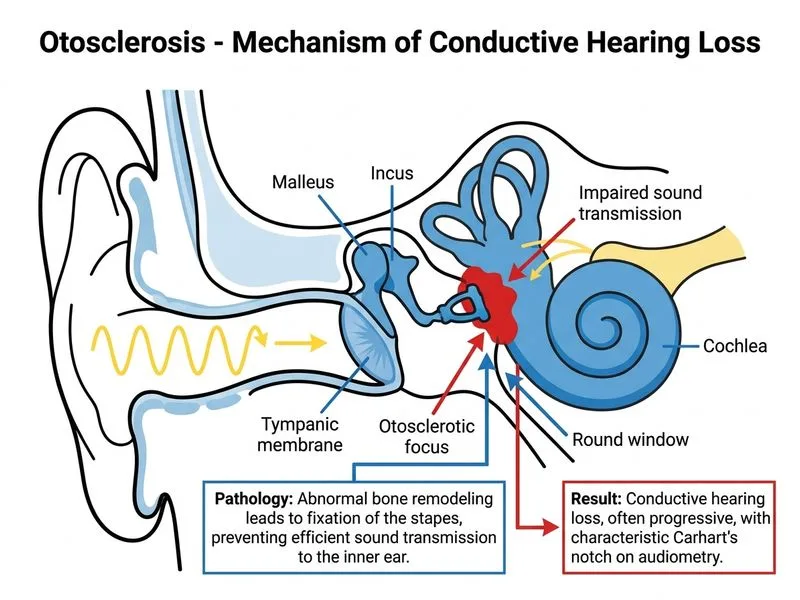
## Management of Otosclerosis in Pregnancy ### Clinical Context **Key Point:** Otosclerosis may accelerate during pregnancy due to hormonal changes (oestrogen and progesterone effects on bone metabolism). However, surgical intervention is deferred until after delivery to avoid anaesthetic and operative risks to the fetus. ### Why Hearing Aid + Counselling Is Correct | Aspect | Rationale | |--------|----------| | **Timing of surgery** | Stapedectomy deferred until postpartum (typically 3–6 months after delivery) | | **Hearing aid** | Provides immediate functional benefit during pregnancy and postpartum period | | **Counselling** | Patient education on natural history, surgical options, risks, and success rates | | **Monitoring** | Audiometry repeated postpartum to reassess before surgery | | **Family history** | Autosomal dominant inheritance (60%); genetic counselling offered | ### Pregnancy-Related Acceleration **Clinical Pearl:** Pregnancy accelerates otosclerosis in ~60% of affected women due to: 1. Increased bone turnover (oestrogen-mediated) 2. Increased vascular permeability in the otic capsule 3. Hormonal stimulation of osteoclasts Hearing loss may progress 1–2 dB per month during pregnancy, then stabilize postpartum. ### Management Algorithm During Pregnancy ```mermaid flowchart TD A[Otosclerosis diagnosed in pregnancy]:::outcome --> B{Hearing loss severity?}:::decision B -->|Mild| C[Hearing aid + counselling]:::action B -->|Moderate-severe| C C --> D[Defer surgery until postpartum]:::action D --> E[Repeat audiometry at 6–8 weeks postpartum]:::action E --> F{Hearing stable or improved?}:::decision F -->|Yes| G[Reassess need for surgery]:::action F -->|No| H[Proceed to stapedectomy]:::action H --> I[Successful ossicular chain reconstruction]:::outcome ``` ### Why Other Options Are Incorrect **High-Yield:** Immediate surgery in pregnancy carries: - Risk of anaesthetic complications (teratogenicity in first trimester, aspiration risk in third trimester) - Risk of fetal loss or prematurity - Unnecessary operative morbidity when hearing aids provide adequate interim support ### Surgical Timing **Key Point:** Stapedectomy is typically performed **3–6 months postpartum**, after: 1. Physiological recovery from pregnancy and delivery 2. Stabilization of hearing loss (post-pregnancy rebound) 3. Completion of breastfeeding (if planned) to minimize anaesthetic drug exposure ### Hearing Aid Fitting Considerations - **Type:** Behind-the-ear (BTE) or receiver-in-canal (RIC) preferred for conductive loss - **Amplification:** Moderate gain (30–40 dB) usually sufficient for air-bone gap of 15 dB - **Benefit:** Immediate functional improvement; allows patient to defer surgery safely ### Sodium Fluoride: Why Not Indicated Here **Warning:** Sodium fluoride therapy is **controversial and not standard of care** in most guidelines: - Evidence for slowing progression is weak and inconsistent - Teratogenic potential in pregnancy (contraindicated) - No proven benefit over hearing aids + planned surgery - Not recommended by major otology societies (AAO-HNS, EENT) ### Counselling Points 1. **Natural history:** ~2/3 of patients progress; ~1/3 remain stable 2. **Surgical success:** Stapedectomy restores air-bone gap in >90% of cases 3. **Risks:** Sensorineural hearing loss (1–2%), facial nerve injury (<0.5%), perilymphatic fistula 4. **Genetics:** Autosomal dominant inheritance; 60% of cases familial (consistent with mother's history) 5. **Pregnancy effect:** Hearing loss may improve slightly after delivery; reassess before committing to surgery [cite:Dhingra ENT 8e Ch 11; Cummings Otolaryngology 7e Ch 137] 

Sign up free to access AI-powered MCQ practice with detailed explanations and adaptive learning.