
NEETPGAI
SubjectsBlogPricing
Log inStart Free
NEETPGAI

AI-powered NEET PG preparation platform. Master all 19 subjects with adaptive MCQs, AI tutoring, and spaced repetition.

Product

  • Subjects
  • Pricing
  • Blog

Features

  • Adaptive MCQ Practice
  • AI Tutor
  • Mock Tests
  • Spaced Repetition

Resources

  • Blog
  • Study Guides
  • NEET PG Updates
  • Help Center

Legal

  • Privacy Policy
  • Terms of Service

Stay updated

© 2026 NEETPGAI. All rights reserved.
Subjects/Forensic Medicine/Pathophysiology of Thermal Burns - Inflammatory Response
Pathophysiology of Thermal Burns - Inflammatory Response
hard
shield Forensic Medicine

A 42-year-old male with 60% TBSA thermal burns is admitted to the burn unit. On examination, the burned areas show a white, leathery appearance with absent sensation to pain and touch, while surrounding areas demonstrate erythema with intact pain sensation. Histopathologically, the deep burned tissue shows complete necrosis of epidermis and dermis with minimal inflammatory response. Which of the following BEST explains the absence of inflammatory response in the burned tissue?

A. The high temperature has denatured all proteins, preventing any immune cell infiltration or inflammatory mediator release
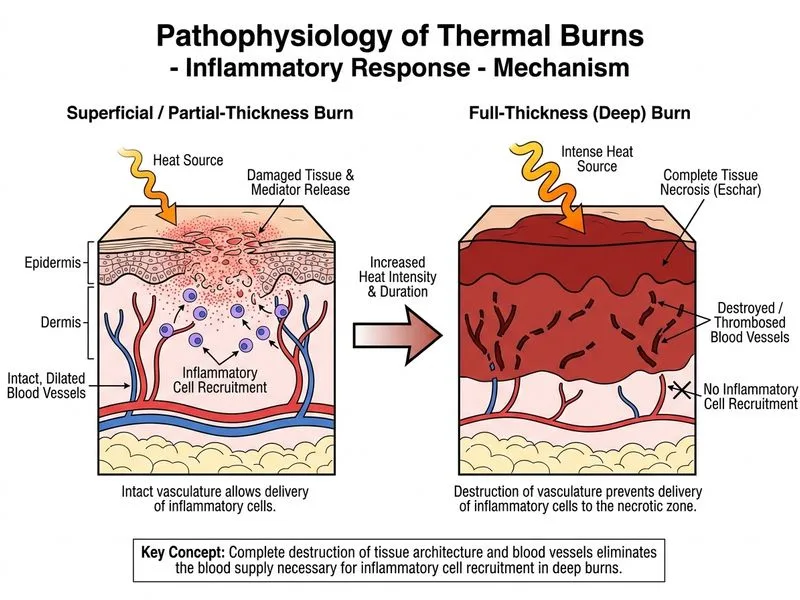
B. Complete destruction of tissue architecture and blood vessels has eliminated the blood supply necessary for inflammatory cell recruitment
C. The patient is immunocompromised, and therefore cannot mount an inflammatory response to thermal injury
D. The burned tissue is already dead, and inflammation only occurs in viable tissue surrounding the burn wound

Explanation

## Pathophysiology of Thermal Injury and Inflammatory Response **Why Minimal Inflammation in Deeply Burned Tissue:** **Mechanism: Loss of Vascular Supply** - Thermal injury causes **coagulation necrosis** of tissue - Blood vessels in the burned zone are destroyed and thrombosed - **No blood flow = no leukocyte recruitment** - Inflammatory cells require intact vasculature to extravasate and migrate - The burned tissue becomes an **avascular zone** incapable of mounting inflammation **Zones of Thermal Injury (Jackson's Theory):** | Zone | Characteristics | Inflammation | |------|-----------------|---------------| | **Zone of Coagulation (Center)** | Complete necrosis, irreversible damage | Minimal (avascular) | | **Zone of Stasis (Middle)** | Partial damage, potentially salvageable | Moderate | | **Zone of Hyperemia (Periphery)** | Viable tissue, increased blood flow | Marked | **Key Point:** Inflammation requires **viable tissue with intact vasculature**. The central burned zone is avascular and cannot support inflammatory cell infiltration. **High-Yield:** The white, leathery appearance with absent sensation indicates full-thickness (third-degree) burn with complete tissue death. The minimal inflammatory response is NOT due to immunosuppression or protein denaturation alone, but rather due to **loss of blood supply** preventing immune cell recruitment. **Clinical Pearl:** Inflammation is most prominent at the **margins** of the burn (zone of stasis and hyperemia), not in the central necrotic zone.
Practice similar questions

Sign up free to access AI-powered MCQ practice with detailed explanations and adaptive learning.

Start Practicing Free More Forensic Medicine Questions