
NEETPGAI
FeaturesBlogComparePricing
Log inStart Free
NEETPGAI

AI-powered NEET PG preparation platform. Master all 19 subjects with adaptive MCQs, AI tutoring, and spaced repetition.

Product

  • Features
  • Subjects
  • Previous Year Questions
  • Compare
  • Pricing
  • Blog

Features

  • Adaptive MCQ Practice
  • AI Tutor
  • Mock Tests
  • Spaced Repetition

Resources

  • Blog
  • Study Guides
  • NEET PG Updates
  • Contact & support

Legal

  • Privacy Policy
  • Terms of Service

Stay updated

© 2026 NEETPGAI. All rights reserved.
    Subjects/Surgery/Penetrating Flank Trauma Management
    Penetrating Flank Trauma Management
    medium
    scissors Surgery

    A 28-year-old man sustains a stab wound to the right flank at the level of the 10th intercostal space. On arrival, he is haemodynamically stable (BP 128/82 mmHg, HR 92/min). Abdominal examination shows a single stab wound with no peritoneal signs. FAST is negative. Local wound exploration under local anaesthesia shows the wound tract does not penetrate the fascia. What is the most appropriate next step?

    A. Immediate exploratory laparotomy
    B. Diagnostic laparoscopy to rule out intra-abdominal injury
    C. CT scan with IV contrast to evaluate for peritoneal penetration
    D. Observation with serial clinical examination and discharge if stable after 24 hours

    Explanation

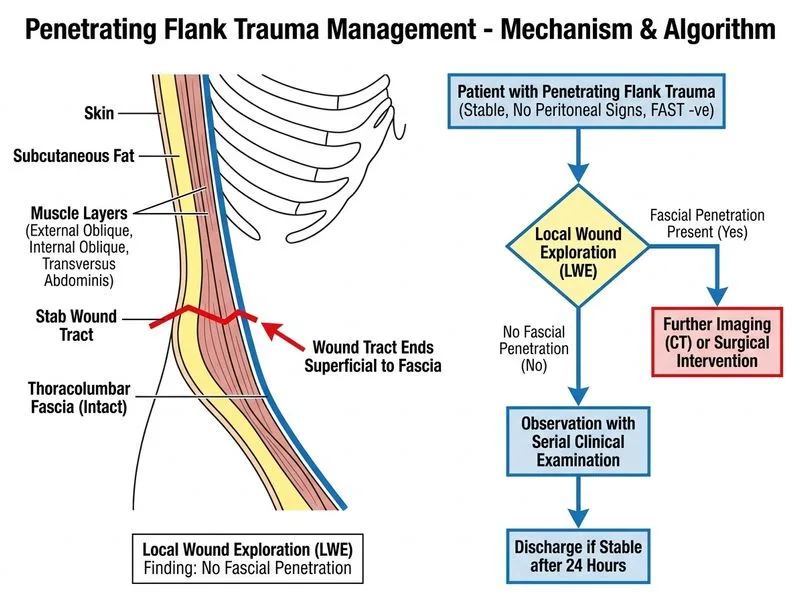
    ## Management of Non-Penetrating Stab Wounds ### Wound Exploration Findings: Local wound exploration is a reliable and cost-effective method to assess penetration in stable patients with flank stab wounds. ### Key Decision Points: - **Fascial penetration absent** → wound does not enter peritoneal cavity - **FAST negative** → no free fluid suggesting intra-abdominal injury - **Haemodynamically stable** → no signs of active bleeding - **No peritoneal signs** → no clinical evidence of visceral injury ### Management Algorithm: When local wound exploration confirms **no fascial penetration** in a stable patient: 1. Observation with serial clinical examination 2. Discharge after 24 hours if patient remains stable and asymptomatic 3. Advise return precautions (fever, abdominal pain, distension, vomiting) **High-Yield Fact:** Approximately 50% of flank stab wounds do not penetrate the peritoneum. Mandatory exploration in all such cases leads to unnecessary laparotomies and morbidity. **Clinical Pearl:** Serial examination is more sensitive than any single imaging modality for detecting evolving peritoneal injury. ![Penetrating Flank Trauma Management diagram](https://mmcphlazjonnzmdysowq.supabase.co/storage/v1/object/public/blog-images/explanation/1994.webp)
    Practice similar questions

    Sign up free to access AI-powered MCQ practice with detailed explanations and adaptive learning.

    Start Practicing Free More Surgery Questions