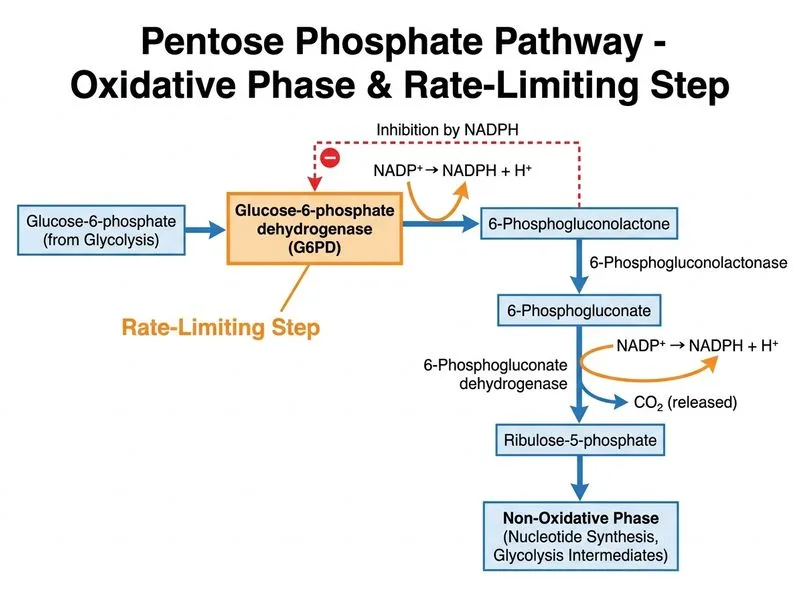
## Oxidative Phase of the Pentose Phosphate Pathway **Key Point:** Glucose-6-phosphate dehydrogenase (G6PD) catalyzes the first and rate-limiting step of the oxidative phase, converting glucose-6-phosphate to 6-phosphogluconolactone while reducing NADP^+^ to NADPH. **High-Yield:** This is the committed step of the pathway. The reaction is irreversible and highly regulated by the availability of NADP^+^ and the concentration of NADPH (product inhibition). ### Why G6PD is Rate-Limiting | Feature | Details | | --- | --- | | **Enzyme** | Glucose-6-phosphate dehydrogenase (G6PD) | | **Substrate** | Glucose-6-phosphate | | **Product** | 6-Phosphogluconolactone + NADPH | | **Cofactor** | NADP^+^ (essential) | | **Regulation** | Inhibited by high NADPH/NADP^+^ ratio | | **Clinical Significance** | Deficiency causes hemolytic anemia (G6PD deficiency) | **Mnemonic:** **G6PD** = **G**lucose-**6**-**P**hosphate **D**ehydrogenase — the gatekeeper of the oxidative pentose phosphate pathway. **Clinical Pearl:** G6PD deficiency is the most common enzyme deficiency worldwide, affecting ~400 million people. Hemolysis is triggered by oxidative stress (fava beans, sulfonamides, antimalarials like primaquine). ### Other Enzymes in the Pathway - **6-Phosphogluconate dehydrogenase**: Second oxidative enzyme; also produces NADPH but is not rate-limiting. - **Phosphoglucose isomerase**: Glycolytic enzyme; not part of the pentose phosphate pathway. - **Glucose-6-phosphatase**: Gluconeogenic enzyme; found in liver and kidney, not in the pentose phosphate pathway. 
Sign up free to access AI-powered MCQ practice with detailed explanations and adaptive learning.