A 48-year-old woman from Mumbai with a 6-month history of recurrent epigastric pain is found to have a 2 cm gastric ulcer on endoscopy. She has been taking ibuprofen 400 mg three times daily for the past 8 months for chronic knee pain. Biopsy from the ulcer margin shows chronic inflammation with intestinal metaplasia but H. pylori serology is negative. She is started on omeprazole and NSAID discontinuation. Despite 8 weeks of therapy, repeat endoscopy shows minimal healing with persistent ulcer. What is the most likely reason for treatment failure?
A. Continued NSAID use or use of alternative NSAIDs for pain relief
B. Undiagnosed H. pylori infection that was missed on initial serology
C. Inadequate acid suppression due to poor compliance with omeprazole
D. Development of gastric adenocarcinoma at the ulcer site
Explanation
NSAID-Associated Peptic Ulcer Disease: Healing and Failure
Pathophysiology of NSAID-Induced Ulcers
Key Point
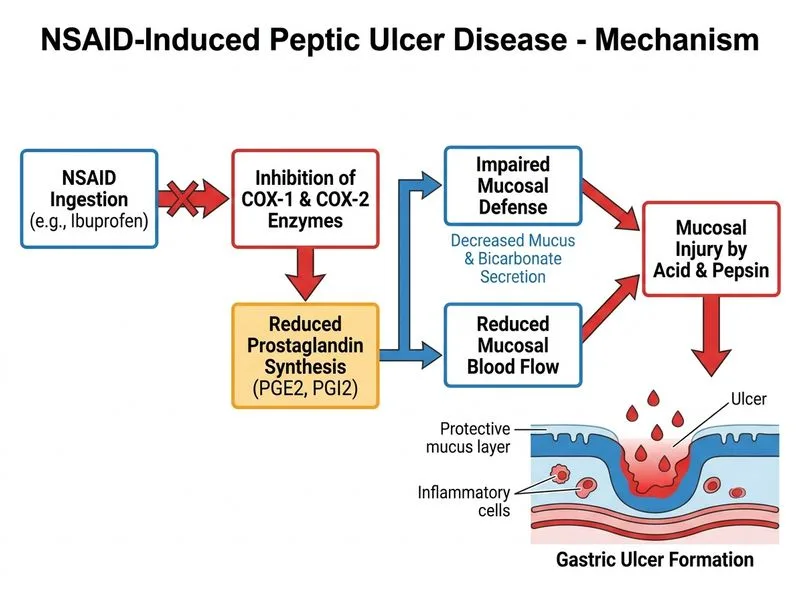
NSAIDs cause ulcers by inhibiting COX-1 and COX-2, reducing prostaglandin E₂ (PGE₂) production. PGE₂ is essential for:
Mucus secretion
Bicarbonate production
Mucosal blood flow
Epithelial cell proliferation
Without these protective mechanisms, the mucosa becomes susceptible to acid-pepsin damage.
Why This Patient Has Treatment Failure
Clinical Pearl
The most common reason for failure of PPI therapy in NSAID ulcers is continued NSAID exposure. Even if the patient reports stopping NSAIDs, they may:
Resume use for pain relief without informing the physician
Switch to alternative NSAIDs (e.g., naproxen, diclofenac)
Use over-the-counter NSAIDs (aspirin, ibuprofen) unknowingly
Take combination analgesics containing NSAIDs
Healing Timeline and Failure Patterns
Table
Factor
Expected Healing
Failure Indicator
NSAID ulcer with PPI alone
4–8 weeks (60–80%)
Persistent ulcer at 8 weeks
NSAID ulcer with PPI + NSAID cessation
4–6 weeks (>90%)
Indicates ongoing NSAID exposure
H. pylori-negative ulcer
Heals with PPI monotherapy
Failure suggests NSAID re-exposure
Gastric vs. duodenal
Gastric ulcers heal slower
Gastric ulcers require 8–12 weeks
High-YieldNEET PG
In an H. pylori-negative patient with an NSAID ulcer, failure to heal on PPI therapy is pathognomonic for continued NSAID use.
Management Algorithm for Treatment Failure
Loading diagram...
Key Point
Gastric ulcers (as in this case) heal more slowly than duodenal ulcers and may require 8–12 weeks of therapy. However, 8 weeks is still a reasonable timepoint to reassess, and failure to heal should prompt investigation for ongoing NSAID use.
Red Flag: When to Suspect Malignancy
Warning
Gastric ulcers carry a small risk of harboring gastric cancer. However, malignancy is unlikely to be the cause of treatment failure because:
Biopsies were taken (showing chronic inflammation, not malignancy)
Cancer would typically show different histology (dysplasia, adenocarcinoma)
The clinical presentation is consistent with NSAID ulcer
Malignancy would be suspected if biopsies showed dysplasia or if the ulcer had an irregular margin with rolled edges.
Harrison 21e Ch 297, Robbins 10e Ch 17
Loading illustration…
Practice similar questions
Sign up free to access AI-powered MCQ practice with detailed explanations and adaptive learning.