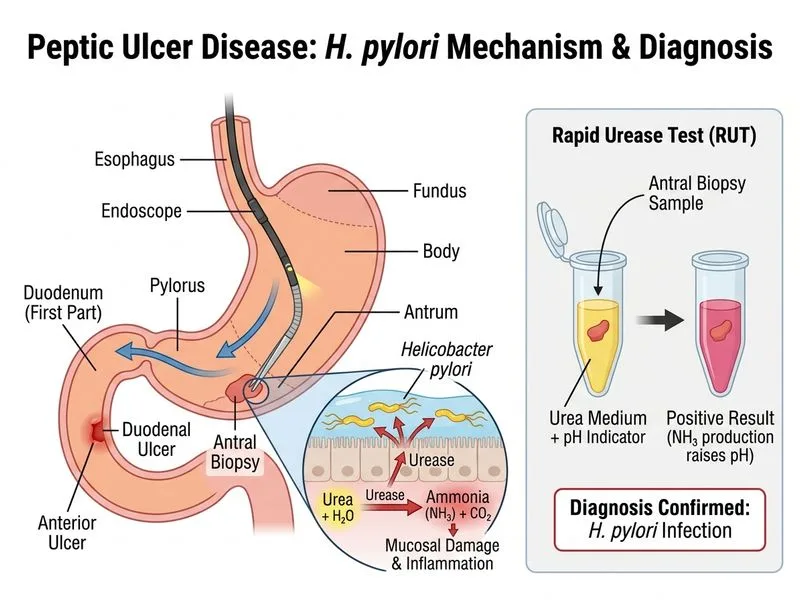
A 42-year-old man from Delhi presents with a 3-month history of epigastric pain relieved by food and antacids. Upper GI endoscopy reveals a 1.5 cm ulcer on the anterior wall of the first part of the duodenum with clean base. Which investigation is most appropriate to confirm the aetiology of this peptic ulcer?
A. Serum pepsinogen I/II ratio
B. Faecal antigen ELISA for H. pylori
C. Serum gastrin level (fasting)
D. Rapid urease test on antral biopsy
Explanation
Investigation of Choice for H. pylori in Peptic Ulcer Disease
Key Point
The rapid urease test (RUT) on antral mucosa obtained during endoscopy is the gold standard for diagnosing active H. pylori infection in a patient with endoscopically confirmed peptic ulcer.
Why Rapid Urease Test?
The rapid urease test is:
Sensitivity: 90–95% (highest among endoscopic tests)
Specificity: 95–98%
Timing: Results within 1–2 hours
Cost-effective: Inexpensive and performed at the bedside
Direct evidence: Detects urease enzyme produced by H. pylori in the biopsy specimen
When to Perform RUT
1.
At the time of endoscopy — ideal because the patient is already sedated and biopsies are being taken
2.
Multiple biopsies — take 2–3 samples from antrum (where H. pylori density is highest) to improve sensitivity
3.
Avoid PPI use — patient should stop PPIs ≥2 weeks before testing (reduces false negatives)
H. pylori Diagnostic Methods Comparison
Table
Investigation
Sensitivity
Specificity
Timing
Requires Endoscopy
Best Use
Rapid Urease Test
90–95%
95–98%
1–2 hrs
Yes
Active infection in ulcer disease
Histology (H&E/IHC)
95–98%
98–100%
24–48 hrs
Yes
Confirmation; assess inflammation
Faecal Antigen (ELISA)
90–95%
93–98%
24–48 hrs
No
Non-invasive screening; post-treatment
Serum IgG antibody
85–95%
90–95%
24 hrs
No
Epidemiology; past infection
Urea Breath Test (UBT)
95–98%
95–98%
20–30 min
No
Gold standard non-invasive; post-Rx
High-YieldNEET PG
In an endoscoped patient with a duodenal ulcer, RUT is the fastest and most practical confirmatory test.
Clinical Pearl
Duodenal ulcers are H. pylori–positive in ~90% of cases (excluding NSAIDs). The anterior wall location is classic for duodenal ulcers and carries risk of perforation. Confirming H. pylori allows targeted eradication therapy.
Mnemonic for H. pylori tests:RUSH = Rapid urease (endoscopic), Urea Breath Test (non-invasive), Serology (IgG), Histology (most specific)
Rationale Against Other Options
Serum gastrin: Used only if Zollinger–Ellison syndrome (ZES) is suspected (multiple ulcers, refractory disease, diarrhoea) — not the first-line test for routine peptic ulcer
Faecal antigen ELISA: Non-invasive but less practical in an already-endoscoped patient; better for screening or post-treatment confirmation
Serum pepsinogen ratio: Reflects gastric acid secretion and mucosal atrophy; not diagnostic for H. pylori infection
Harrison 21e Ch 297
Loading illustration…
Practice similar questions
Sign up free to access AI-powered MCQ practice with detailed explanations and adaptive learning.