
| Feature | NSAID-Induced Ulcer | H. pylori-Associated Ulcer |
|---|---|---|
| Primary location | Anterior duodenal wall, lesser curve of stomach | Posterior duodenal wall, greater curve of stomach |
| Mechanism | Direct mucosal injury + COX inhibition | Chronic inflammation + acid hypersecretion |
| Associated gastritis | Minimal or absent | Chronic active gastritis with intestinal metaplasia |
| Acid secretion | Normal or low | Often elevated (especially in duodenal ulcers) |
| Prevalence | More common in gastric ulcers | More common in duodenal ulcers |
| Bleeding risk | High (anterior wall erosion) | Moderate |
| Perforation risk | High (anterior wall perforation) | Moderate |
| Recurrence after healing | Low (if NSAID stopped) | High (if H. pylori not eradicated) |
Mnemonic: "APE" for NSAID ulcers — Anterior wall, Perforation risk, Exposed to acid and drug.
Mnemonic: "PGA" for H. pylori ulcers — Posterior wall, Greater curve, Acid hypersecretion.
Robbins 10e Ch 17
Loading illustration…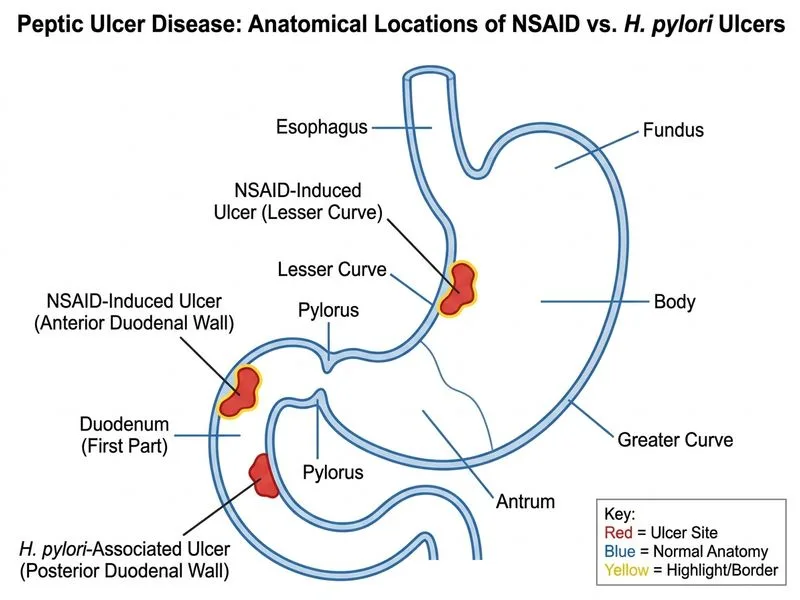
Sign up free to access AI-powered MCQ practice with detailed explanations and adaptive learning.
Daily MCQs, study tips, and topper strategies on Telegram.
Join on Telegram →