
## Clinical Assessment This patient presents with **Fontaine Stage II peripheral arterial disease (intermittent claudication)**—pain on exertion that resolves with rest, without rest pain or tissue loss. ### Key Diagnostic Features **High-Yield:** - ABI 0.45 confirms significant arterial stenosis (normal >0.9; claudication 0.5–0.9; critical limb ischemia <0.4) - Absence of rest pain and tissue loss rules out Stage III (rest pain) and Stage IV (tissue loss) - Cool extremity and absent pulses indicate chronic arterial insufficiency, not acute thrombosis ### Management Algorithm for Claudication ```mermaid flowchart TD A[Claudication diagnosed]:::outcome --> B{Lifestyle modification + medical therapy adequate?}:::decision B -->|Yes| C[Continue aspirin, exercise, smoking cessation]:::action B -->|No| D[Consider revascularization]:::action D --> E{Anatomy suitable for intervention?}:::decision E -->|Yes| F[PTA ± stent or bypass]:::action E -->|No| G[Continue medical management]:::action ``` ### First-Line Management (Stage II) 1. **Antiplatelet therapy**: Aspirin 75 mg daily (or clopidogrel if aspirin intolerant) [cite:Norgren et al., ESC PAD Guidelines 2017] 2. **Supervised exercise program**: 30–60 min, 3×/week for 12 weeks—improves claudication distance by 50–200% 3. **Risk factor modification**: Smoking cessation (critical), BP control, statin, diabetes management 4. **Cilostazol**: Reserved for patients who fail conservative therapy or have contraindications to exercise **Key Point:** - Revascularization (PTA, stent, or bypass) is **not** indicated in Stage II unless claudication severely limits quality of life despite optimal medical therapy and exercise - Acute thrombectomy is for acute limb ischemia (sudden onset), not chronic claudication **Clinical Pearl:** - The absence of rest pain and tissue loss is reassuring; the goal is symptom improvement and prevention of progression, not emergency intervention ## Why This Answer Aspirin + supervised exercise is the **gold-standard first-line approach** for stable claudication. It addresses both thrombotic risk and functional improvement without unnecessary intervention. 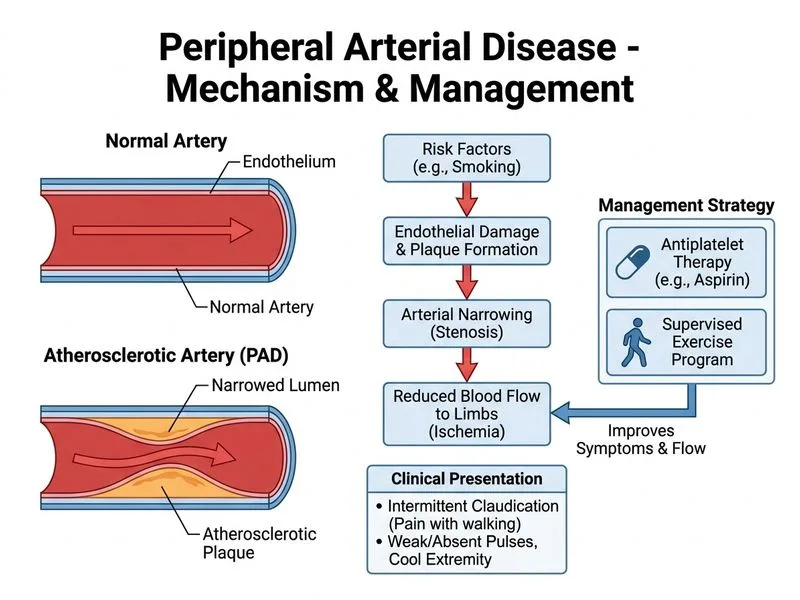
Sign up free to access AI-powered MCQ practice with detailed explanations and adaptive learning.