
## Clinical Diagnosis: Acute Limb Ischemia (ALI) ### Presentation Analysis **High-Yield:** - **Sudden onset** (4 hours ago) with **6 P's**: Pain, Pallor, Pulselessness, Paresthesia (absent sensation), Paralysis (implied), Poikilothermia (cold) - **Mottled skin** indicates microvascular thrombosis—sign of advanced ischemia - **Sensory loss** suggests tissue damage is progressing; limb is at risk - **Absent pulses** across femoral, popliteal, and pedal territories = arterial occlusion ### Rutherford Classification of Acute Limb Ischemia | Grade | Viability | Sensory | Motor | Doppler | |-------|-----------|---------|-------|--------| | I (Viable) | Viable | Normal | Normal | Arterial ± Venous | | IIa (Threatened—Marginal) | Salvageable | Minimal loss | Minimal loss | Arterial ± Venous | | IIb (Threatened—Immediate) | Salvageable | Sensory loss | Muscle weakness | Venous ± Arterial | | III (Irreversible) | Unsalvageable | Sensory/motor loss | Paralysis | Venous absent | **This patient is Grade IIb–III** (sensory loss, mottled skin, imminent irreversibility). ### Emergency Management Algorithm ```mermaid flowchart TD A[Acute limb ischemia diagnosed]:::outcome --> B[Immediate anticoagulation: IV heparin bolus]:::action B --> C[Urgent vascular surgery consultation]:::action C --> D{Time since onset & viability?}:::decision D -->|< 6-8 hrs, viable/marginal| E[Catheter-directed thrombolysis or thrombectomy]:::action D -->|> 12-14 hrs, irreversible| F[Amputation]:::action D -->|Uncertain| G[Imaging: CT angiography or angiography]:::action ``` ### Immediate Steps (First 30 Minutes) 1. **Anticoagulation**: IV heparin bolus 80 U/kg (typically 5000–10,000 U), then continuous infusion - Prevents propagation of thrombus - Must be done before any intervention 2. **Urgent vascular surgery consultation**: Within minutes, not hours - Assess candidacy for thrombectomy vs. thrombolysis vs. amputation 3. **Imaging**: Angiography (gold standard) or CT angiography to define occlusion site and anatomy 4. **Intervention**: Based on time and viability - **< 6–8 hours + viable**: Catheter-directed thrombolysis or surgical thrombectomy - **> 12–14 hours + irreversible**: Amputation **Key Point:** - **Time is tissue**: Every hour of delay increases amputation risk. Sensory loss and mottling indicate the limb is in imminent danger. - Heparin must be given immediately to prevent further thrombosis while definitive intervention is arranged. **Clinical Pearl:** - Acute thrombosis in a patient with diabetes and normal contralateral pulses suggests **embolic occlusion** (e.g., from atrial fibrillation, cardiac thrombus, or atherosclerotic plaque). Urgent angiography will clarify the mechanism. ## Why This Answer This is a **vascular emergency**. Heparin anticoagulation followed by urgent vascular surgery consultation and definitive intervention (thrombolysis or thrombectomy) is the only approach that can salvage the limb. Delays of even a few hours can result in irreversible tissue loss and amputation. 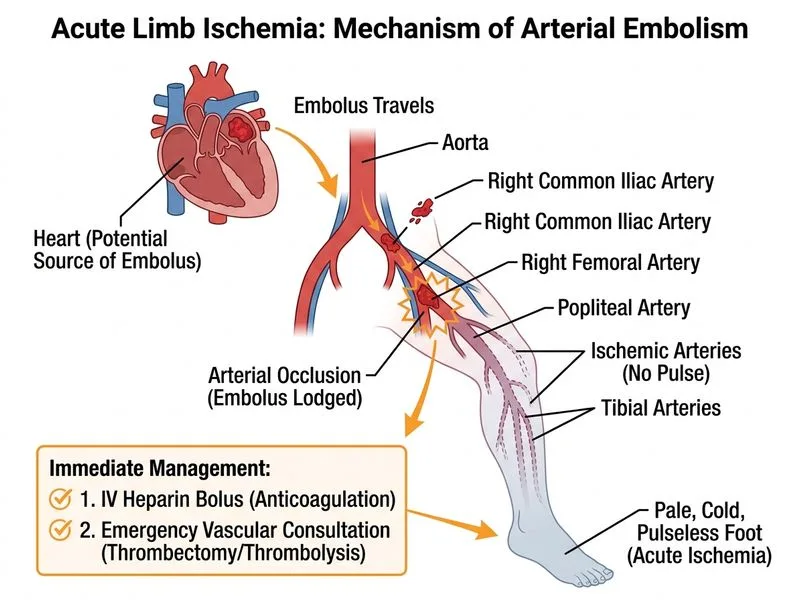
Sign up free to access AI-powered MCQ practice with detailed explanations and adaptive learning.