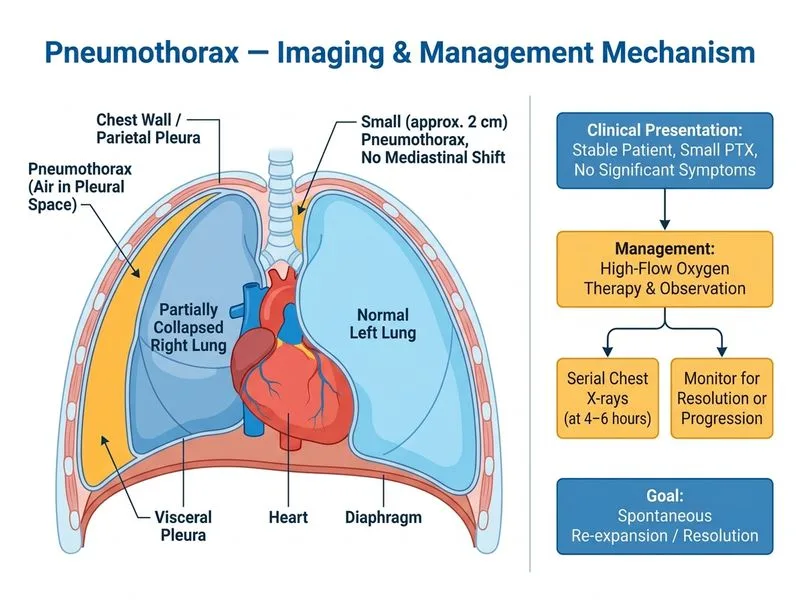
## Clinical Assessment of Pneumothorax Size and Stability **Key Point:** The size of pneumothorax and haemodynamic stability determine management strategy. A 2 cm pneumothorax (measured as the distance between lung edge and chest wall at the hilum) is classified as **small** (≤2 cm) or **minimal**. ### Size Classification | Pneumothorax Size | Measurement | Management | |---|---|---| | Small/Minimal | ≤2 cm at hilum | Conservative: O₂ + observation | | Large | >2 cm at hilum OR >20% lung volume | Intervention: chest tube or aspiration | ### Management Algorithm for Stable Primary Spontaneous Pneumothorax ```mermaid flowchart TD A[Primary Spontaneous Pneumothorax]:::outcome --> B{Haemodynamically stable?}:::decision B -->|No| C[Tension PTX: needle decompression]:::urgent B -->|Yes| D{Size ≤2 cm at hilum?}:::decision D -->|Yes| E[High-flow O₂ + observation]:::action D -->|No| F{Breathless/hypoxic?}:::decision F -->|Yes| G[Chest tube or aspiration]:::action F -->|No| H[Conservative Rx + serial CXR]:::action E --> I[Repeat CXR at 4-6 hours]:::action I --> J{Resolved or stable?}:::decision J -->|Yes| K[Discharge with outpatient follow-up]:::outcome J -->|No| L[Escalate to intervention]:::action ``` **High-Yield:** In a **small, primary spontaneous pneumothorax** with a **haemodynamically stable patient**, high-flow oxygen (10–15 L/min) and observation is the standard first-line approach. Oxygen accelerates reabsorption by increasing the nitrogen gradient. **Clinical Pearl:** Serial chest X-rays at 4–6 hours allow assessment of progression. If the pneumothorax remains stable or resolves, the patient can be discharged with outpatient follow-up. Intervention (chest tube or needle aspiration) is reserved for large pneumothoraces, secondary pneumothorax, haemodynamic instability, or failure to resolve. ### Why High-Flow Oxygen Works 1. Increases partial pressure gradient for nitrogen reabsorption from pleural space into blood 2. Accelerates pneumothorax resolution by 4–8 fold compared to room air 3. Allows time for observation before invasive intervention **Tip:** Do not confuse **small primary spontaneous pneumothorax** (managed conservatively) with **tension pneumothorax** (haemodynamic compromise, mediastinal shift) or **secondary pneumothorax** (underlying lung disease like COPD, cystic fibrosis — lower threshold for intervention). 
Sign up free to access AI-powered MCQ practice with detailed explanations and adaptive learning.