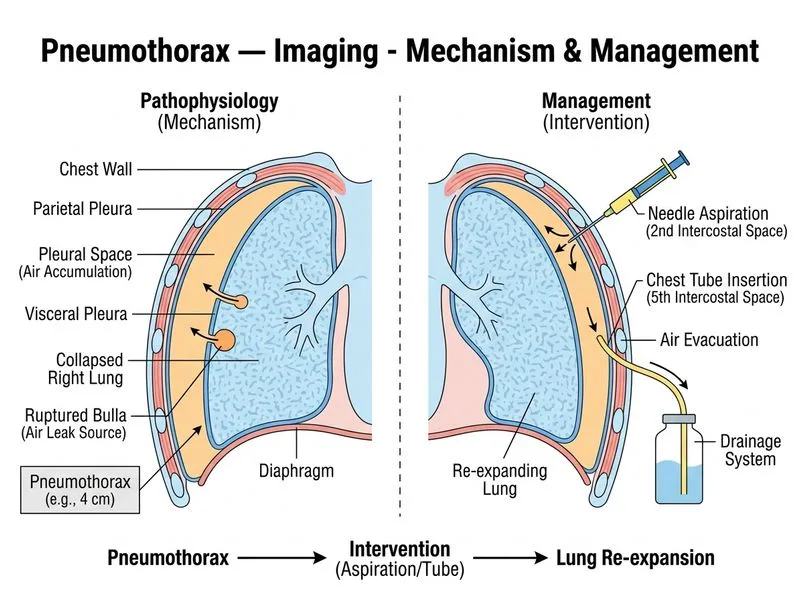
## Secondary Pneumothorax: Different Management Paradigm **Key Point:** **Secondary pneumothorax** (occurring in patients with underlying lung disease) has a **lower threshold for intervention** compared to primary spontaneous pneumothorax. Size and stability thresholds differ. ### Primary vs. Secondary Pneumothorax Management | Feature | Primary Spontaneous | Secondary | |---|---|---| | Underlying lung disease | No | Yes (COPD, CF, ILD, malignancy) | | Small PTX (≤2 cm) | Conservative: O₂ + observation | Consider intervention | | Large PTX (>2 cm) | Intervention if symptomatic | **Always intervene** | | Recurrence rate | 20–30% | 40–50% | | Mortality risk | Low | **Higher** | ### Why Secondary Pneumothorax Requires Lower Threshold for Intervention 1. **Compromised baseline lung function** — patients with CF, COPD, or ILD have reduced respiratory reserve; even small pneumothoraces cause significant hypoxia 2. **Higher recurrence and failure rates** — conservative management fails in 40–50% of secondary cases 3. **Risk of tension physiology** — underlying lung disease increases risk of rapid progression 4. **Mortality** — secondary pneumothorax has higher in-hospital mortality (5–10%) vs. primary (<1%) **High-Yield:** In **secondary pneumothorax**, even a **4 cm pneumothorax** (which would be managed conservatively in primary disease) warrants **intervention** (needle aspiration or chest tube) because the patient's baseline lung function is already compromised. ### Management Algorithm for Secondary Pneumothorax ```mermaid flowchart TD A[Secondary Pneumothorax]:::outcome --> B{Haemodynamically stable?}:::decision B -->|No| C[Needle decompression + chest tube]:::urgent B -->|Yes| D{Size >2 cm OR symptomatic?}:::decision D -->|Yes| E[Needle aspiration or chest tube]:::action D -->|No| F[Trial of O₂ + observation]:::action F --> G{Resolving at 4-6 hours?}:::decision G -->|Yes| H[Continue conservative Rx]:::action G -->|No| I[Escalate to chest tube]:::action E --> J[Repeat CXR post-intervention]:::action I --> J ``` **Clinical Pearl:** This patient has **cystic fibrosis** (secondary pneumothorax) with a **4 cm pneumothorax** and **borderline hypoxia** (92% on room air). Despite haemodynamic stability, intervention is indicated because: - Underlying CF means reduced respiratory reserve - 4 cm is large enough to warrant intervention in secondary disease - Conservative management has high failure rate in CF **Tip:** Do not apply primary pneumothorax thresholds to secondary disease. A 4 cm pneumothorax in CF is an **indication for intervention**; the same size in a healthy 25-year-old might be managed conservatively if fully asymptomatic. 
Sign up free to access AI-powered MCQ practice with detailed explanations and adaptive learning.