
## Anatomical Relationships in the Popliteal Fossa **Key Point:** The popliteal artery passes through the popliteal fossa between the medial and lateral heads of the gastrocnemius muscle, making it vulnerable to compression in this anatomical space. ### Correct Answer Explanation: The popliteal artery enters the popliteal fossa by passing between (or posterior to) the two heads of the gastrocnemius muscle. This anatomical relationship is clinically significant because: - Hypertrophy or spasm of the gastrocnemius can compress the artery - Popliteal artery entrapment syndrome occurs due to anomalous muscular attachments or medial deviation of the medial head - During surgical procedures, awareness of this relationship prevents iatrogenic vascular injury ### Anatomical Boundaries of Popliteal Fossa: | Structure | Position | |-----------|----------| | **Medial border** | Semimembranosus and semitendinosus | | **Lateral border** | Biceps femoris | | **Superior border** | Gastrocnemius (medial and lateral heads) | | **Floor** | Popliteus muscle, posterior knee capsule | | **Contents** | Popliteal artery, vein, tibial and common peroneal nerves | **Clinical Pearl:** Popliteal artery entrapment syndrome (PAES) is a rare but important condition where the artery is compressed by the medial head of gastrocnemius or anomalous muscular slips, leading to claudication or acute thrombosis in young athletes. **High-Yield:** The relationship between the popliteal artery and gastrocnemius is critical for understanding both normal anatomy and pathological compression syndromes. 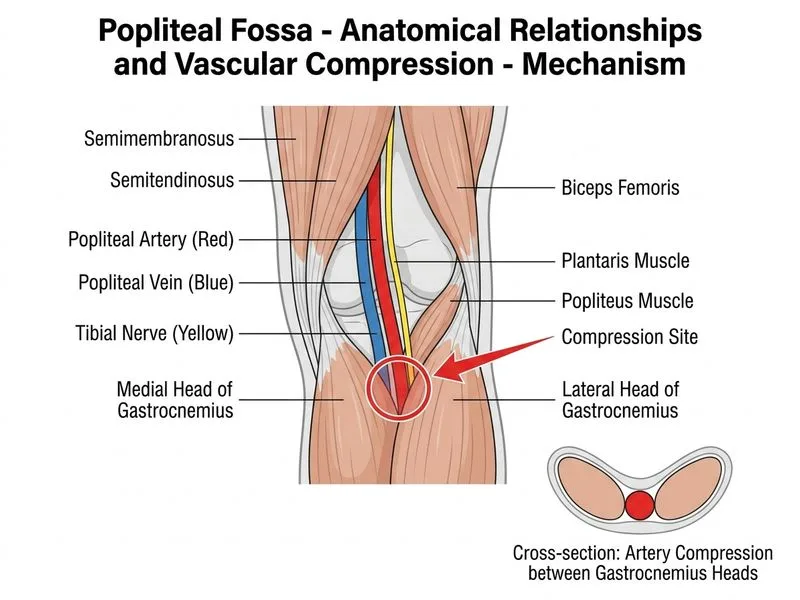
Sign up free to access AI-powered MCQ practice with detailed explanations and adaptive learning.