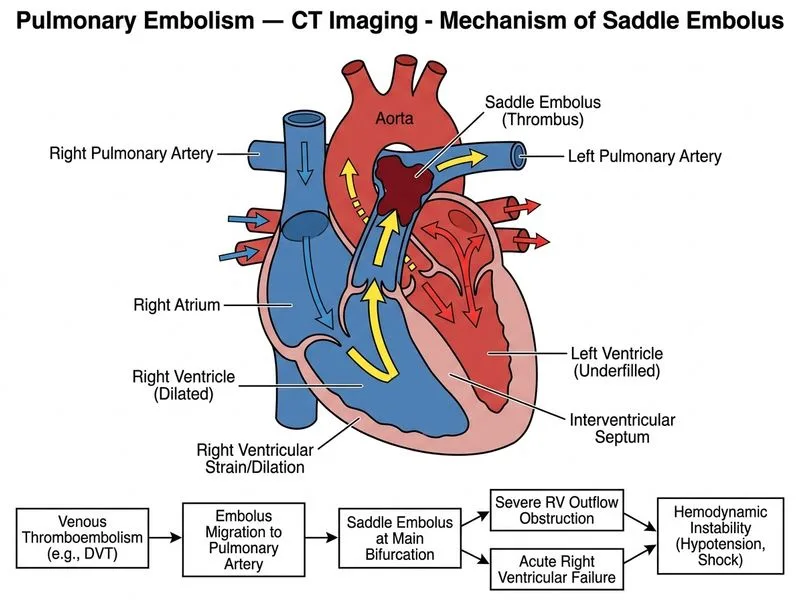
## Massive Pulmonary Embolism: Imaging Classification and Risk Stratification ### Clinical Presentation of Massive PE This patient demonstrates **hemodynamic instability** (syncope, hypotension, shock) with **right heart strain** (RV dilatation on imaging, ECG changes, elevated troponin). These are hallmarks of massive PE requiring urgent intervention. ### CTPA Findings Indicating Massive PE **Key Point:** A **saddle embolus**—a large filling defect straddling the pulmonary artery bifurcation and extending into both main pulmonary arteries—is the classic imaging sign of massive PE. ### PE Classification by CTPA Extent and Hemodynamics | Classification | CTPA Finding | Hemodynamic Status | RV Strain | Management | |---|---|---|---|---| | **Subsegmental** | Filling defect in subsegmental artery only | Stable | Absent | Anticoagulation ± observation | | **Segmental** | Filling defect in segmental artery ± multiple segments | Usually stable | May be present | Anticoagulation ± monitoring | | **Lobar** | Filling defect in lobar artery | Variable | Often present | Anticoagulation; consider escalation if unstable | | **Massive (Saddle)** | Filling defect at PA bifurcation ± bilateral extension | **Unstable (shock, syncope)** | **Severe (RV > 1.5 × LV)** | **Urgent thrombolysis / embolectomy** | ### Radiological Signs of Right Heart Strain on CTPA **High-Yield:** RV/LV diameter ratio > 1.5 on axial imaging is the threshold for diagnosing RV dilatation and predicts poor prognosis in PE. 1. **RV dilatation**: RV diameter > 1.5 × LV diameter 2. **Septal bowing**: Rightward displacement of the interventricular septum 3. **IVC dilatation**: Inferior vena cava > 3 cm without collapse 4. **Reflux into hepatic veins**: Indicates severe RV dysfunction ### Management Algorithm for Massive PE ```mermaid flowchart TD A["PE on CTPA"]:::outcome --> B{"Hemodynamically stable?"}:::decision B -->|"Yes"| C{"RV strain on imaging?"}:::decision B -->|"No (shock/syncope)"| D["Massive PE"]:::urgent C -->|"No"| E["Low-risk PE"]:::outcome C -->|"Yes"| F["Intermediate-risk PE"]:::outcome D --> G["Urgent thrombolysis or embolectomy"]:::action E --> H["Anticoagulation"]:::action F --> I["Anticoagulation + close monitoring"]:::action I --> J{"Hemodynamic deterioration?"}:::decision J -->|"Yes"| G J -->|"No"| K["Continue anticoagulation"]:::action ``` ### Why Saddle Embolus Requires Urgent Intervention **Clinical Pearl:** A saddle embolus causes **acute massive RV afterload increase** by occluding >50% of the pulmonary vascular bed. This leads to: - RV failure and cardiogenic shock - Coronary hypoperfusion → RV infarction - Arrhythmias and sudden death Unlike smaller PEs (which are managed with anticoagulation alone), massive PE has a **mortality of 30–50% without intervention** and requires **immediate thrombolysis (alteplase, tenecteplase) or surgical/catheter embolectomy**. **Mnemonic:** **MASSIVE PE = Saddle + Shock = Thrombolysis/Embolectomy** - **M**ain PA bifurcation involvement - **A**cute hemodynamic collapse - **S**evere RV strain (RV > 1.5 × LV) - **S**yncope or shock - **I**nterventional therapy needed - **V**ital sign instability - **E**mergency management [cite:Harrison 21e Ch 297; Chest Radiology: The Essentials Ch 8] 
Sign up free to access AI-powered MCQ practice with detailed explanations and adaptive learning.