Radial Nerve — Course and Lesions MCQ — NEET PG Practice Question | NEETPGAI
Radial Nerve — Course and Lesions
medium
bone Anatomy
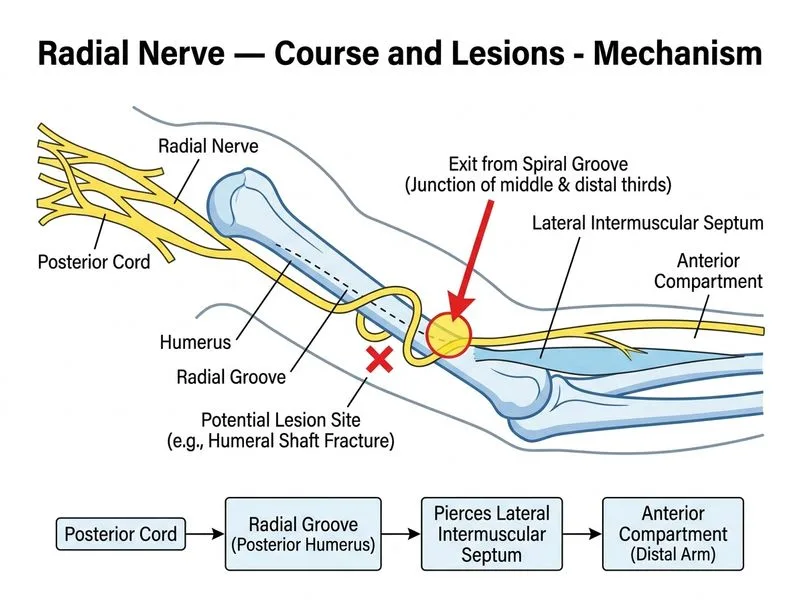
The radial nerve emerges from the posterior cord of the brachial plexus and spirals around the shaft of the humerus in the radial groove. At what level does the radial nerve typically exit the spiral groove to enter the anterior compartment of the arm?
A. At the junction of the middle and distal thirds of the humerus
B. At the junction of the proximal and middle thirds of the humerus
C. At the level of the surgical neck of the humerus
D. At the level of the medial epicondyle of the humerus
Explanation
Radial Nerve Course Through the Arm
Key Point
The radial nerve spirals posteriorly around the humerus within the radial groove (also called the spiral groove or musculospiral groove) and exits to enter the anterior compartment at the junction of the middle and distal thirds of the humerus.
Anatomical Sequence
1.
Origin: Posterior cord of the brachial plexus (C5, C6, C7, C8, T1)
2.
Course in spiral groove: Travels with the profunda brachii artery (superior radial collateral artery)
3.
Exit point: Middle-to-distal third junction — pierces the lateral intermuscular septum
4.
Anterior compartment: Descends between brachialis and brachioradialis muscles
5.
Forearm entry: Passes anterior to the lateral epicondyle and divides into superficial and deep branches
High-YieldNEET PG
This exit point is clinically significant because:
Fractures of the distal humerus (supracondylar fractures) occur below this point and typically spare the radial nerve
Mid-shaft humeral fractures are the classic site of radial nerve injury
The nerve is vulnerable in the spiral groove to compression or stretch injury
Clinical Pearl
Fractures at the junction of middle and distal thirds of the humerus have the highest risk of radial nerve injury because the nerve is tethered in the spiral groove at this exact location.
Mnemonic
RADIAL GROOVE EXITS:Middle-to-Distal junction = MD (Medical Doctor — remember the initials!)
Why This Matters for NEET PG
The exact exit point of the radial nerve from the spiral groove is a high-yield anatomical landmark tested frequently in anatomy and orthopaedic surgery sections. It correlates with fracture patterns and nerve injury risk.
Loading illustration…
Practice similar questions
Sign up free to access AI-powered MCQ practice with detailed explanations and adaptive learning.