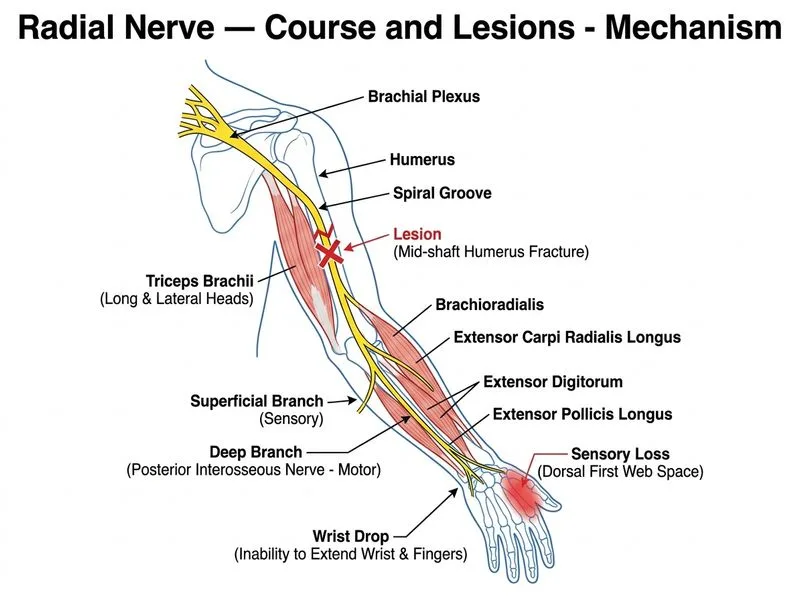
## Clinical Presentation Analysis **Key Point:** Mid-shaft humeral fractures are the classic cause of radial nerve injury in the spiral groove, occurring in 10–15% of cases due to the nerve's intimate relationship with the bone in this region. ### Anatomical Correlation The radial nerve travels in the **spiral groove (radial groove)** on the posterior surface of the mid-shaft humerus. A fracture at this level causes direct nerve trauma or compression from callus formation. ### Clinical Features of Radial Nerve Injury at Spiral Groove Level | Feature | Findings | |---------|----------| | **Motor deficit** | Wrist drop (loss of wrist extension via ECRB, ECRL, ECU) + thumb IP extension loss (EPL) | | **Sensory loss** | Dorsal first web space (radial-supplied area) | | **Nerve branches affected** | Both motor (posterior interosseous nerve) and sensory (superficial radial nerve) branches | | **Mechanism** | Direct trauma or compression in spiral groove | **High-Yield:** The radial nerve is most vulnerable to injury at the **mid-shaft humerus** (spiral groove), making humeral fractures the most common cause of radial nerve palsy in clinical practice. ### Why This Level, Not Others? ```mermaid flowchart TD A[Radial Nerve Course in Upper Arm]:::outcome --> B{Anatomical Level?}:::decision B -->|Axilla to mid-humerus| C[Radial nerve proper]:::action B -->|Spiral groove mid-humerus| D[Most vulnerable to fracture]:::urgent B -->|Below elbow| E[PIN & superficial branch]:::action D --> F[Wrist drop + thumb IP loss + web space sensory loss]:::outcome C --> G[Fracture here causes complete radial nerve injury]:::action ``` **Clinical Pearl:** The **2-week timeline** and **conservative treatment** are key: delayed radial nerve palsies can occur from callus compression or nerve entrapment in healing bone. ## Why Correct The combination of **wrist drop** (ECRB/ECRL loss), **thumb IP extension loss** (EPL loss), and **dorsal web space sensory loss** (superficial radial nerve) indicates injury to the **complete radial nerve at the spiral groove level**, where both motor and sensory branches are still together. [cite:Clinically Oriented Anatomy Moore 8e Ch 6] 
Sign up free to access AI-powered MCQ practice with detailed explanations and adaptive learning.