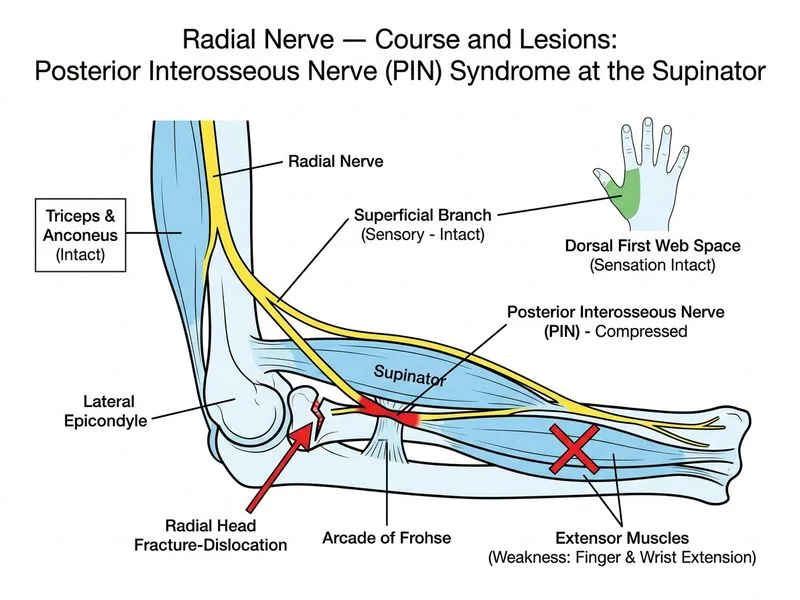
## Clinical Presentation Analysis **Key Point:** Radial head fractures and dislocations can entrap or stretch the **posterior interosseous nerve (PIN)** as it passes through the supinator muscle, causing a pure motor syndrome without sensory loss. ### Anatomical Vulnerability of PIN at Radial Head Level The radial nerve divides into its terminal branches **distal to the elbow**: - **Superficial radial nerve** → sensory (dorsal hand/thumb) - **Posterior interosseous nerve (PIN)** → motor (finger & wrist extension) The PIN is particularly vulnerable at the **supinator muscle level** (just distal to radial head) due to: 1. Passage through the supinator arcade (fibrous tunnel) 2. Proximity to radial head fractures and callus 3. Traction injury from radial head displacement ### Clinical Features of PIN Injury | Feature | PIN Injury | Radial Nerve Proper Injury | |---------|-----------|---------------------------| | **Wrist extension** | Weak (ECRB, ECRL innervated by PIN) | Weak | | **Finger extension** | Weak/absent (EDC, EIP innervated by PIN) | Weak | | **Thumb IP extension** | Weak (EPL innervated by PIN) | Weak | | **Thumb opposition** | Normal (median nerve) | Normal | | **Dorsal web space sensation** | Normal (superficial radial nerve intact) | Absent | | **Palm sensation** | Normal (median/ulnar) | Normal | **High-Yield:** PIN injury produces a **pure motor syndrome** — no sensory loss because the superficial sensory branch is spared. This is the key discriminator from proximal radial nerve injury. ### Anatomical Course of PIN ```mermaid flowchart TD A[Radial Nerve Proper]:::outcome --> B[Divides distal to elbow]:::action B --> C[Superficial Radial Nerve]:::action B --> D[Posterior Interosseous Nerve]:::action D --> E[Passes through Supinator Muscle]:::action E --> F[Vulnerable to radial head fractures]:::urgent F --> G[Motor loss: wrist + finger extension]:::outcome C --> H[Sensory: dorsal hand - SPARED in PIN injury]:::outcome ``` **Clinical Pearl:** The **supinator muscle acts as a tourniquet** around PIN; radial head fractures, swelling, or callus can compress the nerve within this fibrous tunnel, causing delayed or acute PIN palsy ("supinator syndrome"). ## Why Correct The patient has **motor loss** (weak finger and wrist extension) but **intact sensation** (normal dorsal web space sensation and palm sensation). This dissociation—motor loss without sensory loss—is pathognomonic for **PIN injury**, which is a pure motor nerve. The radial head fracture-dislocation is the anatomical mechanism: PIN passes through the supinator muscle just distal to the radial head and is vulnerable to compression or traction. [cite:Clinically Oriented Anatomy Moore 8e Ch 6] 
Sign up free to access AI-powered MCQ practice with detailed explanations and adaptive learning.