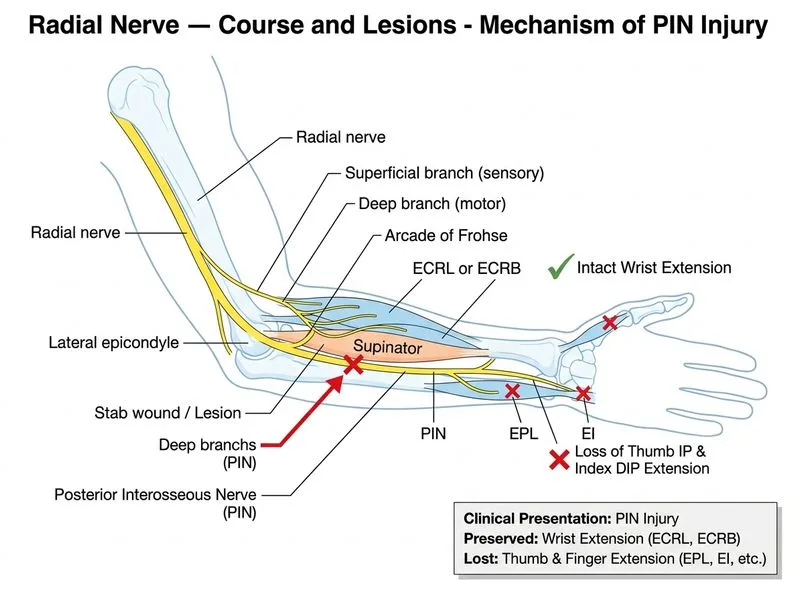
## Distinguishing PIN Injury from Proximal Radial Nerve Lesion ### Anatomical Basis The radial nerve divides into two branches in the proximal forearm: 1. **Superficial radial nerve** — sensory to dorsal hand 2. **Posterior interosseous nerve (PIN)** — motor to finger and thumb extensors The **wrist extensor muscles** (extensor carpi radialis longus and brevis) receive motor innervation from the **main radial nerve BEFORE it branches into PIN**. This is the critical anatomical distinction. ### Motor Innervation of Extensors | Muscle | Innervation | Spiral Groove Lesion | PIN Lesion | |--------|-------------|---------------------|------------| | **ECRL / ECRB (wrist extensors)** | Radial nerve (proximal) | **Paralyzed** | **Preserved** | | **EDC (finger MCP extensors)** | PIN | Paralyzed | Paralyzed | | **EIP (index DIP extensor)** | PIN | Paralyzed | Paralyzed | | **EPL (thumb IP extensor)** | PIN | Paralyzed | Paralyzed | | **EPB (thumb MCP extensor)** | PIN | Paralyzed | Paralyzed | **Key Point:** The **wrist extensor muscles branch off the radial nerve proximal to the PIN origin**. Therefore: - **Spiral groove lesion** → Loss of wrist extension + loss of finger/thumb extension - **PIN lesion** → Preserved wrist extension + loss of finger/thumb extension ### Clinical Presentation in This Case The patient has: - ✓ **Preserved wrist extension** ← This is the discriminator - ✗ Loss of thumb IP extension (EPL — PIN-innervated) - ✗ Loss of index DIP extension (EIP — PIN-innervated) - ✓ Intact finger MCP extension (EDC — PIN-innervated, but this is a motor loss, not preserved) **Clinical Pearl:** The **preservation of wrist extension in the presence of finger/thumb extension loss** is pathognomonic for a PIN lesion distal to the branching of the wrist extensor nerves. A proximal radial nerve lesion (spiral groove) would cause **both** wrist and finger extension loss. ### Mnemonic **"WRIST FIRST"** — Wrist extensors branch from radial nerve FIRST (proximal); PIN branches SECOND (distal). PIN injury spares wrist; proximal injury loses both. **High-Yield:** This is a classic NEET PG discriminator question. The single best feature distinguishing PIN from proximal radial nerve injury is **preserved wrist extension**. 
Sign up free to access AI-powered MCQ practice with detailed explanations and adaptive learning.