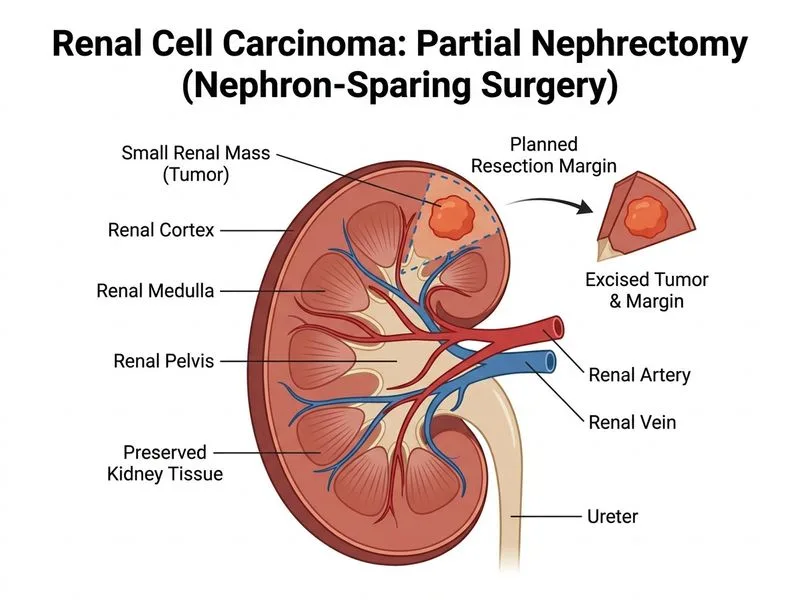
## Clinical Context This is a **small, localized renal mass (2.8 cm, Stage T1a)** with no metastatic disease. The patient is young, fit, and has normal renal function. The key decision is between **nephron-sparing surgery (partial nephrectomy), ablation, and surveillance**. ## Nephron-Sparing Strategy for Small RCC ```mermaid flowchart TD A[Renal mass <4 cm]:::outcome --> B{Renal function normal?}:::decision B -->|Yes, solitary kidney or CKD| C[Nephron-sparing mandatory]:::urgent B -->|Yes, bilateral kidneys| D{Patient age & fitness?}:::decision D -->|Young, fit| E[Partial nephrectomy preferred]:::action D -->|Elderly, unfit| F[Ablation or surveillance]:::action C --> G[Partial nephrectomy]:::action E --> G G --> H[Excellent oncologic outcomes]:::outcome ``` ## Why Partial Nephrectomy is Correct **Key Point:** For small RCC (<4 cm) in patients with **normal bilateral renal function and good performance status**, **partial nephrectomy (nephron-sparing surgery)** is now the preferred standard of care, offering equivalent oncologic outcomes to radical nephrectomy while preserving renal function. **High-Yield:** - Partial nephrectomy achieves 5-year cancer-free survival rates >95% for T1a tumours, equivalent to radical nephrectomy. - Preserves renal parenchyma → reduces long-term risk of chronic kidney disease and cardiovascular disease. - Recommended by NCCN, EAU, and AUA guidelines as the standard approach for T1a RCC in patients with normal contralateral kidney. - This patient is ideal: young, fit, normal renal function, no comorbidities. **Clinical Pearl:** Even in patients with a solitary kidney or baseline CKD, partial nephrectomy is **mandatory** to preserve renal function. In this patient with bilateral normal kidneys, it is **preferred** over radical nephrectomy. ## Comparison of Options for T1a RCC | Approach | Indication | Pros | Cons | Oncologic Outcome | |----------|-----------|------|------|-------------------| | **Partial nephrectomy** | T1a, normal bilateral kidneys, fit patient | Preserves renal function, excellent cancer control | Technically demanding, longer operative time | 5-yr DFS >95% | | Radical nephrectomy | T1a with solitary kidney contraindication or patient refusal | Simpler surgery, complete tumour removal | Unnecessary renal loss in fit patients | 5-yr DFS >95% | | Ablation (RFA/cryo) | T1a, elderly/unfit, poor surgical candidate | Minimally invasive, outpatient | Higher recurrence in large T1a, less data | 5-yr local control ~90% | | Surveillance | T1a, very elderly, limited life expectancy | Avoids surgery | Risk of delayed diagnosis, tumour growth | Variable, not recommended for fit patients | **Tip:** Ablation is reasonable for very elderly or medically unfit patients; surveillance is acceptable only for patients with <5-year life expectancy or those who refuse intervention. [cite:Robbins 10e Ch 20; NCCN Kidney Cancer Guidelines 2023] 
Sign up free to access AI-powered MCQ practice with detailed explanations and adaptive learning.