Which of the following is the primary biochemical defect in Respiratory Distress Syndrome (RDS) of the newborn?
A. Increased pulmonary vascular resistance
B. Excessive production of meconium
C. Impaired diaphragmatic muscle function
D. Deficiency of pulmonary surfactant
Explanation
Pathophysiology of RDS
Key Point
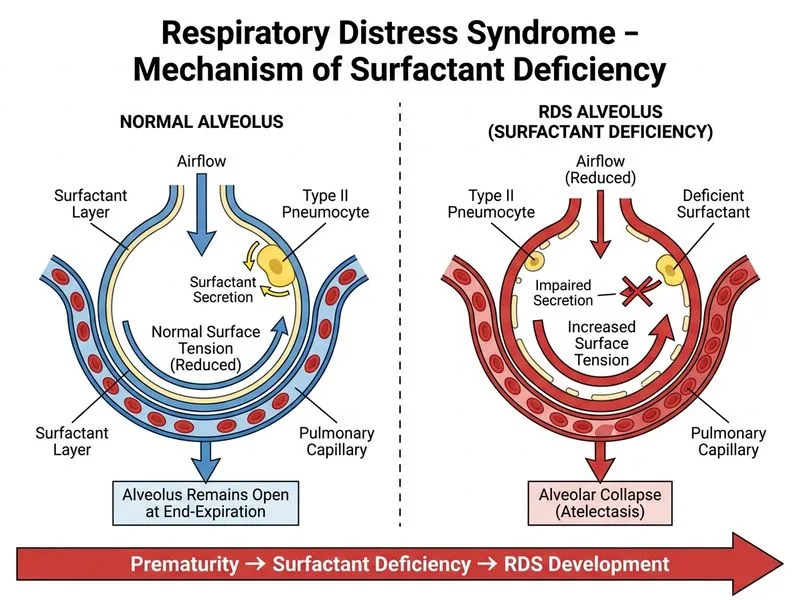
Respiratory Distress Syndrome (RDS), also known as Hyaline Membrane Disease (HMD), is fundamentally caused by deficiency of pulmonary surfactant in the newborn lungs.
Surfactant Function and Deficiency
Surfactant is a lipoprotein complex synthesized by type II alveolar cells. It serves two critical functions:
1.
Reduces surface tension at the air-liquid interface in alveoli
2.
Prevents alveolar collapse during expiration (maintains functional residual capacity)
In RDS, insufficient surfactant leads to:
High surface tension in alveoli
Alveolar collapse at end-expiration (atelectasis)
Increased work of breathing
Ventilation-perfusion mismatch
Hypoxemia and hypercapnia
Surfactant Composition
Table
Component
Percentage
Function
Lipids (DPPC, PG, PI)
90%
Surface tension reduction
Proteins (SP-A, SP-B, SP-C, SP-D)
10%
Immune defense, spreading
High-YieldNEET PG
Dipalmitoylphosphatidylcholine (DPPC) is the most important surface-active lipid in surfactant.
Risk Factors for RDS
Prematurity (< 34 weeks gestation) — most important risk factor
Maternal diabetes
Cesarean delivery without labor
Perinatal asphyxia
Intrauterine growth restriction
Clinical Pearl
Surfactant production begins around 24–25 weeks gestation but reaches adequate levels only after 34–35 weeks. This is why prematurity is the strongest predictor of RDS.
Mnemonic
SURFACTANT = Surface tension reduction, Under-production in prematurity, Resulatory distress, Functional residual capacity loss, Alveolar collapse, Critical in < 34 weeks, Type II cells produce it, Acute respiratory failure, Need for mechanical support, Treatment with exogenous surfactant.
Loading illustration…
Practice similar questions
Sign up free to access AI-powered MCQ practice with detailed explanations and adaptive learning.