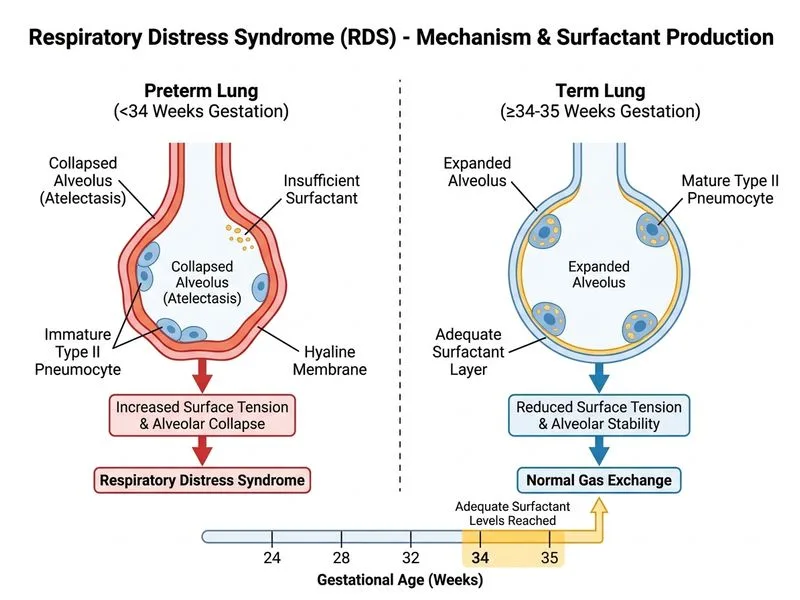
## Surfactant Maturation Timeline **Key Point:** Surfactant production reaches adequate levels at approximately 34–35 weeks gestation, after which the risk of RDS decreases significantly. ### Developmental Milestones in Fetal Lung Maturation | Gestational Age | Surfactant Status | RDS Risk | Clinical Significance | | --- | --- | --- | --- | | < 24 weeks | Absent or minimal | Very high (>90%) | Extreme prematurity; poor prognosis | | 24–28 weeks | Trace amounts | Very high (60–80%) | Severe RDS likely; requires intensive support | | 28–32 weeks | Low levels | High (40–60%) | Moderate RDS risk; antenatal steroids indicated | | 32–34 weeks | Increasing levels | Moderate (20–40%) | RDS possible; close monitoring | | **34–35 weeks** | **Adequate levels** | **Low (< 10%)** | **Threshold for relative safety** | | > 35 weeks | Mature levels | Very low (< 5%) | RDS unlikely unless other complications | **High-Yield:** The **34–35 week threshold** is the critical gestational age used in clinical practice to define "late preterm" and to guide decisions on antenatal corticosteroid administration and delivery timing. ### Fetal Lung Maturity Testing When delivery is anticipated before 34–35 weeks, fetal lung maturity can be assessed via: 1. **Lecithin-to-Sphingomyelin (L:S) ratio** in amniotic fluid - L:S ratio > 2.0 = mature lungs (low RDS risk) - L:S ratio < 1.5 = immature lungs (high RDS risk) 2. **Phosphatidylglycerol (PG) in amniotic fluid** - Presence of PG = mature lungs - Absence = immature lungs 3. **Lamellar body count (LBC)** - LBC > 50,000/μL = mature lungs **Clinical Pearl:** Maternal diabetes delays surfactant maturation by 2–4 weeks, so a higher L:S ratio (> 3.0) or documented PG presence is required before elective delivery in diabetic mothers. **Mnemonic:** **34-35 SAFE** = **34–35 weeks** is the gestational age when surfactant is **A**dequate, **F**etal lung **E**xchange is mature. 
Sign up free to access AI-powered MCQ practice with detailed explanations and adaptive learning.