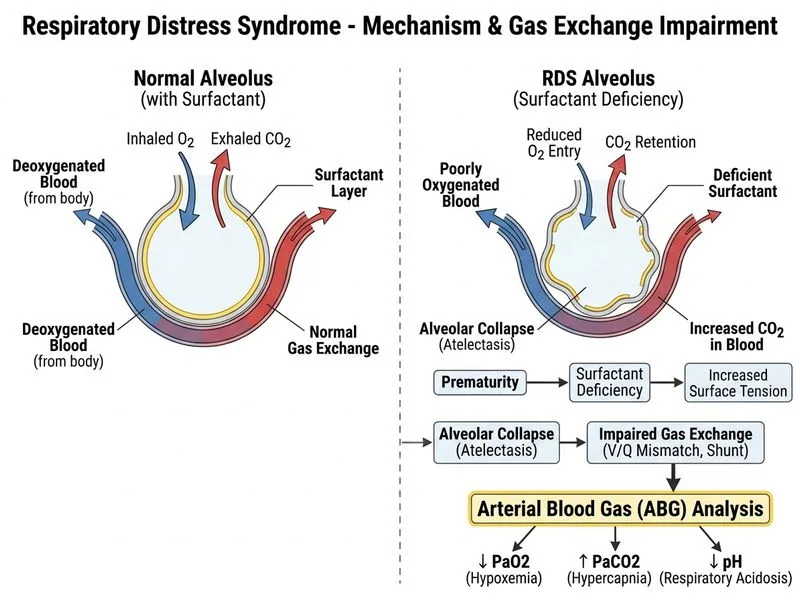
## Severity Assessment and Management Guidance in RDS **Key Point:** Arterial blood gas (ABG) analysis is the most appropriate investigation to assess the severity of gas exchange impairment and guide ventilator settings in a neonate with confirmed RDS. ### Role of ABG in RDS Management **High-Yield:** ABG provides real-time assessment of: - **Oxygenation** (PaO₂, SaO₂) — guides FiO₂ titration - **Ventilation** (PaCO₂) — guides tidal volume and rate - **Acid-base status** (pH, HCO₃⁻) — identifies metabolic vs. respiratory acidosis ### Interpretation of ABG Patterns in RDS | Phase | PaO₂ | PaCO₂ | pH | Clinical Significance | |-------|------|-------|-----|----------------------| | **Early RDS** | ↓ (hypoxemia) | ↑ (hypercapnia) | ↓ (respiratory acidosis) | Severe ventilation-perfusion mismatch | | **After surfactant** | ↑ (improves) | ↓ (improves) | ↑ (toward normal) | Response to therapy | | **Overventilation risk** | ↑↑ | ↓↓ | ↑ (alkalosis) | Risk of barotrauma, volutrauma | | **Inadequate ventilation** | ↓ | ↑↑ | ↓↓ (severe acidosis) | Increase ventilator support | **Clinical Pearl:** Serial ABG measurements (every 15–30 minutes initially, then every 4–6 hours) are essential to titrate oxygen and ventilator parameters. Target PaO₂ 50–80 mmHg and PaCO₂ 45–55 mmHg in RDS to avoid hyperoxia and hypocapnia-related complications. ### Decision Tree for ABG-Guided Management ```mermaid flowchart TD A[RDS confirmed on CXR + surfactant given]:::outcome --> B[Obtain ABG]:::action B --> C{Interpret results}:::decision C -->|PaO₂ < 50| D[Increase FiO₂]:::action C -->|PaO₂ > 80| E[Decrease FiO₂]:::action C -->|PaCO₂ > 55| F[Increase ventilation]:::action C -->|PaCO₂ < 40| G[Decrease ventilation]:::action C -->|pH < 7.20| H[Support ventilation + consider buffer]:::action D --> I[Recheck ABG in 15-30 min]:::action E --> I F --> I G --> I H --> I ``` **Mnemonic:** **ABCDE of RDS Management** — **A**rterial blood gas, **B**ronchial hygiene, **C**ontinuous monitoring, **D**rug therapy (surfactant), **E**xchange transfusion (if severe). ### Why ABG is Superior in This Context **Key Point:** Once RDS is **confirmed** by CXR, the next step is **severity assessment and therapeutic guidance**, not further imaging. ABG provides the physiological data needed to: 1. Quantify hypoxemia and hypercapnia 2. Guide oxygen and ventilator titration 3. Detect complications (severe acidosis, hyperoxia) 4. Monitor response to surfactant therapy 
Sign up free to access AI-powered MCQ practice with detailed explanations and adaptive learning.