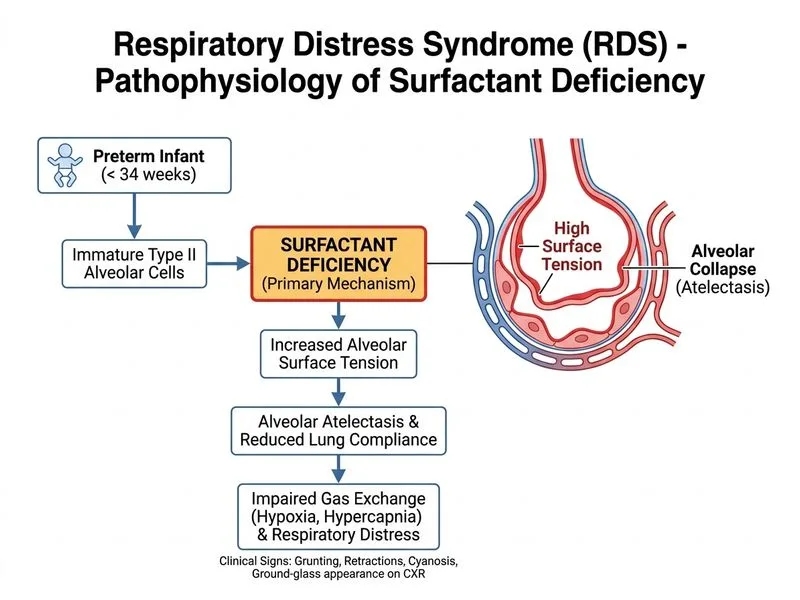
A 28-week preterm infant develops respiratory distress within 2 hours of birth. Chest X-ray shows a ground-glass appearance with air bronchograms. Which single feature best distinguishes Respiratory Distress Syndrome (RDS) from Transient Tachypnea of the Newborn (TTN)?
A. Requirement for supplemental oxygen
B. Presence of air bronchograms on chest X-ray
C. Tachypnea resolving within 24–48 hours
D. Surfactant deficiency as the primary pathophysiologic mechanism
Explanation
Distinguishing RDS from TTN
Pathophysiologic Basis
Key Point
Surfactant deficiency is the PRIMARY and DEFINING pathophysiologic mechanism of RDS, whereas TTN is caused by delayed clearance of fetal lung fluid despite normal surfactant production.
Both conditions present with respiratory distress and tachypnea in the neonatal period, and both may show ground-glass opacification on chest X-ray. However, the underlying mechanism differs fundamentally:
Table
Feature
RDS (Hyaline Membrane Disease)
TTN
Primary cause
Surfactant deficiency
Delayed fetal lung fluid clearance
Surfactant status
Absent or severely reduced
Normal
Gestational age risk
<34 weeks (highest risk)
Term or late preterm; maternal diabetes
Onset
Within 1–2 hours of birth
Within 1–2 hours; may persist 24–72 hrs
Air bronchograms
Present (classic)
May be present
Oxygen requirement
Often significant; may need ventilation
Usually mild; self-limited
Resolution timeline
Days to weeks (with surfactant therapy)
24–72 hours (self-resolving)
Why Surfactant Deficiency Is the Discriminator
High-YieldNEET PG
RDS is defined by surfactant deficiency. This is the mechanistic distinction that drives all downstream clinical and radiologic differences:
TTN has normal surfactant; the problem is mechanical (fluid retention), not biochemical.
Clinical Pearl
Antenatal corticosteroids (betamethasone, dexamethasone) accelerate fetal lung maturity and surfactant synthesis, reducing RDS incidence in preterm infants. TTN is NOT prevented by steroids because the pathology is not surfactant deficiency.
Why Other Options Are Not Discriminators
Air bronchograms: Both RDS and TTN can show air bronchograms; this is not specific to RDS.
Tachypnea resolving in 24–48 hours: TTN typically resolves in 24–72 hours, but RDS may also improve rapidly after surfactant therapy, making this timeline overlap.
Requirement for supplemental oxygen: Both conditions may require supplemental oxygen; severity varies and does not reliably distinguish them.
Mnemonic
SURF = Surfactant Under Reduced Function (RDS); TTN = Transient Tachypnea Normal surfactant.
Loading illustration…
Practice similar questions
Sign up free to access AI-powered MCQ practice with detailed explanations and adaptive learning.