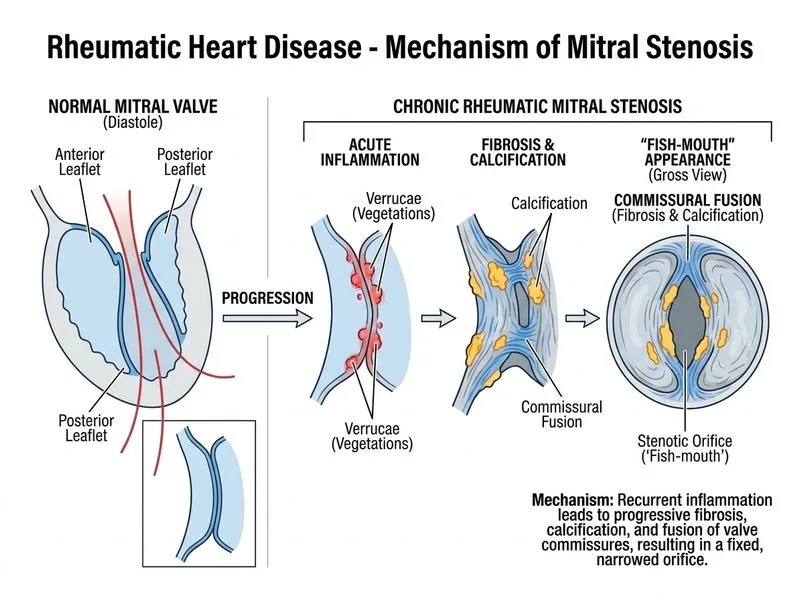
## Chronic Rheumatic Mitral Stenosis: Gross and Microscopic Pathology ### The 'Fish-Mouth' Appearance **Key Point:** The characteristic **'fish-mouth'** or **'buttonhole'** stenosis results from **commissural fusion**—the two commissures (lateral and medial) of the mitral valve are fused together by fibrosis and calcification, leaving only a narrow central opening that resembles a fish mouth when viewed from above. ### Histological Basis of Commissural Fusion **High-Yield:** Repeated episodes of acute rheumatic carditis cause: 1. **Fibrosis** of the valve leaflets and commissural tissue 2. **Calcification** (dystrophic, not metastatic) within fibrotic tissue 3. **Collagen deposition** and scarring 4. **Result:** Commissures become immobile and fused, progressively narrowing the orifice ### Associated Chronic Changes **Clinical Pearl:** Chronic rheumatic mitral stenosis also features: - **Leaflet thickening** due to fibrosis - **Chordal shortening** (not elongation) and fusion - **Calcification** of leaflets and commissures ("hockey stick" appearance on echocardiography) - **Atrial dilation** and fibrillation (due to increased LA pressure) ### Distinction from Other Pathologies | Feature | Rheumatic MS | Degenerative MS | Congenital MS | |---------|--------------|-----------------|---------------| | Commissural fusion | Yes (fibrosis) | No | Rare | | Leaflet thickening | Yes | Yes (calcific) | No | | Chordal involvement | Yes (shortening) | No | No | | Age of onset | Young adult | Elderly | Infancy/childhood | **Mnemonic:** **FCC** — **F**ibrosis, **C**alcification, **C**ommissural fusion = Fish-mouth stenosis 
Sign up free to access AI-powered MCQ practice with detailed explanations and adaptive learning.