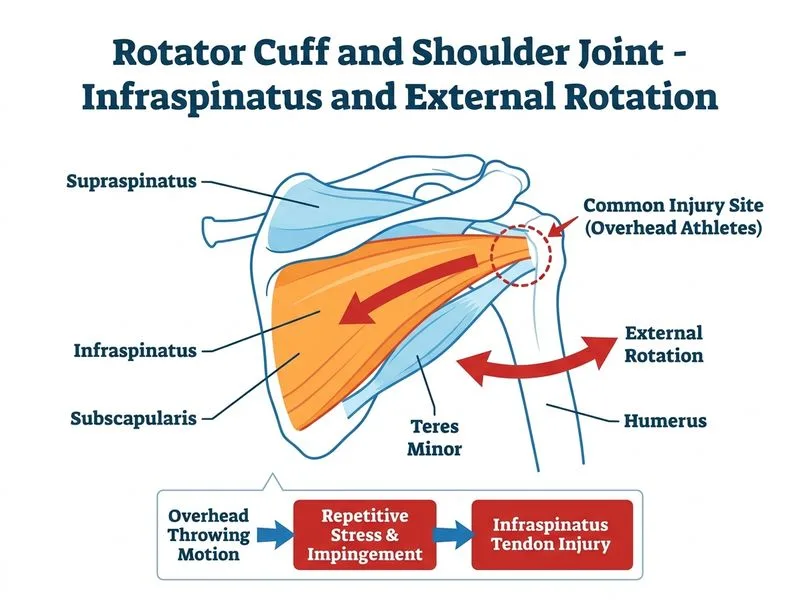
## Infraspinatus: Primary External Rotator **Key Point:** The infraspinatus is the primary external rotator of the shoulder and is the most commonly injured rotator cuff muscle in overhead throwing athletes due to repetitive eccentric loading during the late cocking phase of throwing. ### Anatomical Origin and Insertion - **Origin:** Infraspinous fossa of the scapula - **Insertion:** Middle facet of the greater tubercle of the humerus - **Innervation:** Suprascapular nerve (C5, C6) - **Action:** External rotation of the shoulder (primary), horizontal abduction (secondary) ### Rotator Cuff Muscle Comparison | Muscle | Primary Action | Secondary Action | Common Injury Pattern | |--------|---|---|---| | Supraspinatus | Abduction (0–15°) | Initiates movement | Impingement, degenerative tears | | Infraspinatus | External rotation | Horizontal abduction | Throwing athletes, eccentric overload | | Subscapularis | Internal rotation | Adduction | Less common, associated with anterior instability | | Teres minor | External rotation | Horizontal abduction | Often tears with infraspinatus | **High-Yield:** The infraspinatus and teres minor work together as external rotators, but infraspinatus is the dominant force and most frequently affected in overhead athletes. **Clinical Pearl:** Infraspinatus tears present with weakness on external rotation (positive lag sign or external rotation lag sign) and are best visualized on MRI in the coronal and axial planes. 
Sign up free to access AI-powered MCQ practice with detailed explanations and adaptive learning.