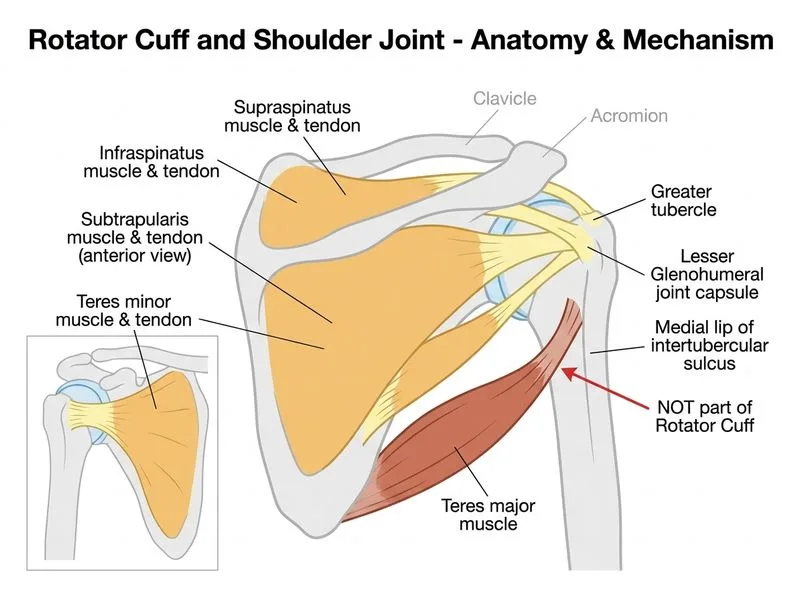
## Rotator Cuff Composition: The Four Muscles **Key Point:** The rotator cuff consists of exactly four muscles: supraspinatus, infraspinatus, teres minor, and subscapularis. Teres major is NOT part of the rotator cuff—it is a separate muscle of the shoulder girdle. **Mnemonic:** **SITS** = Supraspinatus, Infraspinatus, Teres minor, Subscapularis (the four rotator cuff muscles) ### The Four Rotator Cuff Muscles | Muscle | Origin | Insertion | Action | Innervation | |--------|--------|-----------|--------|-------------| | Supraspinatus | Supraspinous fossa | Superior facet of greater tubercle | Abduction (0–15°) | Suprascapular nerve | | Infraspinatus | Infraspinous fossa | Middle facet of greater tubercle | External rotation | Suprascapular nerve | | Teres minor | Lateral border of scapula | Inferior facet of greater tubercle | External rotation | Axillary nerve | | Subscapularis | Subscapular fossa | Lesser tubercle | Internal rotation | Upper/lower subscapular nerves | ### Why Teres Major Is NOT in the Rotator Cuff **High-Yield:** Teres major is a separate muscle that: - **Origin:** Inferior angle and lower lateral border of scapula - **Insertion:** Medial lip of intertubercular groove of humerus - **Action:** Internal rotation, adduction, extension (assists latissimus dorsi) - **Innervation:** Lower subscapular nerve - **Function:** Part of the "lat-teres major" complex for powerful internal rotation and shoulder extension, NOT rotator cuff stabilization **Clinical Pearl:** Teres major is sometimes called a "helper" muscle to the rotator cuff but is NOT functionally or anatomically part of it. The rotator cuff's primary role is dynamic stabilization of the glenohumeral joint; teres major is a mover muscle. 
Sign up free to access AI-powered MCQ practice with detailed explanations and adaptive learning.