Rotator Cuff and Shoulder Joint MCQ — NEET PG Practice Question | NEETPGAI
Rotator Cuff and Shoulder Joint
medium
bone Anatomy
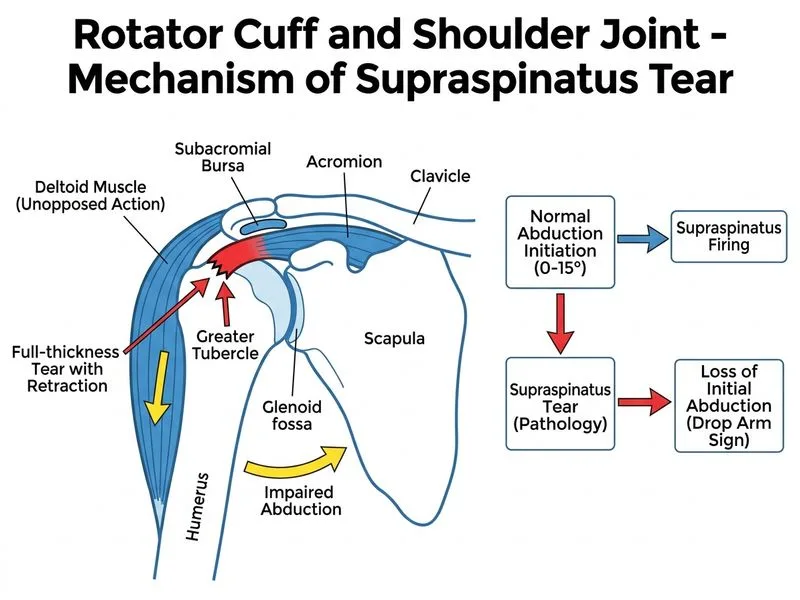
A 58-year-old male carpenter from Delhi presents with a 3-month history of progressive right shoulder pain and weakness. He reports difficulty lifting objects overhead and pain when reaching behind his back. On examination, he has positive "drop arm" sign and "lag sign." Passive range of motion is preserved. MRI shows a full-thickness tear of the supraspinatus tendon with mild retraction. What is the most likely anatomical consequence of this injury?
A. Loss of internal rotation due to teres minor paralysis
B. Loss of shoulder adduction due to subscapularis dysfunction
C. Loss of shoulder abduction in the first 15 degrees due to unopposed action of deltoid
D. Loss of external rotation at the shoulder due to infraspinatus denervation
Explanation
Supraspinatus Tear: Anatomical and Clinical Consequences
Anatomy of the Supraspinatus
Key Point
The supraspinatus is the primary initiator of shoulder abduction, particularly in the first 15 degrees (0–15°). After 15°, the deltoid takes over as the main abductor.
Mechanism of the Drop Arm Sign
When the supraspinatus is torn:
1.
The patient cannot initiate abduction smoothly
2.
The deltoid alone cannot overcome inertia and gravity in the initial arc
3.
The arm "drops" when the patient attempts to lower it in a controlled manner from 90° abduction
4.
This is a highly specific sign for full-thickness supraspinatus tear
Why Passive ROM Is Preserved
Clinical Pearl
Preservation of passive range of motion distinguishes a rotator cuff tear from a frozen shoulder (adhesive capsulitis). The tear does not restrict movement; it prevents active initiation.
Role of Each Rotator Cuff Muscle
Table
Muscle
Primary Action
Nerve
Loss of Function
Supraspinatus
Abduction 0–15°
Suprascapular
Drop arm sign, weak abduction
Infraspinatus
External rotation
Suprascapular
Lag sign (external rotation lag)
Teres minor
External rotation
Axillary
Lag sign
Subscapularis
Internal rotation, adduction
Upper/lower subscapular
Loss of internal rotation, lift-off sign
The Drop Arm Sign and Lag Sign
High-YieldNEET PG
Both signs are present in this case:
Drop arm sign = inability to lower arm in a controlled manner from 90° abduction (supraspinatus)
Lag sign = external rotation lag (infraspinatus/teres minor involvement)
This suggests a large tear involving supraspinatus ± infraspinatus.
Why the First 15 Degrees Matter
The supraspinatus acts as a "starter motor" for abduction. After 15°, the deltoid (innervated by axillary nerve) becomes the dominant abductor. Loss of supraspinatus function means:
Patient cannot initiate abduction from rest
Gravity and inertia cannot be overcome in the critical 0–15° range
Full-thickness tear with mild retraction confirms complete disruption of the tendon. The absence of severe retraction suggests the tear is not chronic (which would show significant muscle atrophy and retraction).
Loading illustration…
Practice similar questions
Sign up free to access AI-powered MCQ practice with detailed explanations and adaptive learning.