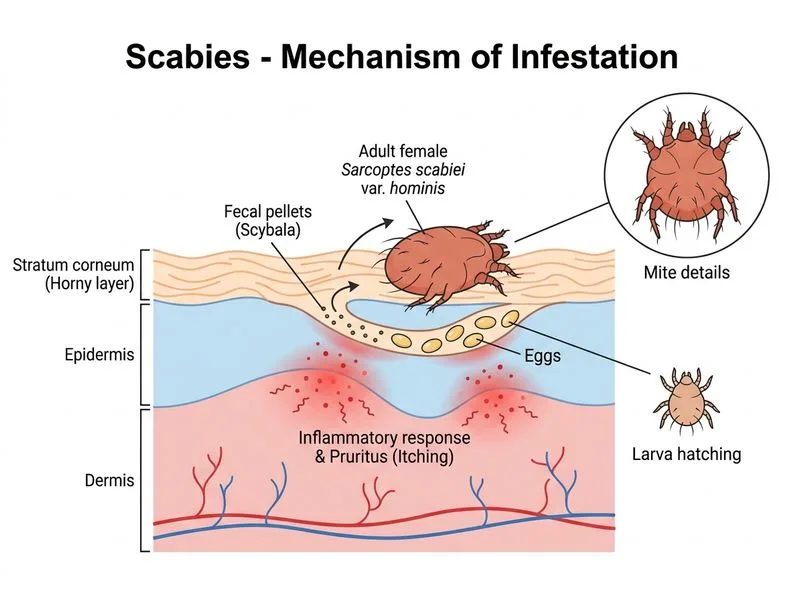
## Causative Agent of Scabies **Key Point:** Sarcoptes scabiei var. hominis is the obligate human parasite responsible for scabies infestation. ### Organism Characteristics | Feature | Details | | --- | --- | | **Taxonomic classification** | Acari family, Sarcoptidae | | **Size** | 0.3–0.4 mm (visible only under microscope) | | **Morphology** | Oval body with 4 pairs of legs; anterior pair have suckers | | **Host specificity** | Strictly human; var. hominis does not infect animals | | **Lifecycle** | 10–14 days from egg to adult | ### Life Cycle & Pathogenesis 1. **Penetration:** Female mite burrows into stratum corneum 2. **Egg laying:** Deposits 2–3 eggs per day in burrow 3. **Larval development:** Larvae emerge, migrate to skin surface 4. **Mating:** Adults mate in follicles; cycle repeats 5. **Immune response:** Sensitization occurs after 4–6 weeks (explains delayed pruritus in primary infestation) **High-Yield:** The burrow is pathognomonic — a linear or S-shaped tunnel in the stratum corneum, typically on wrists, finger webs, axillae, and genitalia. **Clinical Pearl:** Norwegian (crusted) scabies occurs in immunocompromised patients and contains thousands of mites; highly contagious and often misdiagnosed as psoriasis or dermatitis. ### Why Other Mites Are Wrong - **Demodex folliculorum:** Commensal mite; causes rosacea and perioral dermatitis, not scabies - **Psoroptes ovis:** Veterinary mite infesting sheep and cattle; does not cause human disease - **Cheyletiella blakei:** Cat mite; causes transient pruritic papules in humans but not true scabies 
Sign up free to access AI-powered MCQ practice with detailed explanations and adaptive learning.