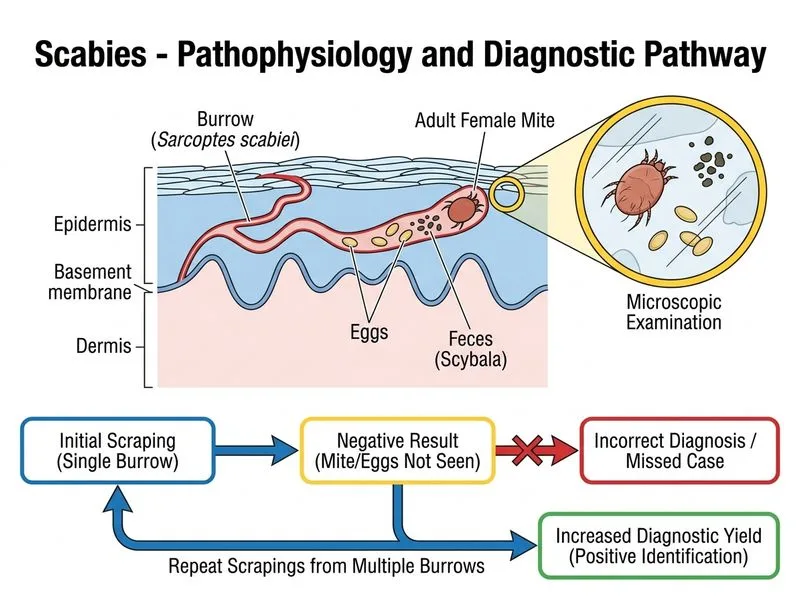
A 28-year-old man with a 3-week history of intensely pruritic papules and burrows on the hands, wrists, and genitalia is suspected to have scabies. Microscopic examination of scrapings from two burrows is negative. The patient has no systemic symptoms, and family members are asymptomatic. What is the most appropriate next investigation?
A. Order a complete blood count and serum IgE level
B. Perform a skin biopsy for histopathological confirmation
C. Repeat scrapings from multiple burrows and examine under microscopy
D. Perform fungal culture and KOH mount to rule out dermatophytosis
Explanation
Approach to Negative Microscopy in Suspected Scabies
Key Point
A single negative scraping does not exclude scabies. Repeat scrapings from multiple, carefully selected burrows should be performed before abandoning the diagnosis, as sensitivity of microscopy is only 60–80%.
Why Repeat Scrapings?
High-YieldNEET PG
Sensitivity of scrapings varies with:
Site selection — Burrows yield higher positivity than papules; interdigital spaces, wrists, and genitalia are optimal
Mite burden — Early infestation or partially treated cases may have fewer organisms
Technique — Inadequate scraping or failure to include burrow material reduces yield
Number of attempts — Repeating from multiple sites increases cumulative sensitivity to >90%
Diagnostic Algorithm for Negative Microscopy
Loading diagram...
Technique for Optimal Yield
1.
Select unscratched burrows — Scratched lesions have fewer mites
2.
Apply mineral oil or 10% KOH — Softens the burrow and aids mite extraction
3.
Scrape firmly — Ensure material from the burrow itself, not just surface
4.
Examine entire slide — Use low power (10×) then high power (40×) systematically
5.
Repeat from multiple sites — Increases sensitivity significantly
Clinical Pearl
In the setting of high clinical suspicion (typical distribution, family involvement, nocturnal pruritus, burrows on exam), a negative single scraping should prompt repeat attempts rather than diagnostic abandonment. Many cases are confirmed on the second or third attempt.
Why Not the Other Options?
Table
Option
Why Inappropriate
Skin biopsy
Invasive and unnecessary as first repeat step; reserved for atypical presentations or after multiple negative scrapings
CBC and IgE
Non-specific; may show eosinophilia in scabies but does not confirm diagnosis
Fungal culture
Scabies is a mite infestation, not fungal; this test is irrelevant and delays diagnosis
Mnemonic
SCRAPE — Select burrows, Clean with oil, Rub firmly, Apply to slide, Power microscopy, Examine thoroughly.
Irvine's Dermatology 10e Ch 31
Loading illustration…
Practice similar questions
Sign up free to access AI-powered MCQ practice with detailed explanations and adaptive learning.