
NEETPGAI
SubjectsBlogPricing
Log inStart Free
NEETPGAI

AI-powered NEET PG preparation platform. Master all 19 subjects with adaptive MCQs, AI tutoring, and spaced repetition.

Product

  • Subjects
  • Pricing
  • Blog

Features

  • Adaptive MCQ Practice
  • AI Tutor
  • Mock Tests
  • Spaced Repetition

Resources

  • Blog
  • Study Guides
  • NEET PG Updates
  • Help Center

Legal

  • Privacy Policy
  • Terms of Service

Stay updated

© 2026 NEETPGAI. All rights reserved.
Subjects/Surgery/Splenic Trauma Management
Splenic Trauma Management
medium
scissors Surgery

A 32-year-old man presents to the emergency department 2 hours after a motor vehicle collision with blunt abdominal trauma. On examination, he is haemodynamically stable with a blood pressure of 130/85 mmHg and heart rate of 88/min. Abdominal examination reveals tenderness in the left upper quadrant with guarding. FAST scan shows free fluid in the perisplenic region. Contrast-enhanced CT abdomen confirms a splenic laceration (Grade III). What is the most appropriate management?

A. Immediate splenectomy
B. Non-operative management with ICU monitoring, bed rest, and serial clinical examination
C. Splenic artery embolization followed by observation
D. Diagnostic laparoscopy to assess splenic viability

Explanation

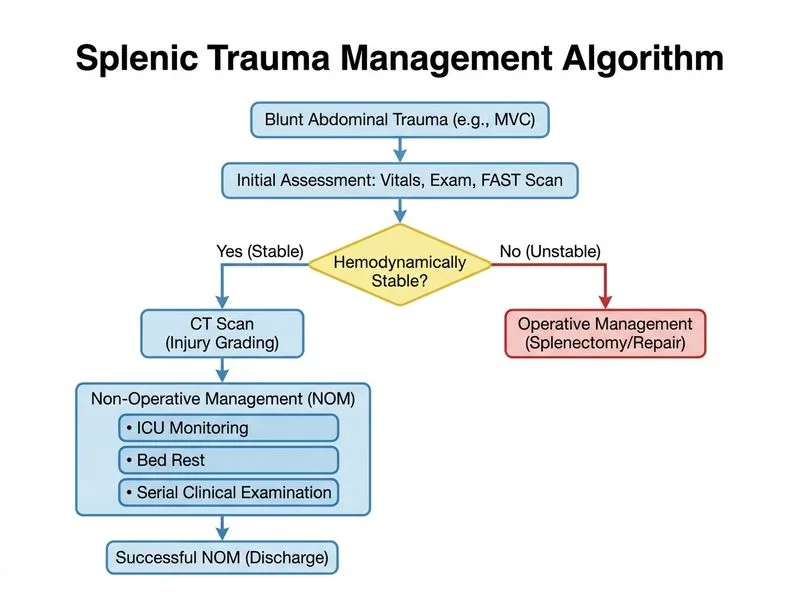
## Splenic Trauma Management Strategy In a **haemodynamically stable patient** with blunt splenic injury, **non-operative management (NOM)** is the standard of care, even for Grade III lacerations. ### Key Principles: - **Haemodynamic stability** is the primary criterion for NOM eligibility - Grade III splenic injuries can be managed conservatively if the patient remains stable - Management includes: - ICU or high-dependency unit admission - Bed rest (initially strict, then progressive mobilization) - Serial clinical examination (abdominal tenderness, peritoneal signs) - Serial haemoglobin checks - Immediate surgical backup availability - Blood products on standby ### Success Rate: - NOM succeeds in >90% of haemodynamically stable patients with blunt splenic injury, regardless of grade - Splenectomy is reserved for haemodynamic instability despite resuscitation or peritoneal signs suggesting ongoing bleeding **Clinical Pearl:** Splenic artery embolization (SAE) is increasingly used as an adjunct in select cases (high-grade injuries with pseudoaneurysm on CT), but observation alone is first-line for uncomplicated Grade III injury in stable patients.
Practice similar questions

Sign up free to access AI-powered MCQ practice with detailed explanations and adaptive learning.

Start Practicing Free More Surgery Questions