TCA Cycle MCQ — NEET PG Practice Question | NEETPGAI
TCA Cycle
easy
flask-conical Biochemistry
Which intermediate of the TCA cycle is regenerated at the end of each cycle, and how many carbon atoms does it contain?
A. Oxaloacetate; 4 carbons
B. α-Ketoglutarate; 5 carbons
C. Citrate; 6 carbons
D. Succinyl-CoA; 4 carbons
Explanation
TCA Cycle: The Regenerated Intermediate
Oxaloacetate as the Cycle Catalyst
Key Point
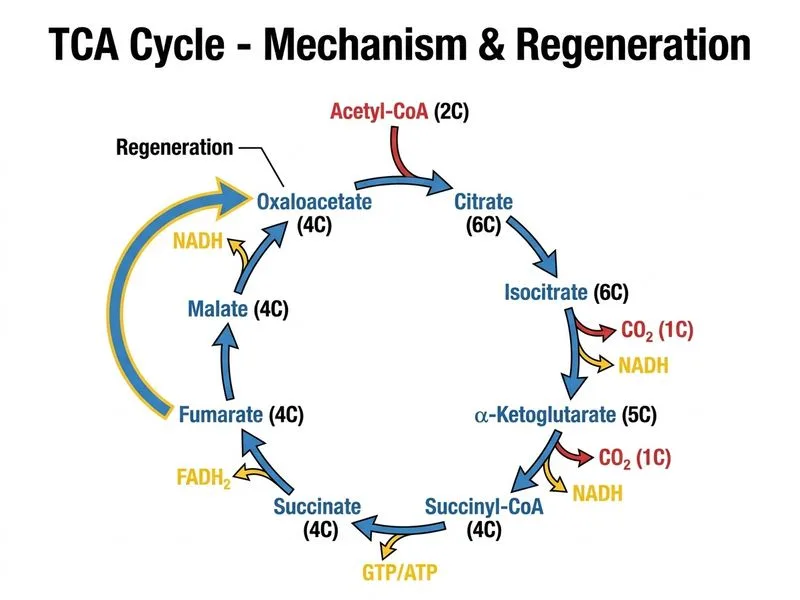
Oxaloacetate (OAA) is the 4-carbon intermediate that is regenerated at the end of each TCA cycle turn. It is not consumed; it acts catalytically to condense with acetyl-CoA and drive the cycle forward.
Exit: Malate (4C) → Oxaloacetate (4C) via malate dehydrogenase
Net result: One molecule of oxaloacetate is regenerated for every turn of the cycle
Why This Matters
Clinical Pearl
Because oxaloacetate is regenerated, the TCA cycle is catalytic, not stoichiometric. A small amount of oxaloacetate can oxidize unlimited acetyl-CoA. This is why oxaloacetate depletion (e.g., during prolonged fasting or starvation) impairs the cycle — gluconeogenesis consumes oxaloacetate, and it must be replenished via anaplerotic reactions (pyruvate carboxylase).
Carbon Tracking Through the Cycle
Loading diagram...
Mnemonic
"CAN'T REMEMBER KREBS?" — Citrate, Aconitase, isocitrate, α-Ketoglutarate, succinyl-CoA, Succinate, Fumarate, Malate → back to Oxaloacetate (the 4C regenerated intermediate).