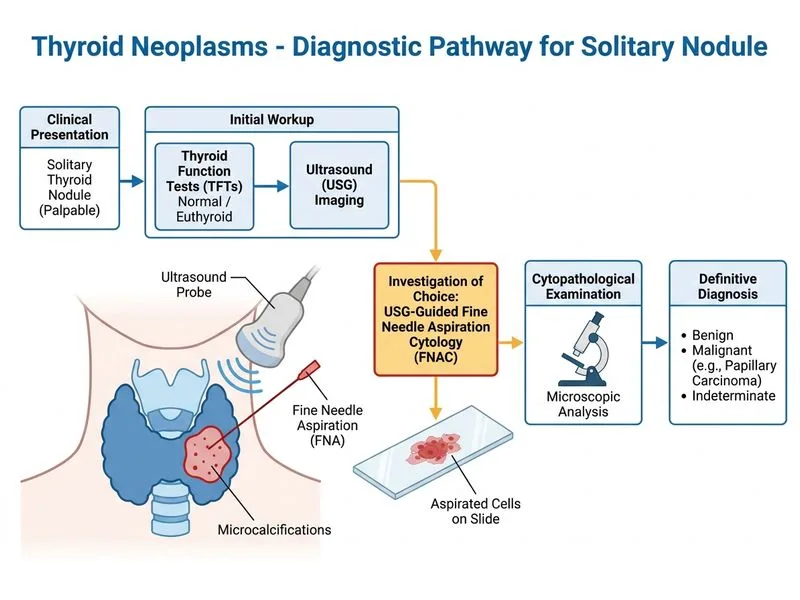
## Investigation of Choice for Thyroid Nodule Evaluation **Key Point:** Fine needle aspiration cytology (FNAC) under ultrasound guidance is the gold standard initial investigation for thyroid nodules with suspicious features. ### Why FNAC is the Investigation of Choice 1. **High sensitivity and specificity** — FNAC has >95% accuracy when performed under ultrasound guidance and interpreted using the Bethesda System for Reporting Thyroid Cytopathology. 2. **Minimal invasiveness** — needle gauge 23–27 G, outpatient procedure with minimal morbidity. 3. **Cost-effective** — inexpensive, reproducible, and widely available. 4. **Guides management** — results directly inform whether surgery is indicated (malignancy/suspicious for malignancy) or conservative follow-up (benign, atypia of undetermined significance). ### Bethesda Classification for Thyroid Cytology | Category | Risk of Malignancy | Recommended Action | |---|---|---| | Non-diagnostic/Unsatisfactory | 1–4% | Repeat FNAC or ultrasound follow-up | | Benign | 0–3% | Clinical and ultrasound follow-up | | Atypia of Undetermined Significance (AUS) | 10–40% | Repeat FNAC or molecular testing | | Follicular Neoplasm | 25–40% | Thyroidectomy or molecular testing | | Suspicious for Malignancy | 50–75% | Thyroidectomy | | Malignant | 97–99% | Thyroidectomy | **Clinical Pearl:** The combination of ultrasound findings (hypoechoic, irregular margins, microcalcifications) and FNAC results provides the highest diagnostic accuracy for distinguishing benign from malignant thyroid lesions. **High-Yield:** FNAC is preferred over core needle biopsy as the first-line tissue diagnosis because it has equivalent diagnostic accuracy, lower cost, fewer complications, and is faster to perform and report. ### Why Other Investigations Are Not First-Line - **Core needle biopsy:** Reserved for non-diagnostic FNAC or when FNAC results are equivocal (e.g., AUS category). Provides better histologic architecture but is more invasive and expensive. - **Thyroid scintigraphy:** Assesses functional status (hot vs. cold nodules) but has poor sensitivity for malignancy; cold nodules have only ~15% malignancy risk. Not used for diagnostic confirmation. - **CT neck:** Useful for staging and assessing extrathyroidal extension in known malignancy, not for initial diagnosis of a nodule. [cite:Robbins 10e Ch 24] 
Sign up free to access AI-powered MCQ practice with detailed explanations and adaptive learning.