
## Clinical Diagnosis The clinical presentation is consistent with **papillary thyroid carcinoma (PTC)** with cervical lymph node metastases (N1 disease). The key features are: - Firm, fixed nodule with microcalcifications - Vascular invasion on FNAC - Ipsilateral cervical lymphadenopathy - Dysphagia/dyspnea suggesting local invasion ## Surgical Indications for Thyroid Cancer | Feature | Hemithyroidectomy | Total Thyroidectomy | |---------|-------------------|---------------------| | Tumor size | ≤1 cm, no extrathyroidal extension | >1 cm OR extrathyroidal extension | | Lymph node involvement | N0 | N1 (any) | | Bilateral disease | No | Yes | | Distant metastases | M0 | Any | **Key Point:** This patient has a 4 cm tumor with N1 disease (ipsilateral lymphadenopathy), meeting criteria for total thyroidectomy per American Thyroid Association (ATA) guidelines. ## Lymph Node Dissection Strategy **High-Yield:** Central compartment neck dissection (CND) is **mandatory** when: 1. Clinically evident lymph node metastases (cN1) — as in this case 2. Tumor >4 cm 3. Extrathyroidal extension Since this patient has **cN1a disease** (ipsilateral central nodes) and **cN1b disease** (ipsilateral lateral nodes), both central and ipsilateral modified radical neck dissection are indicated. ## Rationale for Total Thyroidectomy + Bilateral CND + Ipsilateral MRND 1. **Tumor size (4 cm)** — exceeds 1 cm threshold 2. **Extrathyroidal extension** — dysphagia/dyspnea suggest invasion 3. **Ipsilateral lymphadenopathy** — requires central + lateral node dissection 4. **Allows radioactive iodine (RAI) therapy** — total thyroidectomy enables post-operative RAI for residual disease/metastases **Clinical Pearl:** Papillary thyroid carcinoma has excellent prognosis (10-year survival >90%) even with lymph node metastases, but aggressive surgical clearance reduces recurrence rates from 20–30% to <5%. ## Why Bilateral CND? Although the lymphadenopathy is ipsilateral, **bilateral CND** is performed because: - Occult contralateral central node disease occurs in ~20% of cN1 cases - Bilateral CND does not increase morbidity significantly - Improves staging accuracy (pN staging) - Reduces recurrence in the contralateral central compartment [cite:Harrison 21e Ch 397] 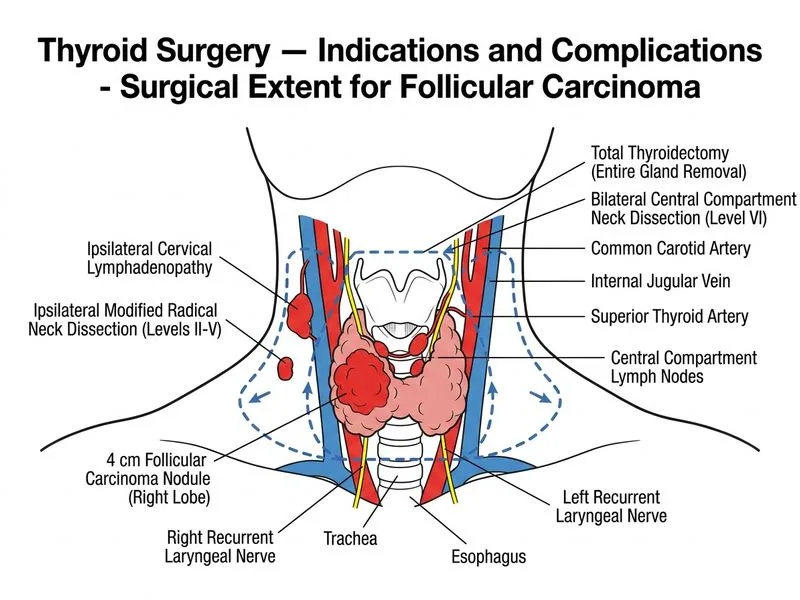
Sign up free to access AI-powered MCQ practice with detailed explanations and adaptive learning.