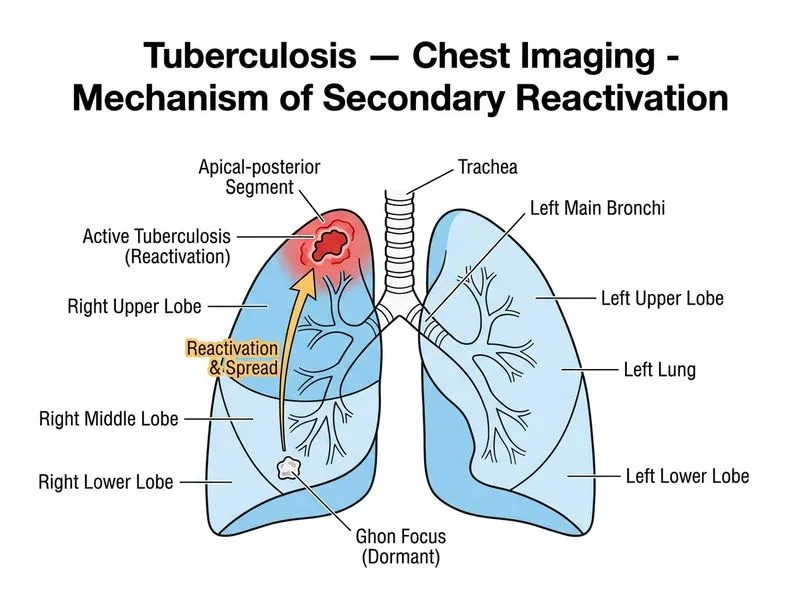
## Secondary TB — Lobar Predilection **Key Point:** The **apical-posterior segment of the right upper lobe** is the most common site of secondary (reactivation) TB. This is followed by the left upper lobe apical-posterior segment. The predilection for upper lobes is due to higher oxygen tension in the apices. ### Pathophysiology of Apical-Posterior Predilection 1. **Higher oxygen tension** in the apices → favors mycobacterial growth (aerobic organism) 2. **Lower blood flow** in apices → reduced immune surveillance 3. **Negative pressure zones** → facilitate bacillary seeding from primary focus 4. **Gravitational factors** → in upright posture, organisms settle in apices ### Distribution Pattern in Secondary TB | Location | Frequency | Notes | |----------|-----------|-------| | **Right upper lobe (apical-posterior)** | 40–50% | Most common single site | | **Left upper lobe (apical-posterior)** | 30–40% | Second most common | | **Right lower lobe** | 10–15% | Less common | | **Bilateral upper lobes** | 20–30% | Indicates advanced disease | | **Lower lobes exclusively** | <5% | Rare in immunocompetent hosts | **High-Yield:** On NEET PG, remember **"Apical-posterior right upper lobe"** as the classic site. This is tested frequently in both radiology and medicine. **Mnemonic:** **APICAL** = **A**pical-**P**osterior **I**s **C**lassic **A**nd **L**ikely (in secondary TB) **Clinical Pearl:** Lower lobe TB is more common in: - Immunocompromised patients (HIV/AIDS) - Young children (primary TB) - Diabetic patients - Patients with altered anatomy (post-gastrectomy) ### Radiological Features at the Apex - Cavitation (50–70% of cases) - Consolidation with air bronchograms - Bronchial spread to adjacent segments - Pleural involvement (less common than in primary TB) 
Sign up free to access AI-powered MCQ practice with detailed explanations and adaptive learning.