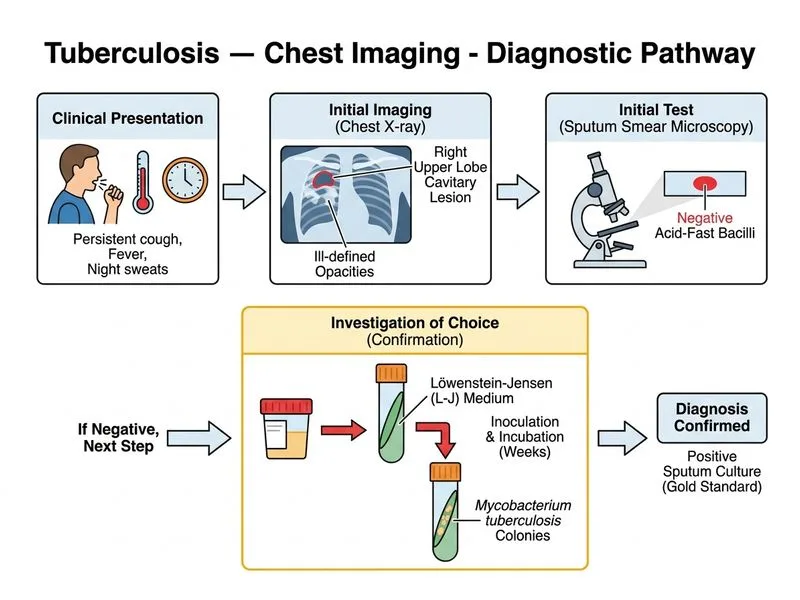
A 32-year-old man from rural Maharashtra presents with persistent cough for 3 weeks, fever, and night sweats. Chest X-ray shows ill-defined opacities in the right upper lobe with a cavitary lesion. Sputum smear microscopy is negative on two occasions. What is the investigation of choice to confirm the diagnosis of pulmonary tuberculosis?
A. High-resolution CT chest
B. Tuberculin skin test (Mantoux test)
C. Bronchoscopy with bronchoalveolar lavage
D. Sputum culture on Löwenstein-Jensen medium
Explanation
Investigation of Choice for Smear-Negative Suspected TB
Key Point
Sputum culture on Löwenstein-Jensen (LJ) medium is the gold standard and investigation of choice for confirming pulmonary TB when sputum smear microscopy is negative but clinical and radiological suspicion remains high.
Why Culture is Superior
Sputum culture has the following advantages:
Sensitivity: 80–90% even in smear-negative cases (vs. 50–60% for smear microscopy)
Gold standard: Remains the reference standard for TB diagnosis
Allows drug susceptibility testing (DST): Essential for detecting MDR-TB and XDR-TB
Turnaround time: 2–8 weeks on LJ medium (faster on liquid media like MGIT)
Role of Other Investigations
Table
Investigation
Role
Limitation
Sputum smear microscopy
Rapid, cost-effective screening
Low sensitivity in smear-negative TB (30–50%)
HRCT chest
Aids diagnosis, assesses extent
Not confirmatory; cannot differentiate TB from other infections
Bronchoscopy with BAL
Reserved for suspected endobronchial TB or when sputum cannot be obtained
Invasive; not first-line
Mantoux test
Indicates TB infection/immunity
Non-specific; positive in latent TB, BCG-vaccinated individuals, and NTM infections
Clinical Pearl
In India, the NTEP (National TB Elimination Programme) recommends sputum culture as the confirmatory test when smear microscopy is negative but clinical and radiological findings are suggestive.
High-YieldNEET PG
Smear-negative TB accounts for ~30–40% of pulmonary TB cases in India. Culture confirmation is mandatory before starting anti-TB therapy in these patients to avoid unnecessary treatment of non-TB conditions.
Loading illustration…
Practice similar questions
Sign up free to access AI-powered MCQ practice with detailed explanations and adaptive learning.