
## BRCA1 as a Tumor Suppressor Gene ### Inheritance Pattern **Key Point:** BRCA1 mutations follow **autosomal dominant inheritance** with high penetrance (~70% lifetime risk of breast cancer by age 80). Affected individuals inherit one mutant allele from a heterozygous parent. ### Molecular Mechanism: Two-Hit Hypothesis **High-Yield:** BRCA1 is a classic **gatekeeper tumor suppressor**. Carcinogenesis requires: 1. **First hit (germline):** Inherited mutant BRCA1 allele present in all cells 2. **Second hit (somatic):** Loss of the wild-type allele in a breast/ovarian epithelial cell (loss of heterozygosity, LOH) Once both alleles are inactivated, the cell loses critical DNA repair and checkpoint control, leading to malignancy. ### BRCA1 Function **Clinical Pearl:** BRCA1 is a **DNA repair gene** (homologous recombination repair pathway) and encodes a nuclear protein that: - Detects and repairs double-strand breaks - Regulates G1/S and G2/M cell cycle checkpoints (via p53 interaction) - Maintains chromosomal stability **Mnemonic:** **BRCA = Break Repair & Cell-cycle Arrest** — loss leads to genomic instability and uncontrolled proliferation. ### Clinical Features Consistent with BRCA1 - Early-onset bilateral breast cancer (as in this case) - Ovarian cancer (especially in the same family) - Triple-negative breast cancers (BRCA1-mutant tumors often lack ER, PR, HER2) - Autosomal dominant pedigree with affected males and females [cite:Robbins 10e Ch 7] 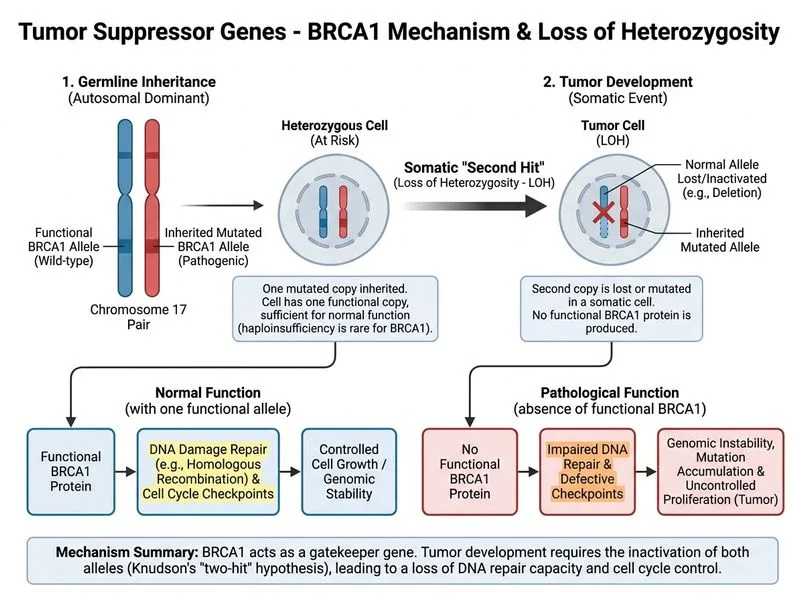
Sign up free to access AI-powered MCQ practice with detailed explanations and adaptive learning.