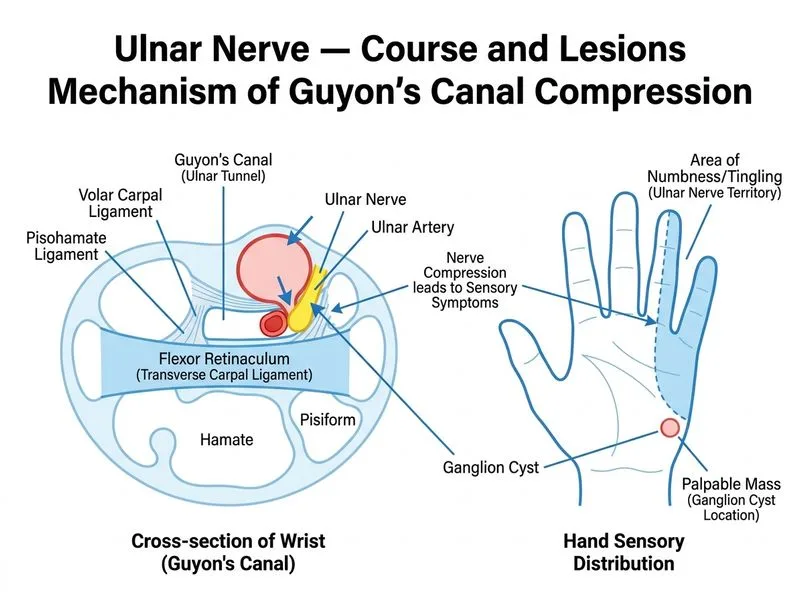
## Clinical Presentation Dissection **Key Point:** A palpable mass in the hypothenar region (medial base of palm) with sensory loss in medial 1.5 fingers but preserved motor function suggests a **superficial branch compression** of the ulnar nerve at Guyon's canal. **High-Yield:** Guyon's canal is bounded by the pisiform medially, the hook of hamate laterally, and the palmaris brevis and hypothenar muscles. Ganglion cysts are the most common compressive lesion here (40–50% of Guyon's canal masses). ## Anatomical Basis: Guyon's Canal Lesions ```mermaid flowchart TD A["Ulnar nerve enters hand<br/>medial to pisiform"]:::outcome --> B{"Splits into branches"}:::decision B -->|"Superficial branch<br/>continues distally"| C["Sensation: palmar medial 1.5 fingers<br/>Motor: palmaris brevis only"]:::action B -->|"Deep branch<br/>curves around hook of hamate"| D["Motor: hypothenar, lumbricals 3-4,<br/>interossei, adductor pollicis"]:::action E["Ganglion cyst in Guyon's canal"]:::urgent --> F["Compresses superficial branch<br/>Spares deep branch"]:::decision F --> G["Sensory loss + preserved motor"]:::outcome ``` ## Differential: Guyon's Canal vs Cubital Tunnel | Feature | Guyon's Canal | Cubital Tunnel | |---------|---------------|----------------| | **Location of mass** | Hypothenar region (base of palm) | Medial elbow | | **Intrinsic muscle wasting** | Absent (deep branch spared) | Present (all intrinsics affected) | | **Dorsal sensation** | Preserved (dorsal cutaneous branch arises proximal) | Lost (branch arises distal) | | **Froment's sign** | Negative | Positive | | **Common cause** | Ganglion cyst, hook of hamate fracture | Cubital tunnel syndrome, trauma | | **Motor deficit** | Minimal or absent | Marked | **Clinical Pearl:** The **superficial branch** of the ulnar nerve at Guyon's canal is purely sensory (supplies medial 1.5 fingers) and motor to palmaris brevis only. Compression here causes sensory loss without significant motor deficit—a key distinguishing feature. ## Why This Is Guyon's Canal Compression 1. **Palpable mass in hypothenar region:** Ganglion cysts commonly arise from the pisotriquetral joint and compress the superficial branch at Guyon's canal. 2. **Sensory loss with intact motor:** The superficial branch (sensory) is compressed while the deep branch (motor to intrinsics) is spared. 3. **No intrinsic wasting:** Preservation of motor function to intrinsic hand muscles rules out cubital tunnel and proximal lesions. 4. **Occupation (tailor):** Repetitive wrist flexion and pressure on the palm can precipitate ganglion formation. **Mnemonic:** **SHAG** = **S**uperficial branch (Sensation), **H**ypothenars (palmaris brevis only), **A**rises at Guyon's, **G**anglion (common cause). 
Sign up free to access AI-powered MCQ practice with detailed explanations and adaptive learning.