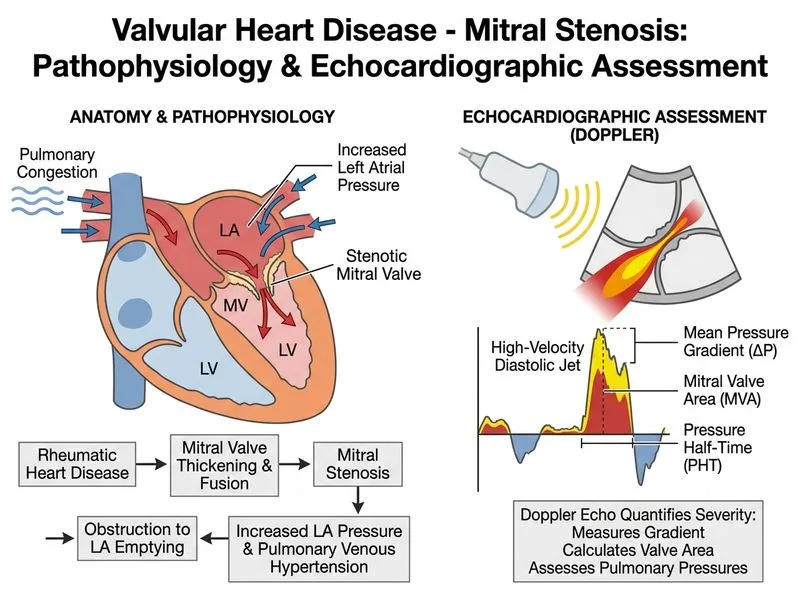
A 35-year-old woman from rural India presents with progressive dyspnea on exertion and orthopnea for 6 months. On examination, she has an opening snap, loud S1, and a low-pitched diastolic murmur at the apex. Chest X-ray shows pulmonary congestion and straightening of the left heart border. What is the investigation of choice to assess the severity of mitral stenosis and guide management?
A. Cardiac catheterization with pressure gradient measurement
B. Cardiac MRI with flow quantification
C. Transthoracic echocardiography with Doppler
D. Transesophageal echocardiography
Explanation
Diagnosis and Severity Assessment of Mitral Stenosis
Key Point
Transthoracic echocardiography with Doppler is the gold standard, first-line investigation for diagnosing and assessing the severity of mitral stenosis.
Why Transthoracic Echocardiography with Doppler?
1.
Non-invasive and widely available — suitable for initial evaluation in resource-limited settings like rural India.
2.
Provides all necessary parameters:
Mitral valve area (MVA) by planimetry or pressure half-time method
Mean diastolic gradient across the mitral valve
Left atrial and ventricular dimensions
Assessment of associated aortic and tricuspid valve disease
Estimation of pulmonary artery pressure
3.
Guides clinical management — determines need for intervention (balloon mitral valvotomy vs. surgical commissurotomy vs. valve replacement).
Severity Grading of Mitral Stenosis
Table
Parameter
Mild
Moderate
Severe
MVA (cm²)
>1.5
1.0–1.5
<1.0
Mean gradient (mmHg)
<5
5–10
>10
PAP systolic (mmHg)
<30
30–50
>50
High-YieldNEET PG
The pressure half-time method (PHT = 0.22 × deceleration time) is the most practical Doppler-derived method for calculating MVA in rheumatic mitral stenosis.
Role of Other Investigations
Cardiac catheterization — Invasive, reserved for:
Discrepancy between clinical and echo findings
Assessment of coronary artery disease in older patients
Suspected thrombus in the left atrium (before valvotomy)
Poor acoustic windows
Detailed assessment of subvalvular apparatus
NOT routine for initial severity assessment
Cardiac MRI — Useful for:
Complex anatomy or post-surgical assessment
NOT first-line; reserved for specific clinical scenarios
Clinical Pearl
In a young woman with classic mitral stenosis (opening snap, loud S1, diastolic murmur), transthoracic echo is sufficient to confirm diagnosis and grade severity. Invasive studies are needed only if considering intervention or if echo findings are inconclusive.
Loading illustration…
Practice similar questions
Sign up free to access AI-powered MCQ practice with detailed explanations and adaptive learning.