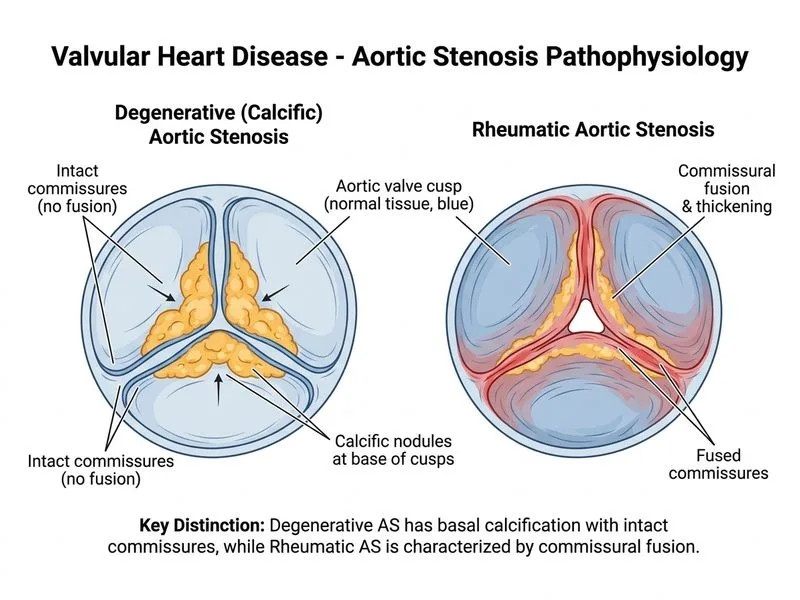
## Distinguishing Degenerative from Rheumatic Aortic Stenosis ### Pathologic Mechanisms **Key Point:** Degenerative (calcific) aortic stenosis results from mechanical wear and tear leading to calcium deposition in the aortic cusps, while rheumatic aortic stenosis is an inflammatory sequela of acute rheumatic fever causing commissural fusion and fibrosis. ### Histopathologic Comparison Table | Feature | Degenerative (Calcific) AS | Rheumatic AS | | --- | --- | --- | | **Commissures** | Intact, not fused | Fused | | **Calcium location** | Nodules at cusp base (fibrosa side) | May be present but not primary | | **Inflammation** | Minimal, degenerative | Prominent: fibrinoid necrosis, lymphocytes | | **Valve substance** | Fibrosis with calcification | Inflammatory infiltrate + fibrosis | | **Leaflet mobility** | Reduced (stiffening) | Reduced (retraction + fusion) | | **Associated lesions** | Aortic regurgitation (late) | Mitral stenosis (often concurrent) | ### Clinical Pearl **Clinical Pearl:** On gross inspection, degenerative AS shows **nodular calcification at the base of the cusps with preserved commissures**, whereas rheumatic AS shows **commissural fusion with a narrowed orifice**. Microscopically, degenerative disease lacks the inflammatory infiltrate characteristic of rheumatic disease. ### High-Yield Discriminator **High-Yield:** **Intact commissures with nodular calcification = Degenerative AS.** **Fused commissures = Rheumatic AS.** This distinction is crucial because rheumatic AS is almost always accompanied by mitral valve disease (especially mitral stenosis), whereas degenerative AS is isolated to the aortic valve. ### Mnemonic **Mnemonic:** **DECAL** = **DE**generative **CAL**cific (nodules, intact commissures); **RHEUM** = **RHEUM**atic (fused commissures, inflammation). [cite:Robbins 10e Ch 12] 
Sign up free to access AI-powered MCQ practice with detailed explanations and adaptive learning.