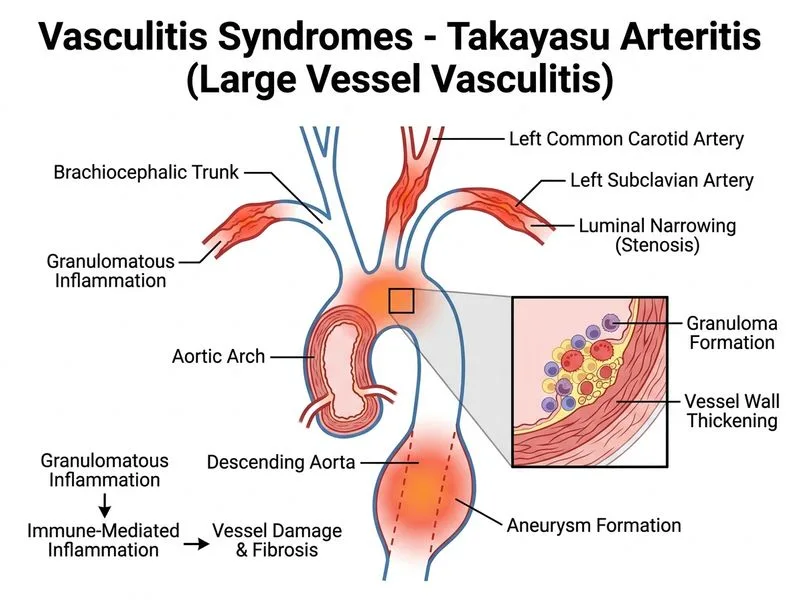
## Takayasu Arteritis: Large Vessel Vasculitis **Key Point:** Takayasu arteritis is a granulomatous vasculitis affecting the aorta and its major branches, classifying it as a large-vessel vasculitis. ### Pathological Features - **Granulomatous inflammation** with giant cells in the media and adventitia - **Predilection sites:** Ascending aorta, aortic arch, thoracic and abdominal aorta - **Consequence:** Progressive stenosis, occlusion, or aneurysm formation - Predominantly affects young women (especially from Asia, Africa, Latin America) ### Comparison with Other Vasculitides | Vasculitis | Vessel Size | Inflammation Type | Key Features | |---|---|---|---| | **Takayasu** | Large (aorta, branches) | Granulomatous | Aortic arch syndrome, pulse deficits | | Polyarteritis nodosa | Medium | Necrotizing (non-granulomatous) | Spares lungs, glomeruli; HBsAg+ | | Microscopic polyangiitis | Small | Necrotizing (ANCA+) | ANCA-positive, glomerulonephritis | | Wegener (GPA) | Small | Granulomatous + necrotizing | Upper respiratory involvement, c-ANCA | **High-Yield:** The hallmark of Takayasu is **granulomatous inflammation of the aorta** — this distinguishes it from necrotizing vasculitides like PAN and MPA. **Clinical Pearl:** Takayasu arteritis is sometimes called "pulseless disease" because stenosis of subclavian arteries can obliterate radial pulses bilaterally. 
Sign up free to access AI-powered MCQ practice with detailed explanations and adaptive learning.