Quick Answer
Chronic pain and palliative care contributes 2–3 NEET PG questions per paper across pharmacology, anesthesia, internal medicine, and ethics. Master these 8 high-yield areas:
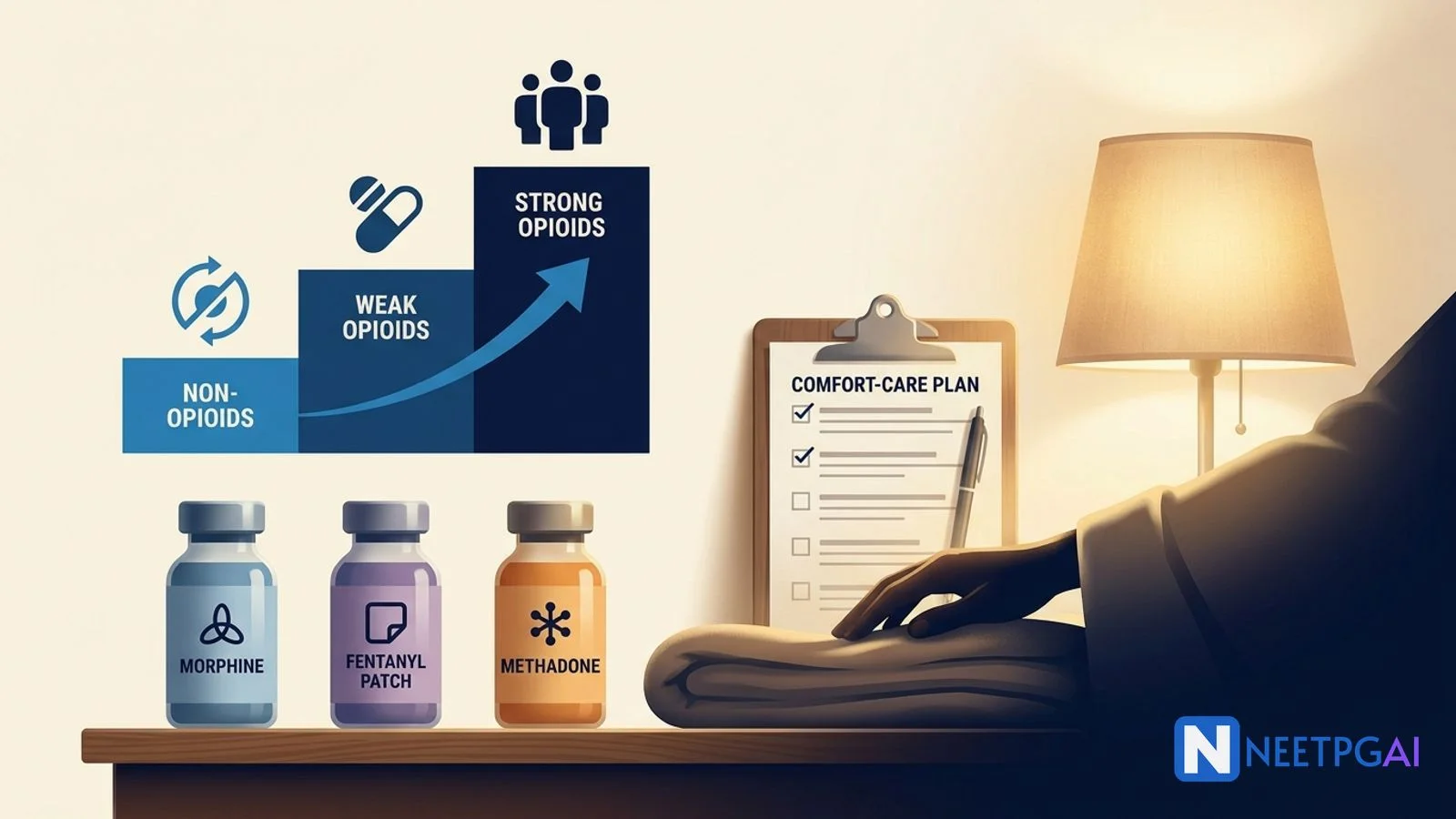
- WHO analgesic ladder — Step 1 (non-opioid + adjuvant), Step 2 (weak opioid), Step 3 (strong opioid); 4th step (interventional) added 2018
- Opioid pharmacology — morphine (gold standard), fentanyl (transdermal patch, 100x potency), tramadol (weak mu agonist + serotonin/NE reuptake inhibitor), methadone (NMDA antagonist), buprenorphine (partial agonist, ceiling effect)
- Opioid side effects — constipation (no tolerance — always laxative), respiratory depression, miosis, nausea, urinary retention, pruritus, hypogonadism, hyperalgesia
- Opioid reversal — naloxone 0.04–0.4 mg IV titrated; short half-life requires re-dosing or infusion
- Neuropathic pain — gabapentin, pregabalin, duloxetine, amitriptyline; first-line over opioids
- Total pain (Saunders) — physical + emotional + social + spiritual; addressed by interdisciplinary team
- Palliative emergencies — superior vena cava syndrome, hypercalcemia, malignant spinal cord compression, hemorrhage, opioid toxicity, terminal restlessness
- End-of-life ethics — autonomy, beneficence, non-maleficence, justice; distinction between withholding/withdrawing treatment and active euthanasia (illegal in India); Common Cause judgment 2018 legalized passive euthanasia
Pain management and palliative care are increasingly tested in NEET PG with the rise of cancer epidemiology and ethics-based questions. Examiners blend pharmacology (opioid mechanisms, drug interactions), anesthesia (interventional pain, regional blocks), and PSM-ethics (NMC code, Common Cause v. Union of India 2018) into single vignettes. This NEETPGAI deep dive consolidates everything from the WHO analgesic ladder to passive-euthanasia jurisprudence.
Reinforce concepts with the anesthesia high-yield topics (overlap with intervention) and the Pharmacology hub for opioid receptor mechanics. The clinical reasoning here also feeds shock and sepsis management when severe pain accompanies systemic illness.
Pain mechanisms and classification
Pain is "an unpleasant sensory and emotional experience associated with, or resembling that associated with, actual or potential tissue damage" (IASP 2020). Chronic pain is pain lasting beyond 3 months or beyond the expected healing time — now classified as a disease in its own right (ICD-11).
Pain types
| Type | Mechanism | Example | First-line therapy |
|---|
| Nociceptive somatic | Tissue damage activating peripheral nociceptors | Bone metastasis, surgical incision | NSAID, paracetamol, opioid |
| Nociceptive visceral | Stretch/ischemia of viscera | Bowel obstruction, hepatic capsule | Opioid (poorly responsive to NSAIDs) |
| Neuropathic | Lesion or disease of somatosensory system | Diabetic neuropathy, post-herpetic neuralgia, phantom limb | Gabapentinoid, SNRI, TCA |
| Nociplastic | Altered central nociceptive processing | Fibromyalgia, IBS | Multimodal (CBT + duloxetine + exercise) |
Pain assessment tools
- Numerical Rating Scale (NRS): 0–10
- Visual Analog Scale (VAS): 100 mm line
- Wong-Baker FACES: Pediatric and non-verbal patients
- FLACC scale: Infants and pre-verbal children
- PAINAD: Advanced dementia
- Brief Pain Inventory (BPI): Cancer pain — pain intensity + functional interference
WHO analgesic ladder
Originally introduced in 1986 for cancer pain, the WHO ladder remains the foundational pharmacological framework for chronic pain. The 2018 update added a 4th step for interventional procedures.
Step 1 — Mild pain (NRS 1–3)
Non-opioid analgesics ± adjuvants:
- Paracetamol — central COX inhibition, analgesic-antipyretic without anti-inflammatory action; max 4 g/day (3 g in elderly, hepatic disease, alcohol use); hepatotoxicity is the dose-limiting toxicity (NAPQI metabolite)
- NSAIDs (ibuprofen, naproxen, diclofenac, celecoxib) — peripheral COX-1 and COX-2 inhibition; effective for bone pain (prostaglandin-mediated). ADRs: GI bleeding, AKI, hypertension, cardiovascular events (especially diclofenac, rofecoxib withdrawn)
Step 2 — Moderate pain (NRS 4–6)
Weak opioids ± non-opioid ± adjuvant:
- Codeine — prodrug; CYP2D6 → morphine; ultra-rapid metabolizers have severe toxicity (FDA black box for children post-tonsillectomy)
- Tramadol — weak mu agonist + serotonin/norepinephrine reuptake inhibition; lowers seizure threshold; serotonin syndrome with SSRIs and MAOIs
- Tapentadol — mu agonist + NE reuptake inhibitor; less serotonin effect than tramadol
Step 3 — Severe pain (NRS 7–10)
Strong opioids ± non-opioid ± adjuvant:
- Morphine — global gold standard; oral bioavailability 30%; renally cleared (active metabolite M6G accumulates in renal failure)
- Oxycodone — better oral bioavailability (~75%); less histamine release than morphine
- Hydromorphone — 5–7× more potent than morphine; useful in renal impairment
- Fentanyl — 75–100× more potent than morphine; transdermal patch lasting 72 hr; buccal/sublingual for breakthrough pain; safe in renal failure (no active metabolites)
- Methadone — mu agonist + NMDA antagonist; long half-life (15–60 hr); useful in opioid rotation and neuropathic pain; QT prolongation
- Buprenorphine — partial agonist; ceiling effect on respiratory depression; transdermal patch; used in opioid use disorder and chronic pain
Step 4 — Interventional (added 2018)
- Neurolytic celiac plexus block (pancreatic cancer)
- Superior hypogastric block (pelvic cancer)
- Intrathecal opioid pump
- Spinal cord stimulation
- Vertebroplasty / kyphoplasty for vertebral metastases
- Radiofrequency ablation for trigeminal neuralgia, facet joints
Opioid pharmacology — deep dive
Opioids act on G-protein-coupled mu, kappa, and delta receptors. Mu agonism mediates analgesia, euphoria, respiratory depression, miosis, constipation, and physical dependence — all the major effects and adverse effects.
Receptor pharmacology
| Receptor | Effects |
|---|
| Mu (MOR) | Supraspinal analgesia, respiratory depression, euphoria, miosis, constipation, dependence |
| Kappa (KOR) | Spinal analgesia, dysphoria, miosis, sedation |
| Delta (DOR) | Analgesia, mood modulation, possibly limits tolerance |
Equianalgesic conversions (for opioid rotation)
| Drug | Oral (mg) | Parenteral (mg) |
|---|
| Morphine | 30 | 10 |
| Oxycodone | 20 | – |
| Hydromorphone | 7.5 | 1.5 |
| Codeine | 200 | 100 |
| Tramadol | 100 (analgesia ceiling at 400 mg/day) | – |
| Fentanyl transdermal | – | 25 mcg/hr ≈ 60–134 mg oral morphine/day |
| Methadone | Non-linear; consult specialist | – |
Rule when rotating: Reduce calculated equianalgesic dose by 25–50% to account for incomplete cross-tolerance.
Adverse effects and management
| Adverse effect | Tolerance? | Management |
|---|
| Constipation | NEVER develops | Stimulant laxative (senna, bisacodyl) ± osmotic; PAMORA (methylnaltrexone, naloxegol) for refractory |
| Nausea | Develops in 1–2 weeks | Metoclopramide, ondansetron, haloperidol |
| Sedation | Develops in days | Reduce dose, methylphenidate if persistent |
| Respiratory depression | Develops with chronic use | Naloxone if life-threatening |
| Pruritus | Variable | Antihistamine, opioid rotation |
| Urinary retention | Variable | Catheterise, opioid rotation |
| Myoclonus | – | Reduce dose, opioid rotation, benzodiazepine |
| Opioid-induced hyperalgesia | – | Reduce dose, switch (especially to methadone), add NMDA antagonist |
| Hypogonadism (chronic) | – | Testosterone supplementation if symptomatic |
Naloxone reversal
Pure mu antagonist. Dose: 0.04–0.4 mg IV/IM/IN, titrate to respiratory rate (NOT consciousness) to avoid acute withdrawal. Half-life ~30–60 min — shorter than most opioids — so repeat dosing or continuous infusion (2/3 of effective bolus per hour) is often required, especially for methadone or extended-release opioid overdose.
Neuropathic pain — beyond opioids
Neuropathic pain responds poorly to opioids alone. First-line agents target central sensitization rather than nociceptor activation.
| Class | Drugs | Notes |
|---|
| Gabapentinoids | Gabapentin, pregabalin | Bind alpha-2-delta subunit of voltage-gated Ca channels; renal dose adjustment; sedation, weight gain, edema |
| SNRIs | Duloxetine, venlafaxine | Best evidence in painful diabetic neuropathy and fibromyalgia; nausea, hypertension |
| TCAs | Amitriptyline, nortriptyline | Block NE/serotonin reuptake + sodium channels; anticholinergic effects (caution in elderly, BPH, glaucoma); QT prolongation |
| Topical agents | Capsaicin 8% patch, lidocaine 5% patch | Localized neuropathic pain (post-herpetic, focal); minimal systemic absorption |
| Anticonvulsants | Carbamazepine (trigeminal neuralgia DOC), oxcarbazepine | First-line for trigeminal neuralgia |
NEET PG anchor: Carbamazepine is the drug of choice for trigeminal neuralgia (Tic douloureux). Microvascular decompression is the surgical option for medical failure.
Palliative care principles
Palliative care is "an approach that improves the quality of life of patients and their families facing the problem associated with life-threatening illness, through the prevention and relief of suffering" (WHO 2002).
Core principles
- Early integration — from diagnosis, alongside disease-modifying therapy (not "after curative options exhausted")
- Holistic care — physical, psychological, social, spiritual ("total pain" — Cicely Saunders)
- Family as unit of care — bereavement support
- Interdisciplinary team — physician, nurse, social worker, chaplain, pharmacist, volunteers
- Patient autonomy — informed decision-making, advance care planning
- Quality over quantity of life — but does not hasten or postpone death
Symptom management beyond pain
| Symptom | First-line therapy |
|---|
| Dyspnea | Low-dose oral morphine 2.5–5 mg q4h; oxygen only if hypoxic; benzodiazepine for anxiety component |
| Nausea (cause-directed) | Metoclopramide (gastroparesis), ondansetron (chemotherapy), haloperidol (opioid-induced, metabolic), cyclizine (mechanical bowel obstruction), dexamethasone (raised ICP) |
| Constipation | Stimulant + osmotic laxative; methylnaltrexone for opioid-induced refractory |
| Death rattle (terminal secretions) | Glycopyrrolate (preferred — does not cross BBB) or hyoscine butylbromide |
| Terminal restlessness / agitation | Haloperidol; midazolam if refractory; rule out reversible causes (urinary retention, fecal impaction, hypoxia, opioid toxicity) |
| Anorexia-cachexia | Megestrol, dexamethasone (short-term); discuss artificial nutrition expectations |
| Depression | SSRI (consider faster-acting methylphenidate or ketamine in last weeks of life) |
Palliative emergencies
- Malignant spinal cord compression — back pain + neurological deficit; emergency MRI; high-dose dexamethasone (10 mg IV bolus then 4 mg q6h) + radiotherapy ± surgical decompression
- Superior vena cava syndrome — facial swelling, dilated chest veins; urgent radiotherapy or stenting; steroids
- Hypercalcemia — IV fluids + bisphosphonate (zoledronic acid); calcitonin for rapid effect; denosumab if bisphosphonate fails
- Massive hemorrhage — dark towels (mask blood), midazolam for distress, family support
- Opioid toxicity — reduce dose 30–50%, hydration, switch opioid, treat hyperalgesia
- Tumor lysis syndrome — hyperuricemia, hyperkalemia, hyperphosphatemia, hypocalcemia; allopurinol/rasburicase, hydration
End-of-life care and ethics
Indian legal framework
- Common Cause v. Union of India (2018) — Supreme Court legalized passive euthanasia (withdrawal of life-sustaining treatment in terminally ill patients) and recognized advance directives (Living Will). Active euthanasia remains illegal.
- NMC Code of Ethics — physicians have duty to relieve suffering; opioid prescribing for pain is ethical and required (no longer legally restricted as it once was under the NDPS Act amendment 2014).
- End of Life Care guidelines (ICMR 2018) — operational protocol for foregoing life-sustaining treatment.
Ethical principles in palliative care
| Principle | Application |
|---|
| Autonomy | Informed consent, advance directives, surrogate decision-making |
| Beneficence | Relieve suffering, maximize quality of life |
| Non-maleficence | Avoid burdensome treatments without benefit |
| Justice | Equitable access to palliative care (NPPC 2012 framework) |
Doctrine of double effect
When a treatment intended to relieve symptoms (e.g., morphine for dyspnea) may foreseeably hasten death, it is ethically permissible if: (1) the action itself is good or neutral, (2) intent is to relieve suffering (not to cause death), (3) good effect is not achieved through the bad effect, (4) proportionality between benefit and risk.
Withholding vs withdrawing treatment
Ethically and legally equivalent. Withdrawing a non-beneficial treatment (e.g., ventilator, dialysis, vasopressors) is permitted in terminally ill patients with surrogate consent. Comfort care and symptom management are continued.
Communication frameworks
- SPIKES protocol for breaking bad news: Setting, Perception, Invitation, Knowledge, Emotion, Strategy/Summary
- NURSE technique for emotional response: Naming, Understanding, Respecting, Supporting, Exploring
- Ask-Tell-Ask for information sharing
Special populations
Pediatric palliative care
- Use FLACC scale (under 2 years and non-verbal); Wong-Baker FACES (3+ years)
- Avoid codeine (CYP2D6 ultra-rapid metabolism); avoid tramadol <12 years (FDA 2017)
- Morphine remains first-line strong opioid; oral oxycodone alternative
- Family-centered care essential
Renal impairment
- Avoid morphine (M6G accumulation) → seizures, toxicity
- Preferred: fentanyl, methadone, buprenorphine (no active renal metabolites)
- Reduce gabapentin, pregabalin doses
Hepatic impairment
- All opioids reduced clearance; start low, titrate slowly
- Avoid paracetamol >2 g/day in cirrhosis
- Avoid NSAIDs (variceal bleeding, hepatorenal syndrome)
Recent updates and guidelines
- WHO 2018 Cancer Pain Guidelines — emphasize integration of opioids early; added Step 4 interventional category.
- NDPS Amendment Act 2014 — simplified opioid licensing in India; Recognized Medical Institution can stock and dispense morphine.
- National Programme for Palliative Care (NPPC) updated 2017–2026 strategic framework — integration with NCD program.
- Common Cause judgment 2018 + 2023 modifications — simplified procedure for advance directives and withdrawal of life support.
- Methadone access expanded in India since 2017 for both pain and OUD via Centres of Excellence; INI-CET frequently tests methadone pharmacology.
- Buprenorphine-naloxone (Suboxone) approved for OUD; sublingual formulation reduces injection abuse.
High-yield NEET PG MCQ traps
- Tolerance to opioid constipation NEVER develops — always co-prescribe stimulant laxative.
- Naloxone half-life is shorter than most opioids — re-bolus or infuse to prevent re-narcotization.
- Codeine is contraindicated in children <12 years post-tonsillectomy (FDA 2017) — CYP2D6 ultra-rapid metabolism.
- Pancreatic cancer pain responds well to celiac plexus block.
- Trigeminal neuralgia DOC is carbamazepine.
- Tramadol + SSRI = serotonin syndrome.
- Methadone QT prolongation mandates baseline ECG.
- Morphine in renal failure accumulates M6G → use fentanyl or hydromorphone.
- Ondansetron for chemotherapy-induced nausea, metoclopramide for opioid-induced nausea — acute mechanism dictates choice.
- Total pain (Cicely Saunders) = physical + emotional + social + spiritual.
Frequently asked questions
What is the WHO analgesic ladder for cancer pain?
Step 1: non-opioid (paracetamol, NSAID) ± adjuvant for mild pain. Step 2: weak opioid (codeine, tramadol) + non-opioid ± adjuvant for moderate pain. Step 3: strong opioid (morphine, fentanyl, oxycodone, hydromorphone) + non-opioid ± adjuvant for severe pain. WHO 2018 added Step 4 — invasive interventions like nerve blocks and intrathecal opioids.
What is the first-line treatment for diabetic neuropathic pain?
First-line agents include duloxetine (SNRI), pregabalin (alpha-2-delta ligand), gabapentin, and amitriptyline (TCA). Pregabalin and duloxetine are FDA-approved for painful diabetic neuropathy. Avoid opioids as first-line — they have limited efficacy in chronic neuropathic pain. Topical capsaicin and lidocaine are useful adjuncts.
How is morphine dose titrated in cancer pain?
Start with immediate-release morphine 5–10 mg every 4 hours plus breakthrough doses (10–15% of total daily dose) every 1 hour as needed. Calculate the 24-hour total and convert to extended-release morphine twice daily. Always co-prescribe a stimulant laxative — opioid-induced constipation does not resolve with tolerance.
What is the difference between palliative care and hospice care?
Palliative care addresses symptoms, suffering, and quality of life from diagnosis of any serious illness — given concurrently with curative treatment. Hospice is a subset of palliative care for life expectancy under 6 months when curative treatment is no longer pursued. Indian guidelines (NPPC 2012) emphasize palliative care integration from diagnosis.
What is the role of methadone in chronic pain?
Methadone is a unique mu-opioid agonist plus NMDA antagonist with potency in neuropathic and opioid-tolerant pain. Long, variable half-life (15–60 hr) requires careful titration. QT prolongation risk mandates baseline ECG. Dose conversion from other opioids is non-linear — use specialist consultation. Indian palliative care has expanded methadone access since 2017.
This content is for educational purposes for NEET PG exam preparation. It is not a substitute for professional medical advice, diagnosis, or treatment. Clinical information has been reviewed by qualified medical professionals.
Written by: NEETPGAI Editorial Team
Reviewed by: Pending SME Review
Last reviewed: April 2026