NEETPGAI
FeaturesBlogComparePricing
Log inStart Free
NEETPGAI

AI-powered NEET PG preparation platform. Master all 19 subjects with adaptive MCQs, AI tutoring, and spaced repetition.

Product

  • Features
  • Subjects
  • Previous Year Questions
  • Compare
  • Pricing
  • Blog

Features

  • Adaptive MCQ Practice
  • AI Tutor
  • Mock Tests
  • Spaced Repetition

Resources

  • Blog
  • Study Guides
  • NEET PG Updates
  • Contact & support

Legal

  • Privacy Policy
  • Terms of Service

Stay updated

© 2026 NEETPGAI. All rights reserved.
    Practice 2,082+ Pharmacology MCQs
    Free signup · Full bank · Detailed explanations
    Start Free
    SubjectsPharmacology
    Para-clinical
    AI-powered

    Pharmacology for NEET PG 2026

    Free practice + topic-wise study material with AI explanations.

    90 daysto NEET PG 2026
    Exam date: 30 Aug 2026
    Your prep stageRevision Phase
    Foundation
    180+ days
    Deep Study
    90-180 days
    Revision
    30-90 days
    Final Sprint
    <30 days

    Rapid revision of all subjects. 2 mock tests per week.

    1. 1Prioritise the 49 high-yield topics — they account for ~70% of Pharmacology questions every year.
    2. 2Practice 2,082+ topic-tagged MCQs with detailed AI explanations to build pattern recognition.
    3. 3Use SM-2 spaced repetition — wrong answers auto-schedule for review at expanding intervals.
    4. 4Revise PYQs from the last 5 years to spot recurring themes and adjust your priorities.
    5. 5Take subject-wise mock tests every 2 weeks to benchmark recall under exam conditions.
    Start Free PracticeGenerate AI Study Plan

    Pharmacology at a glance

    Live from MCQ bank
    2,082practice MCQs
    Updated daily as new questions are SME-approved.
    49
    HY
    high-yield topics
    ~70% of NEET PG Pharmacology marks come from these.
    68total topics
    Across 10 canonical systems.
    100% free — unlimited MCQs and real PYQs, no credit card.
    About Pharmacology in NEET PG

    What you need to know about Pharmacology

    Quick answer

    Pharmacology is the study of drug mechanisms, kinetics, and clinical effects — it carries approximately 18% weightage in NEET PG 2026, making it one of the highest-yield single subjects in the paper. NEET PG tests Pharmacology not as rote recall but as applied reasoning: expect questions that embed a drug interaction (e.g., TMP-SMX raising serum creatinine via OCT2 inhibition), a receptor subtype mismatch, or an adjunct therapy decision in Parkinson's disease within a 4-6 line clinical vignette. Your priority zones are Pharmacokinetics, Receptor Theory, Autonomic Pharmacology (cholinergic, adrenergic, beta blockers), and CNS drugs (antiepileptics, anti-Parkinson agents) — these 12 high-yield topics account for the bulk of the 825 approved questions on NEETPGAI. Allocate at least 3 hours per week to Pharmacology throughout your 6-month prep cycle, and never skip Adverse Drug Reaction classification — it appears in nearly every NEET PG paper. Spaced-repetition tools like NEETPGAI compress the revision cycle to 7-10 days.

    Pharmacology in NEET PG 2026 tests your ability to translate drug mechanisms into clinical decisions. The paper does not ask you to list side effects in isolation — it places a patient on a specific drug regimen, introduces a complication or a new prescription, and asks you to identify the mechanism, the interaction, or the safest adjunct. The 68 syllabus topics spread across 10 body systems mean you cannot afford to treat any system as optional, but the autonomic nervous system (cholinergic, anticholinergic, adrenergic agonists, alpha and beta blockers) and CNS pharmacology (antiepileptics, anti-Parkinson drugs) together account for a disproportionate share of questions.

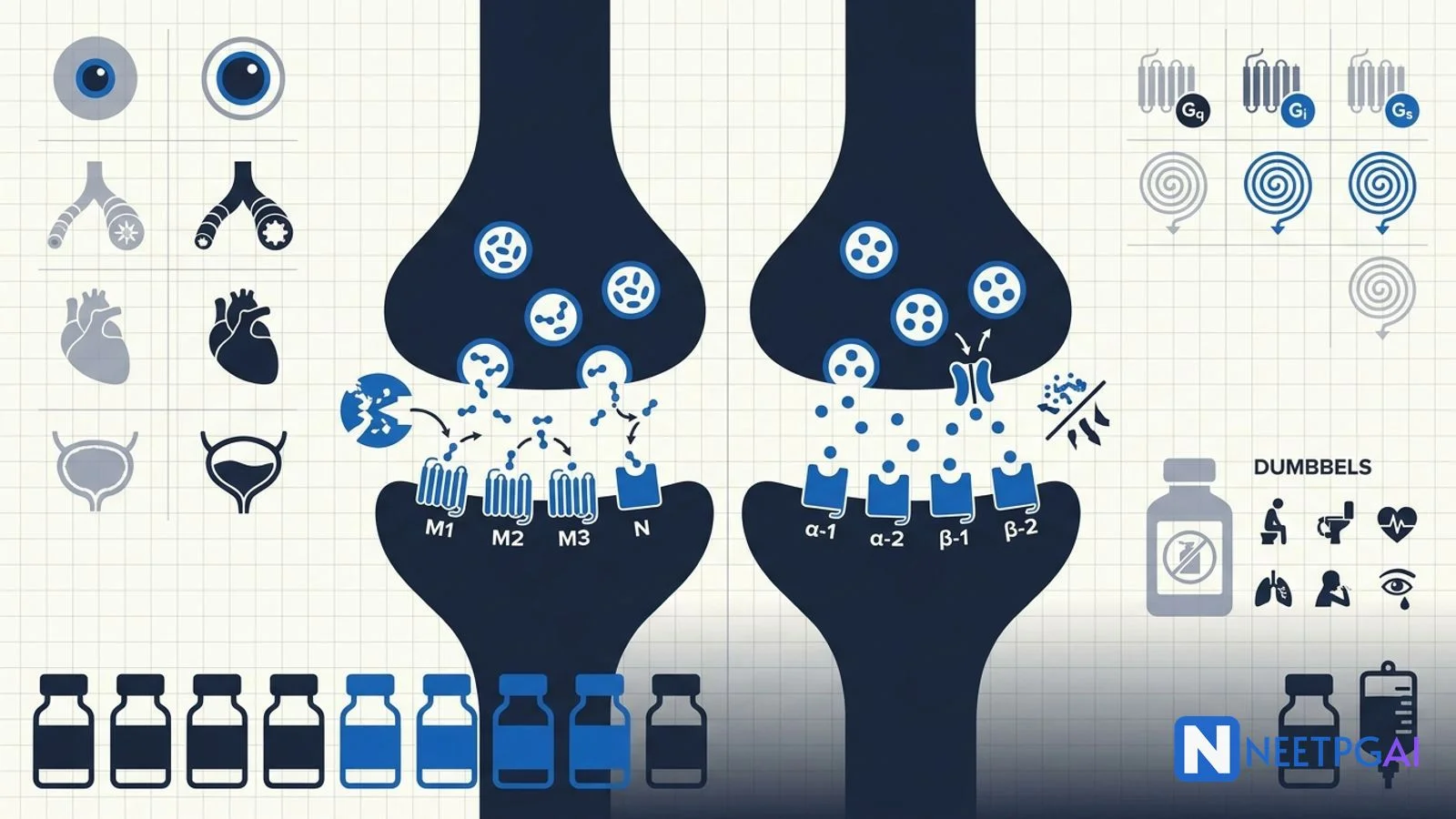
    The subject intersects directly with clinical practice at every rotation. During your MBBS internship year you will encounter atropine dosing in organophosphate poisoning, levodopa-carbidopa titration in Parkinson's disease, and phenytoin drug interactions in epilepsy management — all of which are live NEET PG question archetypes. Understanding receptor subtypes (M1-M3, alpha-1/alpha-2, beta-1/beta-2) is not academic trivia; it is the reasoning scaffold behind every autonomic drug question.

    The syllabus shape rewards a systems-based approach. Start with the foundational pillars — Pharmacokinetics (volume of distribution, half-life, bioavailability, first-pass metabolism) and Pharmacodynamics (Emax, EC50, agonist vs. partial agonist, competitive vs. non-competitive antagonism) — before moving into organ-system pharmacology. These two foundational topics appear as standalone questions and as the explanatory logic inside clinical vignettes across all other topics.

    A common misconception is that Pharmacology is a "memory subject." It is not. Questions on Drug Interactions (e.g., enzyme inducers like rifampicin reducing oral contraceptive efficacy, or OCT2 inhibitors elevating metformin plasma levels) require you to apply a mechanistic framework, not recall a list. Similarly, Adverse Drug Reaction classification (Type A through Type F, per WHO nomenclature) is tested in the context of a described clinical scenario, not as a standalone definition. Aspirants who memorise without understanding mechanism consistently lose marks on these applied stems.

    Free PDF · NEET PG 2026

    Pharmacology High-Yield One-Liners

    200 textbook-style one-liners auto-extracted from approved Pharmacology MCQ explanations. Drop your email and we'll send the PDF — no spam, you can reply to unsubscribe.

    Highest-yield topics

    Pharmacology — focus areas that win the most marks

    These 12 topics historically carry a disproportionate share of Pharmacology questions on NEET PG. Tap any to start practising — the Pharmacology filter is pre-selected for you.

    General Principles

    Pharmacokinetics

    Start practising

    General Principles

    Pharmacodynamics and Receptor Theory

    Start practising

    General Principles

    Drug Interactions

    Start practising

    General Principles

    Adverse Drug Reactions Classification

    Start practising

    Autonomic Nervous System

    Cholinergic Drugs

    Start practising

    Autonomic Nervous System

    Anticholinergic Drugs

    Start practising

    Autonomic Nervous System

    Adrenergic Agonists

    Start practising

    Autonomic Nervous System

    Beta Blockers

    Start practising

    Autonomic Nervous System

    Alpha Blockers

    Start practising

    Autonomic Nervous System

    Receptor Subtypes and Pharmacological Effects

    Start practising

    CNS Pharmacology

    Antiepileptics

    Start practising

    CNS Pharmacology

    Parkinsonism Drugs

    Start practising

    Preparation strategy

    How to prepare Pharmacology — tactics that work

    Five repeatable tactics that NEET PG toppers consistently use for Pharmacology. Below: a deeper play-by-play.

    Build a strong foundation

    Read each high-yield topic from one standard textbook before opening any question bank.

    Practice in tight loops

    After every chapter, attempt 20–30 topic-tagged MCQs while the concepts are still fresh.

    Schedule spaced reviews

    Push wrong answers into SM-2 review queues — short, frequent, expanding intervals beat marathon revisions.

    Mine the last 5 years of PYQs

    Map every PYQ to its parent topic. Recurring themes are louder signal than weightage tables.

    Stress-test with mock tests

    A subject-wise mock every fortnight surfaces blind spots before the real exam does.

    Time budget

    • Allocate 3-3.5 hours per week across a 24-week (6-month) prep cycle — roughly 72-84 hours total for Pharmacology.
    • In the first 8 weeks, cover foundational topics: Pharmacokinetics, Pharmacodynamics and Receptor Theory, and Autonomic Pharmacology (all 6 high-yield autonomic topics). These alone represent the largest single cluster in the 68-topic syllabus.
    • In weeks 9-16, move to CNS (Antiepileptics, Parkinson's drugs), Cardiovascular, and Chemotherapy pharmacology.
    • Reserve weeks 17-24 for full-syllabus revision, PYQ drilling, and mock-test analysis.

    Primary textbook

    • KD Tripathi's Essentials of Medical Pharmacology, 9th Indian edition — this is your anchor. Read Chapters 4-6 (Pharmacokinetics and Pharmacodynamics) first, then Chapter 9 (Cholinergic system) and Chapter 10 (Adrenergic system). Do not skip the tables on receptor subtypes in Chapter 9 — they are directly tested.

    Supplementary resource

    • Gobind Rai Garg & Sparsh Gupta's Review of Pharmacology for rapid-revision tables and PYQ-mapped summaries. Use it from week 9 onward, not as a primary source.

    Put this into a 30-minute session today

    We'll pre-select Pharmacology and serve a mixed difficulty set.

    Try a 10-MCQ set
    Syllabus map
    Pharmacology — full topic list
    68 topics across 10 systems · 49 marked high-yield
    • Pharmacokinetics
      High-yield
    • Pharmacodynamics and Receptor Theory
      High-yield
    • Drug Interactions
      High-yield
    • Adverse Drug Reactions Classification
      High-yield
    • Drug Development and Pharmacogenomics
      Moderate
    • Routes of Administration
      Low-yield
    • Cholinergic Drugs
      High-yield
    • Anticholinergic Drugs
      High-yield
    • Adrenergic Agonists
      High-yield
    • Beta Blockers
      High-yield
    • Alpha Blockers
      High-yield
    • Ganglion Blockers
      Low-yield
    • Receptor Subtypes and Pharmacological Effects
      High-yield
    • Antiepileptics
      High-yield
    • Parkinsonism Drugs
      High-yield
    • Antipsychotics
      High-yield
    • Antidepressants — SSRIs, SNRIs, TCAs
      High-yield
    • Mood Stabilizers — Lithium
      High-yield
    • Sedatives and Hypnotics
      Moderate
    • Opioids
      High-yield
    • General Anaesthetics
      Moderate
    • Local Anaesthetics
      Moderate
    • Antihypertensives
      High-yield
    • Diuretics
      High-yield
    • Heart Failure Drugs
      High-yield
    • Antianginals
      High-yield
    • Antiarrhythmics
      High-yield
    • Anticoagulants and Antiplatelets
      High-yield
    • Thrombolytics
      Moderate
    • Hypolipidemics
      High-yield
    • Antiarrhythmics — Mechanisms and Classification
      High-yield
    • Beta-lactam Antibiotics
      High-yield
    • Aminoglycosides
      High-yield
    • Macrolides
      High-yield
    • Tetracyclines
      Moderate
    • Fluoroquinolones
      High-yield
    • Sulfonamides and Trimethoprim
      Moderate
    • Antitubercular Drugs
      High-yield
    • Antileprotic Drugs
      High-yield
    • Antifungals
      High-yield
    • Antivirals — non-HIV
      High-yield
    • Antiretrovirals
      High-yield
    • Antimalarials
      High-yield
    • Antihelminthics
      Moderate
    • Insulin and Oral Hypoglycemics
      High-yield
    • Thyroid and Antithyroid Drugs
      High-yield
    • Corticosteroids
      High-yield
    • Sex Hormones and Contraceptives
      High-yield
    • Drugs for Osteoporosis
      Moderate
    • Antacids, PPIs, H2 Blockers
      High-yield
    • Antiemetics
      High-yield
    • Laxatives and Antidiarrheals
      Moderate
    • Drugs for IBD
      Moderate
    • Bronchodilators
      High-yield
    • Inhaled Corticosteroids
      High-yield
    • Leukotriene Antagonists
      Moderate
    • Mucolytics and Antitussives
      Low-yield
    • Alkylating Agents
      High-yield
    • Antimetabolites
      High-yield
    • Microtubule Inhibitors
      Moderate
    • Targeted Cancer Therapy
      High-yield
    • Immunosuppressants
      High-yield
    • Folate Metabolism and Nucleotide Synthesis — Drug Targets
      Moderate
    • NSAIDs
      High-yield
    • Disease-Modifying Antirheumatic Drugs
      Moderate
    • Drugs in Pregnancy
      High-yield
    • Drug Poisoning and Antidotes
      High-yield
    • Vitamins Pharmacology
      Moderate
    Today's NEET PG Pharmacology MCQ

    Test yourself in 60 seconds

    New question every day
    Antihypertensives
    medium

    A 58-year-old man with hypertension and chronic kidney disease (eGFR 35 mL/min/1.73 m²) is started on antihypertensive therapy. Which single laboratory finding best distinguishes the use of a beta-blocker from a calcium channel blocker in this patient?

    Tap an option to reveal the answer and AI explanation. New question rotates daily at midnight IST.

    Study guides

    Pharmacology study guides

    8 in-depth Pharmacology guides curated for NEET PG aspirants.
    1 / 3
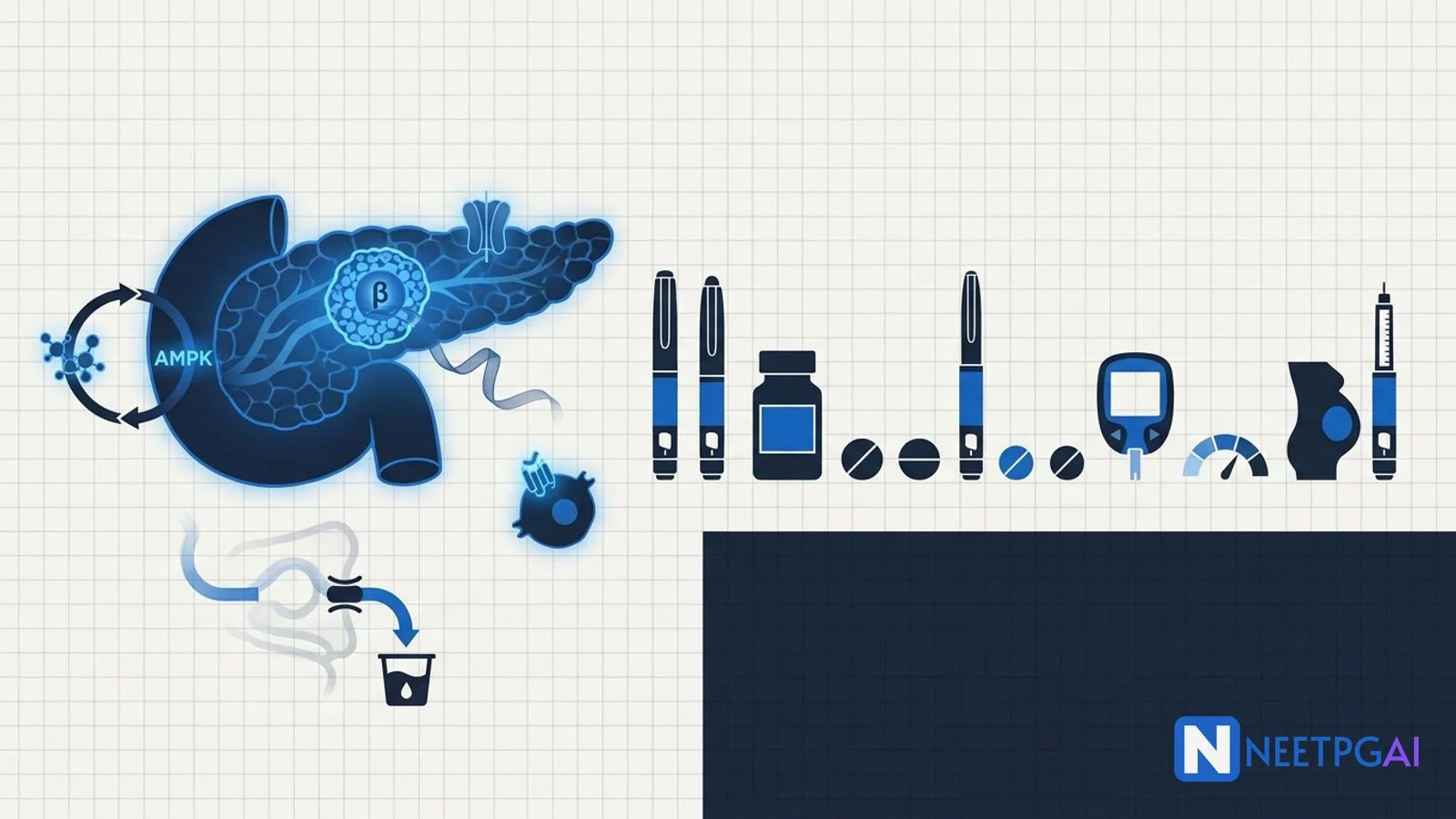
    Antidiabetic Drugs Pharmacology for NEET PG 2026: Complete Guide
    30 Apr 2026
    antidiabetic drugs
    insulin

    Antidiabetic Drugs Pharmacology for NEET PG 2026: Complete Guide

    Master antidiabetic pharmacology for NEET PG 2026 — insulins, sulfonylureas, metformin, DPP-4, SGLT2, GLP-1 analogs, ADA 2025 algorithm, ADRs, DOC tables.

    Read more
    Antihypertensive Drugs Pharmacology for NEET PG 2026: Classes, DOC, ADRs
    21 Apr 2026
    antihypertensives
    ACE inhibitors

    Antihypertensive Drugs Pharmacology for NEET PG 2026: Classes, DOC, ADRs

    Master antihypertensive pharmacology for NEET PG 2026 — ACEi, ARBs, CCBs, beta-blockers, diuretics, drug-of-choice, ADRs, and hypertensive emergency drugs.

    Read more
    Antiepileptic Drugs for NEET PG 2026: Mechanisms, DOC, ADRs, Status Algorithm
    10 Apr 2026
    antiepileptic drugs
    epilepsy

    Antiepileptic Drugs for NEET PG 2026: Mechanisms, DOC, ADRs, Status Algorithm

    Master antiepileptic drug pharmacology for NEET PG 2026 — mechanism by class, drug-of-choice by seizure type, key ADRs, pregnancy choices, and the status epilepticus algorithm.

    Read more
    pharmacology
    Free AI tutor trial · No card required

    Stuck on a Pharmacology concept? Ask the AI tutor.

    Trained on standard textbooks (Harrison's, Robbins, KD Tripathi, BD Chaurasia, Bailey & Love). Drop your email — we'll send a one-tap link to start asking questions. 3 free messages per day, ongoing.

    • Cite-anchored answers (chapter + page when applicable)
    • Mermaid diagrams and clinical pearls inline
    • NEET PG-tuned, never generic ChatGPT

    Why aspirants choose NEETPGAI for Pharmacology

    AI-first preparation built specifically for the NEET PG question pattern.

    Textbook-quality AI explanations

    Every Pharmacology MCQ comes with a detailed Claude-authored explanation citing standard references (Harrison's, Bailey & Love, Robbins, Park's etc.) — never a one-line answer key.

    SM-2 spaced repetition

    Wrong answers auto-schedule for review at expanding intervals (1d → 3d → 7d → 21d). Most aspirants need only half the practice volume to retain the same recall.

    PYQ-aligned question patterns

    Every Pharmacology question is generated against the NMC syllabus and validated against the last 5 years of NEET PG / INI-CET previous year questions.

    24/7 AI Tutor for Pharmacology doubts

    Stuck on a tricky topic? Ask the AI Tutor anytime — it answers in seconds with diagrams, mnemonics, and clinical pearls tailored to NEET PG.

    Ready to test yourself?

    Test your Pharmacology knowledge with AI-powered MCQs and detailed explanations — no signup required to try.

    Practice Pharmacology MCQs

    Pharmacology preparation FAQs

    Common questions from NEET PG aspirants preparing Pharmacology.

    Sources & references
    1. NEETPGAI PYQ Database — Pharmacology module (N = 825 approved questions)
    2. NMC NEET PG Syllabus 2026 — Pharmacology section (68 topics across 10 systems)
    3. KD Tripathi — Essentials of Medical Pharmacology, 9th Edition (Jaypee Brothers, New Delhi)
    4. Gobind Rai Garg & Sparsh Gupta — Review of Pharmacology, 14th Edition (Jaypee Brothers)
    5. WHO Adverse Drug Reaction Classification Framework (Uppsala Monitoring Centre, 2023)

    Ready to master Pharmacology?

    Sign up free and practice all 2082+ MCQs with AI-powered explanations tailored to your performance.

    Create Free Account

    Daily rhythm

    • On a study day, spend the first 45 minutes reading one KD Tripathi chapter section, the next 30 minutes making a one-page receptor/mechanism table, and the final 15 minutes solving 10-15 NEETPGAI MCQs on that exact topic. Do not mix topics within a single session — topic-focused drilling builds pattern recognition faster.

    Weekly rhythm

    • Every Sunday, do a 30-question mixed Pharmacology mock. Review every wrong answer by tracing back to the mechanism in KD Tripathi — not just the correct option.

    High-yield topic tactics

    • For Antiepileptics: map each drug to its mechanism (sodium channel blockade — phenytoin, carbamazepine; GABA enhancement — valproate, benzodiazepines; T-type calcium channel — ethosuximide) and its teratogenic profile. NEET PG 2026 questions in this area will embed a pregnant woman or a drug interaction scenario.
    • For Parkinson's drugs: know the adjuncts to levodopa-carbidopa cold — COMT inhibitors (entacapone, tolcapone), MAO-B inhibitors (selegiline, rasagiline), and dopamine agonists (pramipexole, ropinirole). Know which agents are NOT recommended in fluctuating Parkinson's disease and why.

    Mistakes to avoid

    • Do not skip Adverse Drug Reaction classification (Type A-F). It appears in 1-2 questions every paper and is easy marks if you know the WHO framework.
    • Do not over-invest in rare drug names at the cost of mechanism mastery. NEET PG 2026 will test whether you understand why a beta-1 selective blocker (metoprolol, atenolol) is preferred in a diabetic patient — not whether you can list 12 beta blockers.
    • Do not ignore Drug Interactions — TMP-SMX, rifampicin, warfarin interactions, and P-glycoprotein/CYP450 enzyme inducers/inhibitors are perennial favourites.

    Revision rhythm

    • First revision at Day 7 (use NEETPGAI spaced-repetition flashcards), second at Day 21, third at Day 60. Three revisions before the exam is the minimum for Pharmacology retention given the volume of 68 topics.