Version 1.0 — Published May 2026
Quick Answer
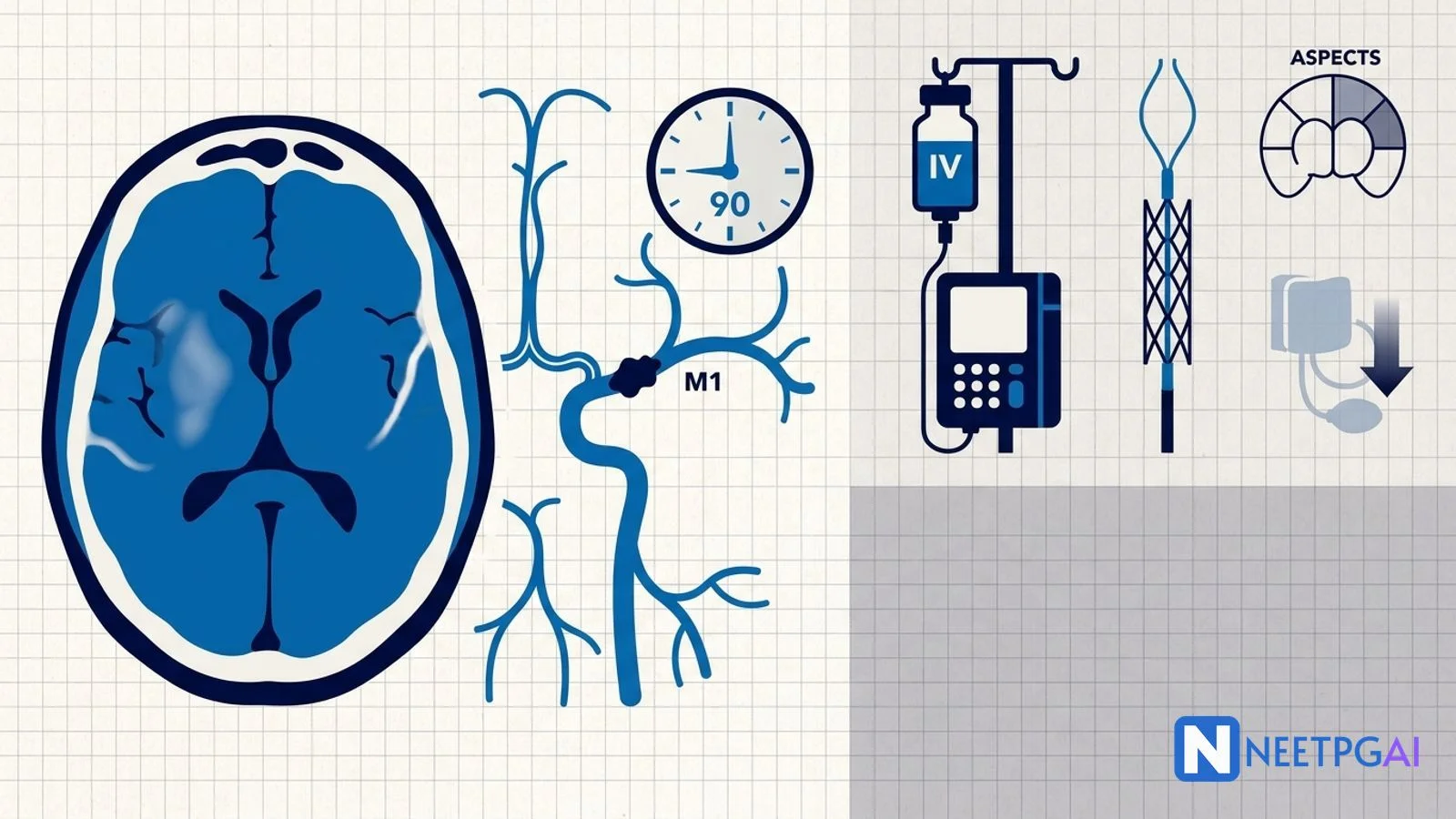
Acute ischemic stroke is a neurological emergency where every minute of delayed reperfusion equals 1.9 million neurons lost. In a 68-year-old with sudden right hemiparesis, expressive aphasia, and a clear last-known-well time of 90 minutes ago, follow this 7-step workflow:
- Recognise the stroke within 10 minutes — BE-FAST positive, NIHSS score, last-known-well time, fingerstick glucose
- Activate stroke code, get NCCT head within 25 minutes — primary goal: rule out hemorrhage
- Assess tPA eligibility — onset <4.5 h, no absolute contraindications, BP controllable to <185/110
- Administer IV alteplase 0.9 mg/kg (max 90 mg; 10 percent bolus, rest over 60 minutes) — door-to-needle target <60 minutes (gold-star centres <45)
- Image the vessels — CTA head and neck for large-vessel occlusion (LVO); ASPECTS on NCCT
- Refer for mechanical thrombectomy if LVO and within 24 h (DAWN/DEFUSE 3 selection)
- Manage BP, glucose, temperature, and dysphagia — ICU/stroke unit; hourly neuro checks for 24 h
Door-to-needle time is the single most important variable: every 15-minute reduction in door-to-needle time increases independent ambulation at discharge by 3 percent.
The case
A 68-year-old retired schoolteacher from Lucknow is brought to the emergency department by her son at 4:30 PM. She was last seen completely well at 3:00 PM when she finished tea. At around 3:10 PM the son heard a thud and found her on the floor of the living room, unable to lift her right arm and unable to speak coherently — she could only produce garbled sounds and one or two recognisable words. There was no head injury witnessed, no preceding chest pain, no headache, no vomiting, no seizure. Last-known-well time is documented as 3:00 PM; the stroke is therefore approximately 90 minutes old at presentation.
Past medical history is significant for hypertension on telmisartan 40 mg + hydrochlorothiazide 12.5 mg (compliant), type 2 diabetes on metformin 500 mg BD with HbA1c 7.4 percent at last review 2 months ago, and dyslipidemia on atorvastatin 20 mg. She does not smoke, does not drink. No prior stroke or TIA. No atrial fibrillation diagnosis but has not had a recent ECG. No anticoagulation. No recent surgery, no head trauma in the last 3 months, no GI bleed, no malignancy. No allergies.
On arrival, vitals are: pulse 88/min irregular, BP 180/100 mmHg, respiratory rate 18/min, SpO2 96 percent on room air, temperature 36.9 C, capillary glucose 156 mg/dL. She is alert but distressed, able to follow simple one-step commands intermittently. Right facial droop with preserved forehead movement (UMN pattern). Right arm drifts to bed within 5 seconds, right leg drifts but holds against gravity briefly. Expressive aphasia — non-fluent, single-word output, comprehension preserved for simple commands. Right-sided extensor plantar. No neck stiffness. Cardiovascular: irregularly irregular pulse, no murmurs. Chest clear. Abdomen unremarkable.
The triage nurse activates the stroke code and the patient is wheeled to CT within 4 minutes of arrival.
NIHSS score: 14 — best language 2 (severe expressive aphasia, comprehension intact), best gaze 1 (partial right gaze preference), facial palsy 2 (partial UMN), motor right arm 3 (no effort against gravity), motor right leg 2 (some effort against gravity), sensory 1 (mild right hemisensory loss), dysarthria 1, neglect 1, level of consciousness questions 1, level of consciousness commands 0, ataxia 0, visual fields 0.
Non-contrast CT head: No hemorrhage. Subtle loss of grey-white differentiation in the left insular ribbon ("insular ribbon sign"). Hyperdense left MCA sign suggestive of intraluminal thrombus. ASPECTS score 9/10 (one point deducted for left insula).
ABCD assessment and initial workflow
Acute ischemic stroke management runs parallel — resuscitation, diagnosis, eligibility check, and reperfusion all start within the first 10 minutes.
A — Airway: Patent. GCS 14 (E4 V3 M6 — verbal 3 due to aphasia). No need for intubation; risk of airway compromise low at this NIHSS.
B — Breathing: RR 18, SpO2 96 percent on room air. Supplemental O2 only if SpO2 <94 percent (routine O2 in normoxic stroke patients does not improve outcome and may worsen oxidative injury).
C — Circulation: BP 180/100, irregularly irregular pulse. Two large-bore IVs (18G). 12-lead ECG to confirm new atrial fibrillation. BP must be lowered to <185/110 BEFORE tPA: IV labetalol 10 mg over 1-2 minutes, repeat or double up to 150 mg total, OR IV nicardipine infusion 5 mg/h titrated. If BP cannot be controlled to under 185/110, do NOT give tPA.
D — Disability/Dextrose: GCS 14, glucose 156 (acceptable; treat if <50 or >400). NIHSS 14 — moderate-to-severe stroke. Last-known-well 3:00 PM, current time 4:30 PM (90 minutes). Within 4.5-hour tPA window.
Initial workflow checklist (target 25 minutes door-to-CT, 60 minutes door-to-needle):
- Stroke code activated; neurologist paged
- NIHSS performed and documented
- Fingerstick glucose, fingerstick INR if on warfarin
- 12-lead ECG, telemetry
- Bloods: CBC, electrolytes, BUN/creatinine, glucose, troponin, coagulation (PT/INR, aPTT)
- NCCT head within 25 minutes — rule out hemorrhage and assess ASPECTS
- CTA head and neck immediately after CT — identify LVO for thrombectomy decision
- Two large-bore IVs; cross-match if active bleeding suspected
- Speak to family for last-known-well time, anticoagulants, surgery, code status
- Prepare alteplase weight-based dose; have it drawn before final eligibility confirmation
Stroke recognition — FAST, BE-FAST, and the imitators
FAST and BE-FAST
The classic FAST mnemonic is the public-facing recognition tool:
- F — Face droop: asymmetric smile or lower facial weakness
- A — Arm drift: raise both arms; one drifts down within 10 seconds
- S — Speech difficulty: slurred speech, word-finding difficulty, or comprehension problem
- T — Time to call emergency: time of onset matters
BE-FAST adds two more screens that catch the 14 percent of strokes missed by FAST — predominantly posterior circulation events:
- B — Balance: new sudden ataxia or unsteady gait
- E — Eyes: sudden visual loss, diplopia, or visual field defect
Any single new finding triggers stroke pathway activation. Don't wait for "all" features — partial syndromes are still strokes.
Stroke mimics — what looks like stroke but isn't
| Mimic | Discriminating features |
|---|
| Hypoglycemia | Glucose <60; deficit reverses with dextrose |
| Postictal Todd's paresis | Witnessed seizure; resolves over hours; preserved language often |
| Complicated migraine | Headache history; gradual aura; cortical spreading depression; visual aura; preserved language |
| Conversion / functional | Inconsistent exam, give-way weakness, Hoover sign, no objective signs |
| Sepsis / metabolic encephalopathy | Fever, AMS without focal signs, raised lactate or ammonia |
| Brain tumor | Subacute deficit over weeks; seizure presentation; mass effect on imaging |
| Bell's palsy | Lower facial weakness PLUS forehead involvement (LMN) — UMN pattern in stroke spares forehead |
In our patient, the abrupt onset, focal cortical deficit (aphasia + UMN right hemiparesis), normal glucose, and CT findings make ischemic stroke the diagnosis.
NIHSS — the mandatory bedside scale
NIHSS (National Institutes of Health Stroke Scale) is a 15-item neurological exam, scored 0-42. Higher scores = worse stroke. Time-limited NIHSS (within 5-7 minutes) at the bedside is mandatory before tPA decision.
| NIHSS | Severity |
|---|
| 0 | No stroke |
| 1-4 | Minor stroke |
| 5-15 | Moderate stroke |
| 16-20 | Moderate-to-severe stroke |
| 21-42 | Severe stroke |
Key thresholds for NEET PG:
- NIHSS >25 is a relative contraindication to tPA in the 3-4.5 h window
- NIHSS <5 with non-disabling deficit — tPA may be deferred (but disabling minor strokes still benefit)
- NIHSS >6 with LVO — strong thrombectomy candidate
Imaging — NCCT, CTA, and ASPECTS
Non-contrast CT head
The first imaging study. Goal: rule out hemorrhage (which would contraindicate tPA) and assess early ischemic changes.
Early signs of acute ischemic stroke on NCCT:
- Hyperdense MCA sign — clot in the M1 segment appears bright (50-90 HU)
- Insular ribbon sign — loss of grey-white differentiation in the insula
- Loss of basal ganglia outlines — early lentiform nucleus obscuration
- Cortical sulcal effacement — local mass effect from edema
- Established hypodensity — present after 6-12 hours; if >1/3 MCA territory, contraindicates tPA
ASPECTS — Alberta Stroke Program Early CT Score
10-point scale assessing 10 MCA territory regions on NCCT (M1-M6, caudate, lentiform, internal capsule, insula). Subtract 1 point for each region with early ischemic changes.
| ASPECTS | Implication |
|---|
| 10 | No early ischemic changes |
| 8-9 | Small core; good thrombectomy candidate |
| 6-7 | Moderate core; thrombectomy still beneficial in most |
| <6 | Large established infarct; thrombectomy benefit reduced; reperfusion may cause hemorrhagic transformation |
Our patient has ASPECTS 9 — excellent thrombectomy candidate if LVO confirmed.
CTA head and neck
Look for large vessel occlusion (LVO): intracranial ICA, M1, proximal M2, basilar, or vertebral. LVO is the indication for mechanical thrombectomy.
Our patient's CTA shows a left M1 occlusion with collateral filling from anterior cerebral artery. Perfect thrombectomy target.
MR imaging in extended window
For patients in the 6-24 hour window or with unclear last-known-well time (e.g., wake-up stroke), MRI with diffusion-weighted imaging (DWI) and perfusion imaging or CT perfusion is used to identify salvageable penumbra:
- DWI — diffusion restriction = infarct core
- PWI/CT perfusion — Tmax >6 sec = penumbra
- Mismatch between core and penumbra defines salvageable tissue
DAWN and DEFUSE 3 trials use perfusion mismatch to select late-window thrombectomy candidates.
Diagnosis
Acute ischemic stroke in the left middle cerebral artery (M1) territory with cortical involvement (Broca's area) producing right hemiparesis (UMN) and expressive aphasia, NIHSS 14, ASPECTS 9, presenting 90 minutes from last-known-well in a 68-year-old hypertensive diabetic with newly identified atrial fibrillation — Class I indication for IV alteplase plus mechanical thrombectomy.
Management — door-to-needle ≤60 minutes is the goal
IV alteplase (tPA)
Dose: 0.9 mg/kg IV (max 90 mg). 10 percent as IV bolus over 1 minute; remaining 90 percent infused over 60 minutes.
Eligibility (0-3 hours from onset, NINDS):
- Age ≥18, NIHSS ≥1
- Last-known-well within 3 hours
- BP controllable to <185/110
- No absolute contraindications
Eligibility (3-4.5 hours, ECASS III adds these exclusions):
- Age over 80
- NIHSS over 25
- Oral anticoagulant use (regardless of INR)
- History of both stroke AND diabetes
Absolute contraindications to alteplase
- Any history of intracranial hemorrhage
- Ischemic stroke or significant head trauma within 3 months
- Intracranial or intraspinal surgery within 3 months
- Intracranial neoplasm (intra-axial), AVM, or aneurysm
- Suspected SAH
- Active internal bleeding
- Bleeding diathesis: platelets <100k, INR >1.7, aPTT >40 sec
- Therapeutic LMWH within 24 hours
- DOAC within 48 hours (unless reversed)
- BP >185/110 not controlled
- Blood glucose <50 mg/dL
- CT showing established hypodensity >1/3 MCA territory
- GI malignancy or bleed within 21 days
Tenecteplase as an alternative
Tenecteplase 0.25 mg/kg single IV bolus is now used at many centres — non-inferior to alteplase, easier to administer (no infusion pump needed), and especially advantageous when the patient must be transferred to a thrombectomy centre. EXTEND-IA TNK and AcT trials established equivalence.
Mechanical thrombectomy
Indications (Class I, 0-6 hours): disabling LVO stroke (intracranial ICA, M1, proximal M2, basilar) with NIHSS ≥6 and ASPECTS ≥6, within 6 hours of last-known-well, mRS 0-1 baseline, age ≥18.
Extended window (6-24 hours): based on imaging mismatch:
- DAWN trial (6-24 h): clinical-imaging mismatch (NIHSS-vs-infarct-core mismatch). Older patients ≥80 with NIHSS ≥10 and core <21 mL; or NIHSS ≥10 and core <31 mL; or NIHSS ≥20 and core <51 mL.
- DEFUSE 3 trial (6-16 h): perfusion mismatch — core <70 mL, penumbra-to-core ratio >1.8, absolute mismatch volume >15 mL.
Both trials produced NNT 2-3 for functional independence — among the most effective interventions in all of medicine.
Bridging strategy
In LVO patients eligible for both, give IV alteplase first, then proceed to thrombectomy ("drip and ship" or "mothership"). Delaying alteplase to wait for thrombectomy worsens outcome.
Our patient's pathway
She is 90 minutes from onset, NIHSS 14, ASPECTS 9, BP controlled to 178/95 with IV labetalol then nicardipine, no contraindications. IV alteplase 0.9 mg/kg (weight 60 kg = 54 mg total, 5.4 mg bolus, 48.6 mg over 60 min). CTA confirms left M1 occlusion. Stroke team activates the cath lab. Mechanical thrombectomy with stent retriever achieves TICI 2b reperfusion at 165 minutes from onset. Door-to-needle time: 38 minutes. Door-to-groin: 90 minutes.
Post-procedure she is admitted to the stroke ICU. Within 24 hours, NIHSS improves from 14 to 4 (mild residual aphasia and right hand weakness only). MRI at 24 hours shows a small infarct in the left insula and inferior frontal gyrus — vastly less than the at-risk territory. By day 5 she is discharged to inpatient rehabilitation with mRS 2.
Post-thrombolysis / post-thrombectomy care
First 24 hours (stroke unit / ICU)
- BP target <180/105 for first 24 hours post-tPA (lower than non-tPA stroke)
- No antiplatelets or anticoagulants for 24 hours after tPA
- Hourly NIHSS for first 4 hours, then q2h for 8 hours, then q4h
- Repeat NCCT at 24 hours before starting antiplatelets — rule out hemorrhagic transformation
- DVT prophylaxis with mechanical compression initially; pharmacological after 24 h imaging
- Glucose control to 140-180 mg/dL — both hyperglycemia and hypoglycemia worsen outcome
- Temperature control — treat fever >37.5 with paracetamol; hyperthermia worsens outcome
- Dysphagia screen before any oral intake — aspiration pneumonia is the leading early complication
Days 1-7
- Antiplatelet — aspirin 162-325 mg loading then 75-100 mg daily after 24-h imaging clear
- DAPT (aspirin + clopidogrel) for 21 days for minor non-cardioembolic stroke (CHANCE, POINT) then aspirin alone
- Anticoagulation for cardioembolic stroke (e.g., AF) — typically warfarin or DOAC; timing depends on infarct size:
- Small TIA: start day 1
- Small stroke: start day 3
- Moderate stroke: start day 6
- Large stroke: start day 12-14 (the "1-3-6-12 day rule")
- High-intensity statin — atorvastatin 80 mg or rosuvastatin 20-40 mg regardless of LDL
- BP control — target <130/80 within 1 month
- Diabetes control — HbA1c target individualised, typically <7
- Smoking cessation, dietary counselling, weight optimisation
- Multidisciplinary rehabilitation — physiotherapy, occupational therapy, speech-language therapy
Etiology workup
- TTE for cardiac source (especially in cryptogenic stroke); TEE if PFO/atrial appendage suspected
- Carotid Doppler or CTA — symptomatic carotid stenosis >50 percent → carotid endarterectomy or stenting
- Holter monitor or implantable loop recorder for paroxysmal AF (CRYSTAL AF: ICM detected AF in 8.9 percent of cryptogenic strokes vs 1.4 percent with conventional monitoring)
- Lipid profile, HbA1c, hypercoagulable workup if young/cryptogenic
Complications — what to watch for
Early (first 24-72 hours)
- Hemorrhagic transformation — symptomatic ICH in 6 percent post-alteplase; sudden neurological deterioration, headache, vomiting; stop tPA infusion if active, urgent CT, FFP/cryoprecipitate, neurosurgery
- Malignant MCA infarction — large hemispheric infarct, midline shift, herniation in days 2-5; decompressive hemicraniectomy in patients ≤60 (DESTINY/DECIMAL/HAMLET trials) reduces mortality from 70 to 30 percent
- Cerebral edema / raised ICP — hypertonic saline, mannitol, head elevation, hyperventilation as bridging
- Aspiration pneumonia — leading cause of post-stroke fever and 30-day mortality
- Seizure — 5-10 percent post-stroke; lamotrigine or levetiracetam preferred; routine prophylactic AEDs not indicated
- DVT/PE — mechanical compression early, pharmacological after hemorrhage excluded
- Hyperglycemia — independent predictor of worse outcome; target 140-180
Late
- Post-stroke depression — 30 percent; SSRIs effective (fluoxetine also has motor recovery signal — FLAME trial)
- Spasticity — physiotherapy, oral baclofen/tizanidine, botulinum toxin for focal spasticity
- Shoulder subluxation — common in flaccid hemiplegia; sling, electrical stimulation
- Recurrent stroke — 10 percent at 1 year without secondary prevention; secondary prevention reduces by 50-80 percent
India-specific considerations
NEET PG vignettes increasingly include India-specific context. Key points:
Access to thrombectomy. India has roughly 200 comprehensive stroke centres for 1.4 billion population — most in metros. Tier-2 and rural India rely on drip-and-ship strategies: alteplase given at primary centre, transfer to thrombectomy centre. Telestroke networks (e.g., AIIMS hub-and-spoke models, ICMR pilots) are expanding tPA access; tPA in India is approximately 8-15 percent in tier-1 cities and <2 percent overall.
Generic alteplase. Generic alteplase made in India costs roughly ₹25,000-30,000 per dose vs branded ₹40,000-60,000 — still a major out-of-pocket barrier. PMJAY covers tPA in empanelled hospitals; many states have state-level stroke programs (e.g., Kerala, Tamil Nadu).
Risk factor profile. Indians have stroke at younger ages (mean 55-60 vs 70 in West), higher proportion of intracerebral hemorrhage (25-30 percent vs 10-15 percent), and high rates of hypertension, diabetes, and tobacco use. RHD-related cardioembolic stroke is more common; CHA2DS2-VASc thresholds for anticoagulation apply but RHD with AF is automatically high-risk.
Tenecteplase availability. Tenecteplase (used widely for STEMI in India) is increasingly used off-label or under emerging guideline endorsement for stroke — logistically simpler, cheaper, and bolus-only.
Public-health structure. National Programme for Prevention and Control of Cancer, Diabetes, CVD and Stroke (NPCDCS) under Ministry of Health funds CHC/PHC-level screening and stabilisation; ICMR-NCDIR maintains the National Stroke Registry.
How NEET PG tests acute stroke
Seven recurring patterns. Recognise the pattern and the question collapses.
Pattern 1 — The tPA window question: Vignette gives last-known-well time. Within 4.5 h with no contraindications? Give alteplase 0.9 mg/kg. Trap: vignette mentions wake-up stroke or unknown onset — answer is MRI DWI/FLAIR mismatch or perfusion imaging (WAKE-UP trial), not "no thrombolysis."
Pattern 2 — The BP-before-tPA question: Patient eligible but BP 195/115. Next step? Lower BP to <185/110 with IV labetalol or nicardipine, THEN give tPA. Trap: "withhold tPA" — wrong; control BP first. Different rule for non-tPA stroke (permissive HTN up to 220/120).
Pattern 3 — The thrombectomy window question: Wake-up stroke with unclear onset, NIHSS 18, M1 occlusion. Best management? Perfusion-imaging-based thrombectomy (DAWN/DEFUSE 3 criteria) up to 24 hours. Trap: assuming ">6 hours = no intervention" — wrong since DAWN/DEFUSE 3.
Pattern 4 — The contraindication question: Vignette gives recent surgery, recent stroke, or anticoagulation. Tests recognition of absolute contraindications. Trap: "ischemic stroke 6 weeks ago" excludes tPA (within 3 months).
Pattern 5 — The localisation question: Right hemiparesis + expressive aphasia = left MCA, dominant hemisphere, Broca's area. Right hemiparesis + receptive aphasia = left MCA, Wernicke's area. Left hemiparesis + neglect = right MCA, non-dominant. Quadriparesis + cranial nerve signs = basilar.
Pattern 6 — The post-tPA hemorrhage question: Sudden deterioration after alteplase, headache, vomiting. Next step? Stop alteplase if still infusing, urgent NCCT, cryoprecipitate (10 units) ± FFP and platelets, neurosurgery consult.
Pattern 7 — The secondary-prevention question: Patient with new AF post-stroke. When to start anticoagulation? 1-3-6-12 day rule based on infarct size: TIA day 1, small day 3, moderate day 6, large day 12-14. DOAC preferred over warfarin for non-valvular AF.
High-yield one-liners:
- IV alteplase 0.9 mg/kg (max 90 mg), 10% bolus, rest over 60 min, within 4.5 h
- Door-to-CT <25 min, door-to-needle <60 min, door-to-groin <90 min
- Pre-tPA BP <185/110, post-tPA BP <180/105 for 24 h, non-tPA stroke permissive HTN to 220/120
- ASPECTS ≥6 for thrombectomy candidacy
- DAWN: 6-24 h, clinical-core mismatch; DEFUSE 3: 6-16 h, perfusion mismatch core <70 mL
- Hemorrhagic transformation post-tPA: stop infusion, NCCT, cryoprecipitate + FFP
- Decompressive hemicraniectomy in malignant MCA infarction in patients ≤60 (DESTINY/DECIMAL/HAMLET)
- 1-3-6-12 day rule for starting anticoagulation in AF post-stroke
- DAPT (aspirin + clopidogrel) for 21 days only in minor non-cardioembolic stroke (CHANCE/POINT)
- BE-FAST adds Balance and Eyes — catches posterior circulation strokes missed by FAST
Frequently Asked Questions
What is the time window for IV alteplase in acute ischemic stroke?
IV alteplase (tPA) is approved within 4.5 hours of symptom onset (or last-known-well time when onset is unwitnessed) for eligible patients. The 0-3 hour window is the strongest indication; the 3-4.5 hour window is supported by ECASS III with additional exclusions (age over 80, NIHSS over 25, oral anticoagulation regardless of INR, history of both stroke and diabetes). The standard dose is 0.9 mg/kg IV (max 90 mg) — 10 percent as a bolus over 1 minute, the remainder infused over 60 minutes. Tenecteplase 0.25 mg/kg single bolus is increasingly used as a non-inferior alternative with logistical advantages, particularly before transfer for thrombectomy.
When is mechanical thrombectomy indicated and what trials defined the extended window?
Mechanical thrombectomy is indicated for large vessel occlusion (intracranial ICA, M1, and selected M2/basilar) with disabling deficit and salvageable brain tissue. The standard window is 0-6 hours from last-known-well based on the 2015 trials (MR CLEAN, ESCAPE, EXTEND-IA, SWIFT PRIME, REVASCAT). The extended window of 6-24 hours uses imaging-based selection: DAWN (6-24 h, NIHSS-vs-infarct-volume mismatch) and DEFUSE 3 (6-16 h, perfusion mismatch with core under 70 mL and penumbra-to-core ratio over 1.8). ASPECTS score on non-contrast CT helps quickly screen for thrombectomy candidacy — a score under 6 typically excludes patients due to large established infarct.
How is blood pressure managed before and after tPA in acute stroke?
Pre-tPA: BP must be lowered to under 185/110 before alteplase is given — use IV labetalol 10-20 mg or IV nicardipine infusion. If BP cannot be controlled, do not give tPA. Post-tPA: maintain BP under 180/105 for the first 24 hours to reduce hemorrhagic transformation risk; check BP every 15 min for 2 hours, then every 30 min for 6 hours, then hourly. For non-tPA-eligible ischemic stroke, permissive hypertension up to 220/120 is acceptable in the first 24 hours unless there is end-organ damage, aortic dissection, or another indication for treatment — aggressive lowering reduces collateral perfusion to the penumbra and worsens outcome.
What are the absolute contraindications to IV alteplase in acute ischemic stroke?
Absolute contraindications: any history of intracranial hemorrhage; ischemic stroke or significant head trauma within 3 months; intracranial or intraspinal surgery within 3 months; intracranial neoplasm (intra-axial), AVM, or aneurysm; suspected subarachnoid hemorrhage; active internal bleeding; bleeding diathesis (platelets under 100k, INR over 1.7, aPTT over 40, recent therapeutic LMWH); BP over 185/110 not controlled; blood glucose under 50 mg/dL; CT showing established hypodensity over one-third of MCA territory; recent gastrointestinal malignancy or bleed within 21 days. Relative contraindications include minor or rapidly improving deficit, recent major surgery within 14 days, recent MI within 3 months, pregnancy, and seizure at onset with post-ictal residual deficit.
How is FAST and BE-FAST applied at the bedside for stroke recognition?
FAST is the standard mnemonic — Face droop, Arm drift, Speech difficulty, Time to call emergency. BE-FAST adds Balance (sudden ataxia or vertigo) and Eyes (sudden visual loss or diplopia) at the front, capturing posterior circulation strokes that classic FAST misses. Roughly 14 percent of ischemic strokes are missed by FAST alone; BE-FAST reduces missed posterior strokes by about half. At the bedside: ask the patient to smile, raise both arms, repeat a sentence, walk a few steps if safe, and look at a moving target. Any new abnormality in any of these prompts immediate stroke pathway activation, even if the patient looks otherwise stable.
This content is for educational purposes for NEET PG exam preparation. It is not a substitute for professional medical advice, diagnosis, or treatment. Clinical information has been reviewed by qualified medical professionals.
Written by: NEETPGAI Editorial Team
Reviewed by: Pending SME Review
Last reviewed: May 2026