Version 1.0 — Published May 2026
Quick Answer
Psychiatry contributes 4-6 questions per NEET PG paper, often paired with pharmacology and forensic medicine. The 15 most expensive mistakes cluster around diagnostic duration cut-offs, antipsychotic side effects, suicide risk assessment, ECT use, and the legal framework. To protect your marks:
- Do not assign DSM-5 schizophrenia subtypes — DSM-5 abolished them; ICD-10 still uses paranoid, disorganised, catatonic, undifferentiated, residual
- Lock the duration boundaries — brief psychotic less than 1 month, schizophreniform 1-6 months, schizophrenia 6 months or more
- Differentiate mood disorders correctly — bipolar I (mania), bipolar II (hypomania plus major depression), cyclothymia (chronic less-severe), persistent depressive disorder (dysthymia)
- Use a validated suicide risk assessment — Columbia Suicide Severity Rating Scale or SAD PERSONS; recognise warning signs
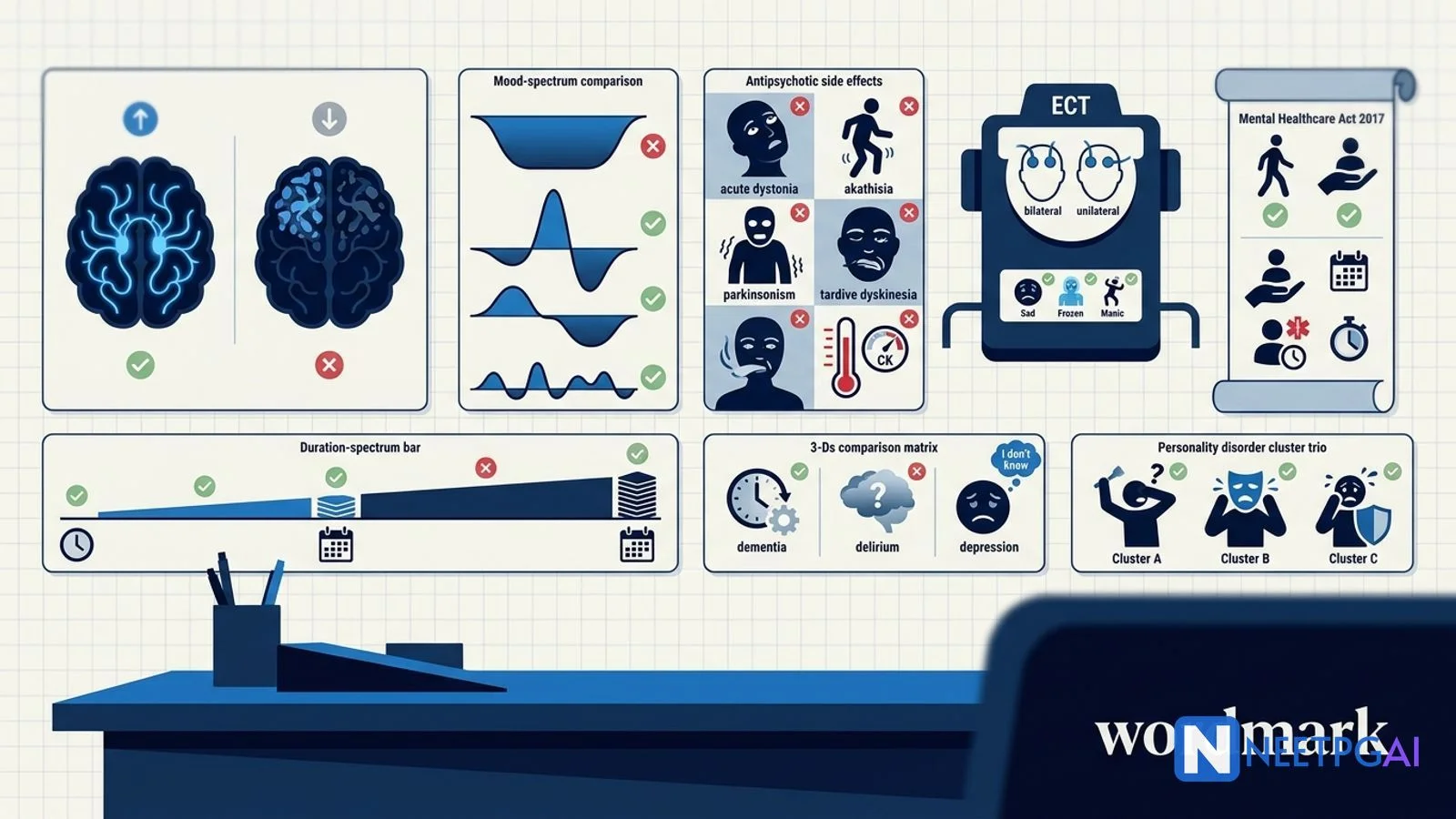
- Match the antipsychotic side effect to its time course — acute dystonia (hours), akathisia (days), parkinsonism (weeks), tardive dyskinesia (months-years), NMS (hours-days)
- Recognise neuroleptic malignant syndrome immediately — hyperthermia, rigidity, autonomic instability, altered mental status, raised CK
- Know ECT indications and that there are no absolute contraindications — first-line for severe suicidal depression and catatonia, NOT for schizophrenia
- Read child psychiatry milestones correctly — ADHD age under 12, autism social and communication deficits with restricted interests, conduct disorder rule-breaking
- Distinguish anorexia restrictive vs binge-purge and bulimia nervosa — BMI cut-off, compensatory behaviours
- Apply substance use diagnostic criteria — 2 of 11 in DSM-5 (mild 2-3, moderate 4-5, severe 6+)
- Apply the 3 D's framework for the elderly — dementia (chronic), delirium (acute, fluctuating, inattention), depression (slow, intact attention)
- Cluster personality disorders A/B/C correctly — A (eccentric — paranoid, schizoid, schizotypal), B (dramatic — antisocial, borderline, histrionic, narcissistic), C (anxious — avoidant, dependent, OCPD)
- Recognise sleep disorder tetrad and triad — narcolepsy (excessive daytime sleepiness, cataplexy, sleep paralysis, hypnagogic hallucinations), RLS (Willis-Ekbom)
- Apply MHCA 2017 correctly — 30-day supported admission, advance directive, decriminalised suicide attempt
- Know the correct neurotransmitter associations and avoid the common myths
Why psychiatry mistakes are costly
Psychiatry sits at the intersection of clinical medicine, pharmacology, and law. A single misclassified mood disorder, a missed NMS, or an outdated MHCA reference on an MCQ can cost 1-2 marks; in practice, missing a suicide risk can mean lost lives, missing NMS can be fatal, and using ECT inappropriately can cause harm and stigma. NEET PG, INI-CET, and FMGE examiners increasingly test psychiatry through clinical vignettes that probe diagnostic acumen, pharmacological judgement, ECT indications, and the legal framework.
The 15 mistakes below come from analysis of NEET PG 2019-2024 psychiatry questions and represent the most frequent error patterns.
Mistake 1: Citing DSM-5 schizophrenia subtypes (they no longer exist)
Why students get it wrong: Older textbooks (Kaplan-Sadock pre-2013, ICD-10) describe paranoid, disorganised (hebephrenic), catatonic, undifferentiated, and residual schizophrenia. Many Indian psychiatry teaching materials still use these.
How to remember it correctly:
- DSM-5 (2013) abolished schizophrenia subtypes because of poor inter-rater reliability and limited prognostic value
- ICD-10 still uses subtypes; ICD-11 (2018, adopted by India formally) also moved to a dimensional approach
- DSM-5 criteria for schizophrenia — A: 2 or more of (delusions, hallucinations, disorganised speech, disorganised or catatonic behaviour, negative symptoms), with at least one being delusions, hallucinations, or disorganised speech, for at least 1 month (active phase); B: significant functional impairment; C: continuous signs for at least 6 months
- NEET PG follows DSM-5 conventions for most modern questions; if a question specifically uses ICD-10 framework, subtypes are valid
Trap: A vignette describing a young man with prominent persecutory delusions, intact affect, and preserved cognition — the older "paranoid schizophrenia" — should be answered as "schizophrenia" under DSM-5 framework, not "paranoid type".
Mistake 2: Missing the duration boundaries for psychotic disorders
Why students get it wrong: All psychotic disorders look similar on cross-section. Duration is the key discriminator and is often glossed over.
How to remember it correctly:
| Disorder | Duration | Functional outcome |
|---|
| Brief psychotic disorder | 1 day to less than 1 month | Full return to premorbid functioning |
| Schizophreniform disorder | 1 month to less than 6 months | Variable; 1/3 progress to schizophrenia |
| Schizophrenia | 6 months or more (1 month active phase) | Significant functional impairment |
| Schizoaffective disorder | Same as schizophrenia plus prominent mood episodes; psychosis present without mood for at least 2 weeks | Intermediate prognosis |
| Delusional disorder | 1 month or more, non-bizarre delusions, no other psychotic symptoms, functioning preserved apart from delusion impact | Excellent if delusion is encapsulated |
Memory aid: 1 day - 1 month - 6 months — brief - schizophreniform - schizophrenia.
Mistake 3: Confusing bipolar I, bipolar II, and cyclothymia
Why students get it wrong: Three "bipolar-spectrum" disorders blur in students' minds.
How to remember it correctly:
- Bipolar I disorder — at least one MANIC episode (1 week or more of elevated/irritable mood + 3 of DIGFAST: Distractibility, Indiscretion, Grandiosity, Flight of ideas, Activity increase, Sleep decrease, Talkativeness/pressured speech; 4 if mood is only irritable); requires hospitalisation, psychotic features, or marked impairment; depression not required for diagnosis but usually present
- Bipolar II disorder — at least one HYPOMANIC episode (4 days or more, same symptoms but milder, no hospitalisation or psychosis) AND at least one major depressive episode
- Cyclothymia — chronic (2 years or more, 1 year in children/adolescents) fluctuation between sub-syndromal hypomania and sub-syndromal depression; never meets criteria for full manic/hypomanic/major depressive episode
- Persistent depressive disorder (dysthymia) — chronic low-grade depression for 2 years or more (1 year in children)
Trap: A patient with a manic episode plus depression is BIPOLAR I (not bipolar II); a single manic episode is sufficient for bipolar I diagnosis.
Mistake 4: Underestimating suicide risk assessment
Why students get it wrong: Students rely on intuition rather than structured tools.
How to remember it correctly:
- SAD PERSONS mnemonic (adult): Sex (male), Age (under 19 or over 45), Depression, Previous attempt, Ethanol/substance use, Rational thinking loss, Social support lacking, Organised plan, No spouse, Sickness (chronic illness)
- Columbia Suicide Severity Rating Scale (C-SSRS) — preferred in modern practice for both intensity (ideation, intent, plan, behaviour) and recency
- Highest-risk groups — males, elderly, prior attempts (strongest single predictor — 30-40x risk), comorbid depression and substance use, hopelessness, organised plan with access to means, recent discharge from psychiatric hospital
- Protective factors — family support, religious/spiritual beliefs, future-orientation, children at home
- In India — pesticide poisoning and self-immolation are the leading methods; restrictive access to means (pesticide regulation) is a public-health intervention; the National Mental Health Programme (NMHP) and DMHP (District Mental Health Programme) include suicide prevention
Mistake 5: Mismatching antipsychotic side effects to their time course
Why students get it wrong: EPS is treated as one entity; the time course differs sharply.
How to remember it correctly:
| Side effect | Onset | Treatment |
|---|
| Acute dystonia | Hours to days; oculogyric crisis, torticollis, trismus, laryngeal | IM benztropine, IM diphenhydramine, IV/IM lorazepam |
| Akathisia | Days to weeks; subjective inner restlessness, motor restlessness | Propranolol, benztropine, lower dose, switch to lower-EPS antipsychotic |
| Parkinsonism | Weeks to months; tremor, rigidity, bradykinesia, mask facies | Benztropine, lower dose, switch |
| Tardive dyskinesia | Months to years; oro-facial dyskinesia, lip smacking, tongue darting — often IRREVERSIBLE | VMAT-2 inhibitors (valbenazine, deutetrabenazine), switch to clozapine |
| Neuroleptic malignant syndrome | Hours to days; hyperthermia, lead-pipe rigidity, autonomic instability, raised CK | STOP antipsychotic; supportive care; dantrolene or bromocriptine |
Memory aid: Hours-days-weeks-months/years — dystonia, akathisia, parkinsonism, tardive dyskinesia.
Mistake 6: Missing neuroleptic malignant syndrome (NMS)
Why students get it wrong: NMS overlaps with sepsis, heatstroke, and serotonin syndrome.
How to remember it correctly:
- NMS tetrad — hyperthermia, severe muscle rigidity (lead-pipe), autonomic instability (BP swings, tachycardia, diaphoresis), altered mental status
- Lab findings — raised CK (often over 1000), raised WBC, raised LFTs, AKI from rhabdomyolysis
- Triggers — initiation or dose increase of antipsychotics (any class, highest with typical), abrupt withdrawal of dopaminergic agents (levodopa, dopamine agonists)
- Treatment — STOP the offending drug; aggressive supportive care (IV fluids, cooling, ICU); dantrolene 1-2.5 mg/kg IV for severe rigidity; bromocriptine 2.5-5 mg PO three times daily; benzodiazepines for agitation; consider ECT in refractory cases
- Distinguish from serotonin syndrome — SS shows hyperreflexia, clonus, MORE common shivering; NMS shows lead-pipe rigidity; both can have hyperthermia and autonomic instability
- Distinguish from malignant hyperthermia — MH triggered by inhaled anaesthetics or succinylcholine in genetically susceptible patients (RyR1 mutation); treat with dantrolene
Mistake 7: Treating ECT as a last-resort or as first-line for schizophrenia
Why students get it wrong: Films and stigma portray ECT as barbaric or as a default for psychosis.
How to remember it correctly:
- First-line indications for ECT — severe major depression with suicidal intent, psychotic depression, depression with food refusal, peripartum depression with suicidal intent, catatonia (any cause)
- Strong indications — severe mania refractory to mood stabilisers, schizophrenia with catatonic features OR severe refractory positive symptoms (NOT first-line — antipsychotics are first-line)
- Emerging indications — neuroleptic malignant syndrome refractory to medical treatment
- No absolute contraindications — every case is a relative risk-benefit decision
- Relative contraindications — raised intracranial pressure (space-occupying lesion, recent stroke), recent MI (4-6 weeks), unstable arrhythmia, severe osteoporosis (managed with succinylcholine), retinal detachment, pheochromocytoma
- Procedure — short-acting GA (methohexital or propofol), muscle relaxation (succinylcholine), bilateral or unilateral electrode placement, monitored seizure 20-60 seconds, 6-12 sessions over 2-4 weeks
- MHCA 2017 mandates — anaesthesia required (no "direct ECT" without anaesthesia); banned in minors except with MHRB approval
Mistake 8: Confusing ADHD, autism, and conduct disorder in children
Why students get it wrong: All three present with "difficult-to-manage" children.
How to remember it correctly:
- ADHD — inattention (6 or more symptoms — careless mistakes, difficulty sustaining attention, doesn't listen, fails to finish tasks, disorganised, avoids effortful tasks, loses things, distracted, forgetful) AND/OR hyperactivity-impulsivity (6 or more — fidgets, leaves seat, runs/climbs inappropriately, can't play quietly, always on the go, talks excessively, blurts out, can't wait turn, interrupts) for at least 6 months, onset BEFORE age 12, in 2 or more settings
- Autism spectrum disorder (ASD) — persistent deficits in social communication and social interaction (3 areas: social-emotional reciprocity, non-verbal communication, relationships), PLUS restricted repetitive behaviours/interests (2 of 4: stereotypy, insistence on sameness, restricted interests, sensory issues); symptoms must be present in early developmental period
- Conduct disorder — repetitive and persistent pattern of behaviour violating others' basic rights or major societal norms (aggression to people/animals, destruction of property, deceitfulness/theft, serious violation of rules); 3 or more behaviours in past 12 months; onset can be childhood (under 10) or adolescent
- Oppositional defiant disorder (ODD) — milder than conduct disorder; angry/irritable mood, argumentative/defiant behaviour, vindictiveness; lasts at least 6 months
- DSM-5 change — Asperger syndrome merged into autism spectrum disorder; "pervasive developmental disorder" terminology replaced by "autism spectrum disorder"
Mistake 9: Confusing anorexia subtypes and bulimia
Why students get it wrong: All eating disorders involve disturbed eating and body image.
How to remember it correctly:
- Anorexia nervosa — restriction of energy intake leading to significantly low body weight (DSM-5 dropped the strict BMI under 17.5 cut-off; criterion is "less than minimally normal" based on age, sex, developmental trajectory, physical health), intense fear of weight gain, distorted body image
- Restricting subtype — weight loss through diet, fasting, excessive exercise; no binge-purge in last 3 months
- Binge-eating/purging subtype — recurrent binge eating or purging (vomiting, laxatives, diuretics, enemas) in the last 3 months, while still meeting low-weight criterion
- Bulimia nervosa — recurrent binge eating (loss of control, large amount in discrete period) PLUS compensatory behaviours (vomiting, laxatives, fasting, excessive exercise) at least ONCE A WEEK for 3 months; body weight is normal or overweight (NOT underweight — that's anorexia binge-purge subtype)
- Binge eating disorder (DSM-5 new) — recurrent binge eating without compensatory behaviours; at least once a week for 3 months
- Avoidant/restrictive food intake disorder (ARFID) — disturbed eating without body-image disturbance; often in children with sensory issues, autism
Memory aid: Anorexia binge-purge subtype is still underweight; bulimia is normal weight or overweight.
Mistake 10: Misapplying DSM-5 substance use criteria
Why students get it wrong: Old DSM-IV separated "abuse" and "dependence"; DSM-5 merged them.
How to remember it correctly:
- DSM-5 substance use disorder — a single category with 11 criteria; severity is graded by number met
- Mild — 2-3 criteria
- Moderate — 4-5 criteria
- Severe — 6 or more criteria
- The 11 criteria (DSM-5):
- Larger amounts/longer time than intended
- Persistent desire/unsuccessful attempts to cut down
- Time spent obtaining/using/recovering
- Craving
- Failure to fulfil major obligations (work, school, home)
- Continued use despite social/interpersonal problems
- Important activities given up
- Use in physically hazardous situations
- Continued use despite physical/psychological problems
- Tolerance
- Withdrawal
- Old DSM-IV abuse-vs-dependence terminology is obsolete — but you'll still see "alcohol dependence" in Indian clinical practice and older Indian textbooks
Mistake 11: Confusing the 3 D's (dementia, delirium, depression) in the elderly
Why students get it wrong: All three present with cognitive impairment in elderly patients.
How to remember it correctly:
| Feature | Dementia | Delirium | Depression |
|---|
| Onset | Insidious, months-years | Acute, hours-days | Variable, weeks |
| Course | Progressive, slow | Fluctuating, worse at night (sundowning) | Steady |
| Duration | Years | Days-weeks | Months |
| Attention | Preserved early, impaired late | Markedly impaired (hallmark) | Mildly impaired |
| Consciousness | Clear | Clouded, fluctuating | Clear |
| Memory | Recent then remote affected | Variable | Selective ("don't know") |
| Affect | Variable, often shallow | Anxious, fearful, irritable | Low, hopeless |
| Sleep | Normal initially, disrupted late | Disrupted, sundowning | Insomnia or hypersomnia |
| Reversibility | Mostly irreversible | Reversible if cause treated | Reversible with treatment |
| MMSE/MoCA pattern | Persistent deficits | Fluctuating deficits | Variable — pseudodementia |
| EEG | Normal early or slow late | Diffuse slowing | Normal |
| Treatment | Cholinesterase inhibitors, memantine | Treat underlying cause (infection, drugs, metabolic) | Antidepressants, ECT |
Pseudodementia of depression — elderly patient appears demented but answers "I don't know" to questions, intact attention, responds to antidepressants. NEET PG tests this distinction.
Mistake 12: Mis-clustering personality disorders
Why students get it wrong: 10 personality disorders are hard to memorise without clustering.
How to remember it correctly:
- Cluster A — eccentric/odd ("MAD")
- Paranoid — suspicious, mistrustful
- Schizoid — detached, solitary, anhedonic
- Schizotypal — odd beliefs, magical thinking, social anxiety
- Cluster B — dramatic/emotional ("BAD")
- Antisocial — disregard for rights of others, criminality, no remorse (M:F 5:1)
- Borderline — unstable affect, identity, relationships; impulsivity; self-harm; abandonment fears (M:F 1:3)
- Histrionic — attention-seeking, sexually provocative, theatrical
- Narcissistic — grandiose, lack of empathy, need for admiration
- Cluster C — anxious/fearful ("SAD")
- Avoidant — feels inadequate, sensitive to criticism, avoids social interaction
- Dependent — submissive, clinging, fear of separation
- Obsessive-compulsive personality disorder (OCPD) — preoccupation with order, perfectionism, control; DIFFERENT from OCD (which has ego-dystonic obsessions and compulsions)
Memory aid: MAD, BAD, SAD = A, B, C.
Mistake 13: Missing the narcolepsy tetrad and RLS
Why students get it wrong: Sleep disorders are deprioritised in revision.
How to remember it correctly:
- Narcolepsy tetrad
- Excessive daytime sleepiness (EDS) — irresistible sleep attacks
- Cataplexy — sudden loss of muscle tone triggered by strong emotion (laughter, anger); pathognomonic of narcolepsy type 1
- Sleep paralysis — inability to move at sleep onset or offset
- Hypnagogic (onset) or hypnopompic (offset) hallucinations
- Pathophysiology — loss of hypocretin (orexin) neurons in lateral hypothalamus; HLA-DQB1 association
- Diagnosis — polysomnography (PSG) followed by Multiple Sleep Latency Test (MSLT) showing mean sleep latency under 8 minutes and 2 or more sleep-onset REM periods (SOREMPs)
- Treatment — modafinil for EDS, sodium oxybate (GHB) for cataplexy, SSRIs/SNRIs for cataplexy
- Restless legs syndrome (RLS / Willis-Ekbom disease) — urge to move legs with uncomfortable sensations, worse at rest, worse in evening/night, relieved by movement
- Causes — idiopathic (genetic), iron deficiency (ferritin under 75), pregnancy, uraemia, neuropathy
- Treatment — iron supplementation if ferritin under 75, dopamine agonists (pramipexole, ropinirole), gabapentin, low-dose opioids
Mistake 14: Misquoting the Mental Healthcare Act 2017 (MHCA 2017)
Why students get it wrong: Older Indian textbooks still describe MHA 1987 admission categories (voluntary, involuntary, reception orders).
How to remember it correctly:
- MHCA 2017 replaced MHA 1987 (effective from May 2018 in most states)
- Key reforms:
- Right to access mental healthcare as part of right to health
- Decriminalisation of attempted suicide (Section 115) — presumed under severe stress
- Advance directive — patient can specify treatment preferences for future mental illness
- Nominated representative — patient-chosen substitute decision-maker
- Mental Health Review Boards (MHRB) — district and state-level review
- Prohibition of ECT without anaesthesia and on minors except with MHRB approval
- No sterilisation as treatment for mental illness
- Chaining and restraint prohibited
- Admission categories:
- Independent admission (Section 86) — voluntary, patient self-requests, can leave anytime
- Admission of minor (Section 87) — parent/guardian consent for under-18; MHRB review at 3 days
- Supported admission up to 30 days (Section 89) — patient lacks capacity, two psychiatrists agree, nominated representative consents
- Supported admission beyond 30 days (Section 90) — MHRB review and approval
- Emergency treatment up to 72 hours (Section 94) — without formal admission
Trap: Questions referring to "reception order" or "indoor patient under MHA" are using the obsolete MHA 1987 framework.
Mistake 15: Believing common neurotransmitter myths
Why students get it wrong: Pop-science oversimplifies neurotransmitter roles.
How to remember it correctly:
- MYTH: "Depression is just low serotonin" — REALITY: depression involves multiple systems (serotonin, noradrenaline, dopamine, glutamate, GABA, BDNF, HPA axis); the simple "chemical imbalance" model is outdated. SSRIs work but the mechanism is more complex than simple serotonin restoration. NMDA antagonists (ketamine, esketamine) are effective in treatment-resistant depression.
- MYTH: "Dopamine is the pleasure neurotransmitter" — REALITY: dopamine encodes reward prediction error and motivational salience, not pleasure per se. Opioid and endocannabinoid systems mediate hedonic pleasure.
- MYTH: "Schizophrenia is just too much dopamine" — REALITY: classic dopamine hypothesis (mesolimbic excess for positive symptoms; mesocortical hypoactivity for negative symptoms) is a partial truth. Glutamate (NMDA) hypofunction, GABA interneuron dysfunction, and neurodevelopmental pruning abnormalities are also key. This is why clozapine (less D2 blockade, more 5-HT2A) and emerging non-dopaminergic drugs (xanomeline-trospium, an M1/M4 muscarinic agonist) are effective.
- MYTH: "All antidepressants take 6 weeks to work" — REALITY: structural changes begin within hours; mood improvement often starts at 2-3 weeks; full response by 6-8 weeks. Ketamine works in hours.
- MYTH: "Benzodiazepines are safe long-term" — REALITY: tolerance, dependence, cognitive impairment, fall risk in elderly, paradoxical disinhibition in some patients; reserve for short-term (under 4 weeks) use
- Correct neurotransmitter associations for NEET PG:
- Dopamine excess (mesolimbic) — positive symptoms of schizophrenia, addiction, vomiting (chemoreceptor trigger zone)
- Dopamine deficiency (nigrostriatal) — Parkinson disease, EPS from antipsychotics
- Serotonin — mood, sleep, appetite, sexual function, anxiety; gastrointestinal motility
- Noradrenaline — arousal, attention, autonomic function
- Acetylcholine — memory (deficient in Alzheimer disease), parasympathetic
- GABA — inhibitory; benzodiazepines, alcohol, barbiturates target GABA-A
- Glutamate — excitatory; NMDA hypofunction in schizophrenia; excitotoxicity in stroke
How to use this guide
- Rapid revision — bookmark this article; reread 1-2 weeks before NEET PG
- Active recall — close the article and try to recall each mistake's "Why" and "How"
- Pair with PYQs — for each of the 15 mistakes, find 3-5 PYQs that tested it; do them in the NEETPGAI question bank with the "psychiatry-mistakes" tag
- Spaced repetition — schedule reviews at 1d, 3d, 7d, 14d, 30d using Anki or NEETPGAI's flashcards
- Mock simulation — take 4-5 psychiatry mini-tests of 25 questions each; track which mistakes you still make; iterate
Final summary
Psychiatry rewards precision in three dimensions — diagnostic criteria with duration cut-offs, pharmacological side-effect pattern recognition, and legal framework (MHCA 2017). Most NEET PG psychiatry failures come from outdated frameworks (DSM-IV instead of DSM-5, MHA 1987 instead of MHCA 2017, abolished schizophrenia subtypes), incorrect time-course matching for antipsychotic side effects, and missing the 3 D's distinction in elderly cognitive impairment. Lock these 15 mistakes, drill PYQs, and your psychiatry accuracy will move from 50 to 80 percent.
Frequently Asked Questions
How many psychiatry questions appear in NEET PG and what are the highest-yield topics?
Psychiatry contributes 4-6 questions per NEET PG paper (2021-2024 paper analysis), often overlapping with internal medicine, pharmacology, and forensic medicine. High-yield topic clusters are diagnostic criteria with duration cut-offs (brief psychotic disorder, schizophreniform, schizophrenia, mood disorders), antipsychotic and antidepressant side-effect profiles (EPS, NMS, tardive dyskinesia, serotonin syndrome, metabolic syndrome), ECT indications and contraindications, suicide risk assessment, dementia vs delirium vs depression in the elderly, substance use diagnostic criteria, child psychiatry milestones (ADHD vs autism vs conduct), and the Mental Healthcare Act (MHCA) 2017 admission categories. The 15 mistakes in this guide cover roughly 65-75 percent of typical psychiatry question failures.
What is the difference between brief psychotic disorder, schizophreniform disorder, and schizophrenia?
All three present with psychotic symptoms (delusions, hallucinations, disorganised thought or behaviour, negative symptoms) but differ by duration. Brief psychotic disorder — symptoms last from 1 day to less than 1 month with eventual full return to premorbid functioning. Often precipitated by stressors (postpartum, bereavement) and has the best prognosis. Schizophreniform disorder — symptoms last 1 month to less than 6 months. May or may not have full functional recovery. About one-third progress to schizophrenia. Schizophrenia — symptoms last 6 months or more, with at least 1 month of active-phase symptoms (delusions, hallucinations, disorganised speech, disorganised or catatonic behaviour, negative symptoms — at least 2 of these, with at least one being delusions, hallucinations, or disorganised speech). Significant functional impairment is required. NEET PG tests these duration cut-offs every paper — the 1 month / 6 month boundary is the most common trap. DSM-5 abolished the schizophrenia subtypes (paranoid, disorganised, catatonic, undifferentiated, residual) — questions referring to these subtypes are outdated and reflect ICD-10 framework.
How are antipsychotic side effects categorised and which require urgent intervention?
Antipsychotics cause six broad categories of side effects. Extrapyramidal symptoms (EPS) — acute dystonia (hours to days; oculogyric crisis, torticollis, trismus; treat with IM benztropine or diphenhydramine, lorazepam), akathisia (days to weeks; inner restlessness, motor restlessness; treat with propranolol, benztropine, lower-dose antipsychotic), parkinsonism (weeks to months; tremor, rigidity, bradykinesia; treat with benztropine, lower dose), tardive dyskinesia (months to years; oro-facial dyskinesias, irreversible; treat with VMAT-2 inhibitors valbenazine or deutetrabenazine, switch to clozapine). Neuroleptic malignant syndrome (NMS) — emergency. Hyperthermia, severe rigidity (lead-pipe), autonomic instability, altered mental status, raised CK and WBC; treat by stopping the antipsychotic, supportive care, IV fluids, cooling, dantrolene or bromocriptine for severe cases. Metabolic syndrome — weight gain, dyslipidaemia, diabetes (worst with olanzapine and clozapine); monitor weight, lipids, FBS, HbA1c. Hyperprolactinaemia — galactorrhoea, gynaecomastia, amenorrhoea, sexual dysfunction (worst with risperidone, paliperidone, haloperidol; less with aripiprazole). QT prolongation — torsades de pointes risk (worst with thioridazine, IV haloperidol); ECG before treatment, avoid in long QT syndrome. Agranulocytosis with clozapine — weekly CBC for 18 weeks, then 2-weekly to 1 year, then 4-weekly. Urgent intervention required for NMS, severe EPS (laryngeal dystonia), agranulocytosis, torsades, and serotonin syndrome (if SSRI co-prescribed).
What are the indications and contraindications for ECT in psychiatric practice?
Electroconvulsive therapy (ECT) is highly effective but reserved for specific indications because of its invasive nature and stigma. Primary indications — severe major depression with suicidal intent or psychotic features (response rate over 80 percent, faster than antidepressants), catatonia (any cause — psychiatric, neurological, medical), severe mania refractory to mood stabilisers, severe schizophrenia with catatonic features or refractory positive symptoms (NOT first-line for schizophrenia, contrary to popular belief), neuroleptic malignant syndrome (an emerging indication when dopamine agonists fail), peripartum depression with suicidal intent or refusal to eat/care for baby. Absolute contraindications — none for life-threatening psychiatric emergencies (always a relative risk-benefit decision). Relative contraindications — raised intracranial pressure (space-occupying lesion, recent stroke), recent myocardial infarction within 4-6 weeks, unstable cardiac arrhythmia, severe osteoporosis with high fracture risk (managed by succinylcholine muscle relaxant during ECT), retinal detachment, pheochromocytoma. NEET PG repeatedly tests that ECT is NOT first-line for schizophrenia (antipsychotics are), that catatonia of any cause is a strong indication, and that there are NO absolute contraindications. Bilateral vs unilateral electrode placement, current dose titration, and 6-12 sessions over 2-4 weeks are typical.
What is the Mental Healthcare Act 2017 (MHCA 2017) and how does it govern admission categories in India?
The Mental Healthcare Act 2017 (MHCA 2017) replaced the Mental Health Act 1987 and reformed psychiatric admission and treatment in India. Key provisions are right to access mental healthcare, decriminalisation of attempted suicide (Section 115 — presumed under severe stress, not punishable), advance directive for future mental illness, nominated representative, prohibition of ECT without anaesthesia and on minors, and Mental Health Review Boards (MHRB) at district and state levels. Admission categories under MHCA 2017 — Independent admission (Section 86, voluntary, patient self-requests admission, can leave anytime). Admission of minors (Section 87, parent/guardian consent for under 18, MHRB review at 3 days). Supported admission up to 30 days (Section 89, when patient lacks capacity to make informed decisions due to mental illness, two psychiatrists agree, nominated representative consents, MHRB notified). Supported admission beyond 30 days (Section 90, MHRB review and approval). Section 92-94 deal with absconding, transfer between MHE. Emergency treatment up to 72 hours (Section 94) without formal admission. NEET PG tests the duration cut-offs (30 days vs beyond 30 days), the consent framework (nominated representative, advance directive), and the decriminalisation of suicide attempt under Section 115. Also remember that the older Indian Lunacy Act (1912) and Mental Health Act 1987 are obsolete.
This content is for educational purposes for NEET PG exam preparation. It is not a substitute for professional medical advice, diagnosis, or treatment. Clinical information has been reviewed by qualified medical professionals.
Written by: NEETPGAI Editorial Team
Reviewed by: Pending SME Review
Last reviewed: May 2026