Quick Answer
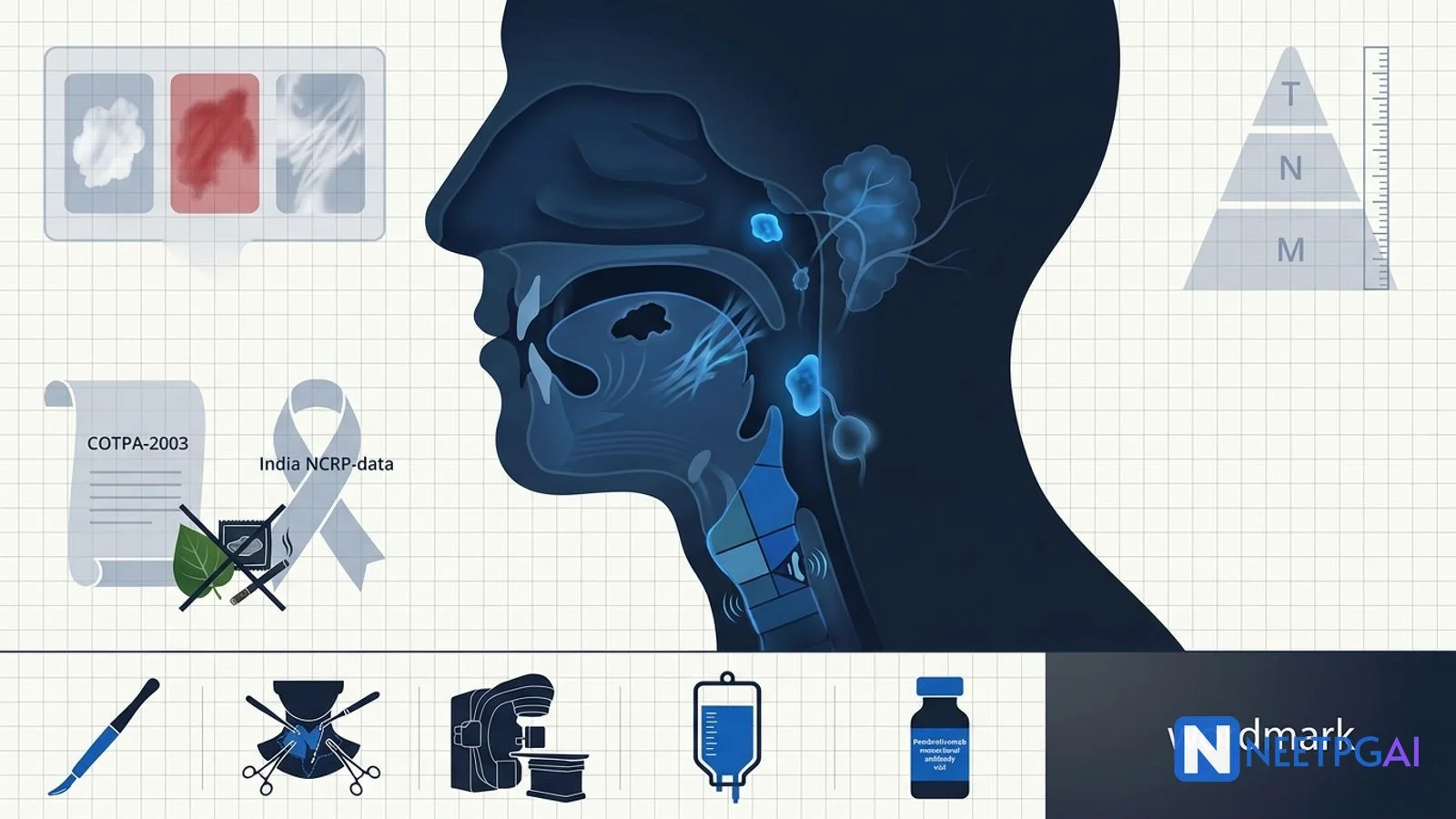
Head and neck cancer is a 2 to 4 question topic per NEET PG paper with disproportionate India relevance. Lock these:
- Oral cancer — most common cancer in Indian males (30 percent of all male cancers); tobacco + areca nut.
- OSMF — areca nut driven; 7 to 13 percent malignant transformation.
- Glottic cancer — best prognosis (early hoarseness, sparse lymphatics).
- NPC — EBV-linked; Cantonese cancer; cluster in Northeast India; cisplatin chemoradiation.
- HPV-positive oropharyngeal — separate AJCC 8 staging; better prognosis.
- Salivary gland — pleomorphic adenoma is the most common benign; mucoepidermoid is the most common malignant.
- COTPA Act 2003 — banned smoking in public places, advertising, sale to minors.
Head and neck cancer is uniquely Indian in epidemiology — oral cancer alone accounts for about 30 percent of all cancers in Indian males, the highest national share globally. The reason is the South Asian-specific habit of chewing tobacco-areca-nut quids (paan, gutka, khaini, mishri), reinforced by bidi smoking. The Cigarettes and Other Tobacco Products Act (COTPA, 2003), the National Tobacco Control Programme (NTCP), and the National Cancer Registry Programme (NCRP) are the policy responses you need to know.
This NEETPGAI deep dive walks through oral, laryngeal, nasopharyngeal, oropharyngeal, salivary gland, and thyroid cancer — with AJCC TNM 8 staging, management principles, and Indian programmatic context. Pair this with the autonomic pharmacology guide and the otitis media and sinusitis ENT guide for full ENT coverage.
Oral cavity cancer
Epidemiology — India context
The most common cancer in Indian males. NCRP 2020 reports — male age-adjusted incidence 11 to 13 per 100,000; tongue and buccal mucosa are the leading subsites (vs floor-of-mouth in the West).
Risk factors
- Tobacco — bidi, cigarette, chewing tobacco (paan, gutka, khaini, mawa, mishri).
- Areca (betel) nut — independent carcinogen (IARC group 1); central to OSMF.
- Alcohol — synergistic with tobacco.
- HPV — modest role in oral cavity proper; major role in oropharynx.
- Chronic mucosal trauma — sharp teeth, ill-fitting dentures.
- Genetic — Fanconi anaemia, dyskeratosis congenita.
Pre-malignant lesions
| Lesion | Appearance | Malignant transformation |
|---|
| Leukoplakia | White patch that cannot be wiped off, not explained by other disease | 5 to 10 percent (higher if non-homogeneous, dysplastic) |
| Erythroplakia | Red velvety patch | 50 percent or higher (highest risk) |
| Oral submucous fibrosis (OSMF) | Fibrous bands, trismus, blanching | 7 to 13 percent over 10 years |
| Speckled leukoplakia | Mixed white and red | Higher than pure leukoplakia |
| Lichen planus (erosive) | Wickham striae | 1 to 2 percent |
Histology and subsites
Oral squamous cell carcinoma (OSCC) dominates (over 90 percent). Indian subsite distribution: tongue (lateral border most common), buccal mucosa, gingiva, floor of mouth, hard palate, lip.
Clinical features
Non-healing ulcer > 2 weeks, indurated edges, fixity to deep tissues, cervical lymphadenopathy (levels I-II first), referred otalgia (via auriculotemporal nerve), trismus, dysphagia, weight loss.
Investigations
- Biopsy of all suspicious lesions (incisional for large; excisional for small).
- MRI — preferred for soft-tissue extent.
- CT — bony involvement (mandible erosion).
- PET-CT — staging, distant metastasis, occult primary.
- Panendoscopy — second primary screening (5 to 10 percent synchronous in upper aerodigestive tract).
AJCC TNM 8 staging — key changes
- Depth of invasion (DOI) added to T staging (separate from tumour size). DOI > 5 mm upstages.
- Extranodal extension (ENE) added to N staging (N3b for clinically detected ENE).
Treatment
- T1-T2 (early) — wide local excision with 1 cm clear margin + elective neck dissection if DOI > 3 mm. Adjuvant RT if positive margins or ENE.
- T3-T4 (locally advanced) — composite resection (commando operation with marginal/segmental mandibulectomy) + selective or modified radical neck dissection + reconstruction (free flap) + adjuvant chemoradiation.
- Unresectable / metastatic — concurrent chemoradiation (cisplatin), or palliative chemotherapy (cisplatin + 5-FU + cetuximab — the EXTREME regimen; pembrolizumab for PD-L1 positive).
Laryngeal cancer
| Subsite | Lymphatics | Presentation | Prognosis |
|---|
| Supraglottic (above cords) | Rich bilateral | Late: dysphagia, otalgia, neck mass | Worst (5-year survival 50 to 60%) |
| Glottic (cords) | Sparse | Early: hoarseness | Best (5-year survival up to 90% in T1) |
| Subglottic | Bilateral paratracheal | Late: stridor | Intermediate |
Risk factors — smoking (bidi, cigarette) + alcohol synergistic; GERD; HPV (rare in larynx). All glottic cancers are HPV-negative.
Investigations — flexible nasolaryngoscopy with biopsy; CT/MRI; CT chest for distant metastasis.
Treatment — T1-T2 glottic: transoral laser microsurgery (TLM) or radiotherapy (preserves voice). T3-T4: total laryngectomy + neck dissection + adjuvant chemoradiation OR organ-preservation chemoradiation. Speech rehabilitation with tracheoesophageal prosthesis (TEP) or electrolarynx after total laryngectomy.
Nasopharyngeal carcinoma (NPC)
"Cantonese cancer"
Strong EBV association (over 95 percent of undifferentiated NPC). High incidence in southern China, Hong Kong, North Africa, and a notable cluster in Northeast India (Nagaland, Mizoram, Manipur).
Risk factors
EBV, salt-cured (Cantonese-style) fish, genetic (HLA-A2, certain Asian haplotypes), family history, smoking.
Clinical features
- Cervical lymphadenopathy — upper deep cervical / level II / retropharyngeal node (often the presenting feature).
- Nasal — epistaxis, obstruction, post-nasal drip.
- Ear — unilateral serous otitis media (eustachian tube blockage), hearing loss, otalgia.
- Cranial nerve palsies — III, IV, V, VI from skull base invasion through foramen lacerum.
Investigations
- Endoscopic biopsy of fossa of Rosenmüller (most common site).
- MRI — preferred (skull base, soft tissue).
- Plasma EBV-DNA — screening, response monitoring, prognosis.
Treatment
- T1N0 — radiotherapy alone.
- Stage II to IVA — concurrent chemoradiotherapy with cisplatin; induction or adjuvant chemotherapy in select cases.
- NPC is highly radiosensitive — IMRT is standard.
Oropharyngeal carcinoma — HPV-positive vs HPV-negative
| Feature | HPV-positive | HPV-negative |
|---|
| Subsites | Tonsil, base of tongue | All oropharyngeal sites |
| Patient | Younger, non-smoker, often male | Older, smoker, alcohol |
| Geography | Rising in West; lower in India | Common globally including India |
| Histology | Non-keratinising | Keratinising |
| Stage at presentation | Cystic nodal involvement common | Variable |
| Prognosis | Better (5-year OS over 80%) | Worse (5-year OS 50 to 60%) |
| AJCC TNM 8 | Separate staging system | Standard HNSCC staging |
| Treatment | De-escalation trials active | Concurrent chemoradiation, surgery |
p16 IHC is the surrogate marker for HPV in clinical practice.
Salivary gland tumours
Most common
- Most common gland affected: parotid (80 percent).
- Most common benign: pleomorphic adenoma (mixed tumour) — typically parotid; "pleomorphic" because of epithelial and mesenchymal elements.
- Most common malignant overall: mucoepidermoid carcinoma.
- Most common malignant parotid: mucoepidermoid; most common malignant submandibular: adenoid cystic.
- Bilateral parotid tumour in elderly smoker: Warthin tumour (papillary cystadenoma lymphomatosum).
Key clinical pearls
- The smaller the gland, the higher the malignancy risk — parotid 20 percent malignant, submandibular 50 percent, sublingual/minor glands 70 percent.
- Facial nerve involvement = malignant until proven otherwise.
- FNAC is the initial investigation; ultrasound + MRI for staging.
- Adenoid cystic carcinoma — perineural invasion is hallmark; long indolent course but late distant metastases (lung).
Treatment
Surgery is mainstay — superficial or total parotidectomy with facial-nerve preservation if possible; adjuvant RT for high-grade tumours, ENE, perineural invasion, positive margins.
Thyroid cancer (high-yield head-and-neck overlap)
| Type | Frequency | Cell of origin | Key features |
|---|
| Papillary | 70 to 80% | Follicular | Lymphatic spread; "Orphan Annie" nuclei, psammoma bodies; best prognosis |
| Follicular | 10 to 15% | Follicular | Haematogenous spread (lung, bone); needs capsular/vascular invasion to diagnose |
| Medullary | 5% | Parafollicular C cells | Calcitonin marker; MEN-2A and 2B (RET); amyloid stroma |
| Anaplastic | 1 to 2% | Dedifferentiated | Worst prognosis (months); elderly |
| Lymphoma | < 1% | B cell | Hashimoto association |
Management — total thyroidectomy ± central neck dissection + radioactive iodine ablation (papillary, follicular); levothyroxine TSH suppression. Medullary — total thyroidectomy + central neck dissection; screen for pheo (MEN 2). Anaplastic — multimodality; lenvatinib for advanced.
NEET PG MCQ traps
- Oral cancer — 30 percent of all male cancers in India; tongue (lateral border) most common subsite.
- OSMF — areca nut chewing → trismus, blanching, fibrous bands; 7 to 13 percent malignant transformation.
- Erythroplakia — highest single malignant transformation among pre-cancers.
- Glottic cancer — best prognosis; early hoarseness; sparse lymphatics.
- Supraglottic cancer — worst laryngeal prognosis; rich lymphatics; late presentation.
- Subglottic cancer — stridor; bilateral paratracheal nodes.
- NPC — EBV-associated; Cantonese cancer; cluster in NE India.
- Fossa of Rosenmüller — most common NPC primary site.
- NPC plasma EBV-DNA — screening, response, prognosis.
- HPV-positive oropharyngeal — younger, non-smoker, cystic nodes; better prognosis; separate AJCC 8 staging.
- p16 IHC — surrogate for HPV in oropharynx.
- Pleomorphic adenoma — most common benign salivary tumour; parotid.
- Warthin tumour — bilateral, elderly smoker; only parotid; cold on radionuclide scan.
- Mucoepidermoid carcinoma — most common malignant overall.
- Adenoid cystic carcinoma — perineural invasion hallmark; late lung metastases.
- Facial nerve palsy + parotid mass — malignant until proven otherwise.
- Smaller salivary gland, higher malignancy risk — sublingual/minor 70 percent malignant.
- AJCC TNM 8 — depth of invasion (DOI) added for oral cancer; extranodal extension (ENE) added for nodes.
- EXTREME regimen — cisplatin + 5-FU + cetuximab for metastatic HNSCC.
- Pembrolizumab/nivolumab — PD-L1 positive recurrent/metastatic HNSCC.
- Anaplastic thyroid cancer — worst prognosis (months); elderly.
- Medullary thyroid cancer — calcitonin marker; MEN-2; amyloid stroma.
- Papillary thyroid cancer — psammoma bodies, "Orphan Annie eye" nuclei.
Recent updates and Indian context
- NCRP 2020 — oral cancer 30 percent of male cancers; lip and oral cavity together highest national share globally.
- COTPA Act 2003 — bans smoking in public places, sale to minors (under 18), advertising; pictorial warnings (85 percent of pack since 2016); amendment 2020 added e-cigarette ban.
- NTCP (National Tobacco Control Programme) — covers 612 districts; Tobacco Cessation Centres (TCCs) at district hospitals.
- HPV vaccination — bivalent and quadrivalent HPV vaccines approved in India; ICMR recommends 9-14 years; primarily reducing cervical cancer but also relevant for oropharyngeal HPV cancer.
- Plasma EBV-DNA — emerging biomarker for NPC screening in high-incidence Indian NE states.
- Pembrolizumab and nivolumab — KEYNOTE-048 trial supports pembrolizumab as first-line for recurrent/metastatic HNSCC; Indian availability under NPPDR has expanded.
- Robotic and transoral surgery (TORS) — increasingly used for early oropharyngeal HPV-positive disease in tertiary centres (Tata Memorial, AIIMS).
- Smokeless tobacco ban — over 25 Indian states have banned gutka, paan masala, mawa under the FSS Regulations 2011; enforcement remains uneven.
Frequently asked questions
Why is oral cancer the most common cancer in Indian males?
Oral cancer accounts for about 30 percent of all cancers in Indian males, the highest national share in the world. The driver is the unique South Asian habit of chewing tobacco-containing products — paan, gutka, khaini, mawa, mishri, and the betel quid (paan masala) — which combine tobacco, areca nut, slaked lime, and catechu. These deliver carcinogens (nitrosamines, polycyclic aromatic hydrocarbons) directly to the oral mucosa for prolonged dwell times. Bidi and cigarette smoking add to risk. Pre-cancerous lesions (leukoplakia, erythroplakia, oral submucous fibrosis from areca nut) are common precursors.
What is oral submucous fibrosis (OSMF) and its malignant potential?
Oral submucous fibrosis is a chronic, progressive, fibrosing pre-malignant condition of the oral mucosa caused by areca (betel) nut chewing. Features include burning sensation, restricted mouth opening (trismus), blanching and fibrous bands of the buccal mucosa, palate and tongue. Histology shows juxtaepithelial inflammation, atrophic epithelium, and dense submucosal collagen deposition. Malignant transformation rate is 7 to 13 percent over 10 years. Management — areca nut cessation (absolute), intralesional steroids and hyaluronidase, mouth-opening exercises; severe trismus may need surgical release.
Why is glottic cancer prognostically better than supraglottic cancer?
Glottic carcinoma (true vocal cords) has the best prognosis among laryngeal cancers because (1) the cords have sparse lymphatics — nodal metastases are rare until disease becomes advanced (T3-T4); (2) hoarseness occurs early, prompting earlier presentation and diagnosis; (3) the cords are well-visualised on laryngoscopy. T1 glottic cancer has 90 percent 5-year survival with radiotherapy or transoral laser microsurgery. In contrast, supraglottic cancer (above the cords) has rich bilateral lymphatic drainage, presents late with referred otalgia or dysphagia, and has 50 to 60 percent 5-year survival.
What is the EBV link in nasopharyngeal carcinoma?
Nasopharyngeal carcinoma (NPC) has a unique strong association with Epstein-Barr virus (EBV) — over 95 percent of undifferentiated, non-keratinising NPC cases carry EBV DNA. Other risk factors include consumption of Cantonese-style salt-cured fish (nitrosamines), genetic susceptibility (HLA-A2 haplotype), and family history. NPC has high incidence in Southern China, Hong Kong, North Africa, and a notable cluster in Northeast India (Nagaland, Mizoram, Manipur). Plasma EBV-DNA is used for screening and monitoring response. NPC is highly radiosensitive — concurrent chemoradiotherapy (cisplatin) is the standard of care.
Why is HPV-positive oropharyngeal cancer prognostically distinct?
HPV-positive (especially HPV-16) oropharyngeal squamous cell carcinoma — primarily of the tonsil and base of tongue — is a biologically and clinically distinct disease from HPV-negative tobacco-driven cancer. Patients are younger, often non-smokers, present with cystic cervical nodes, and have markedly better treatment response and overall survival. AJCC TNM 8 (2017) created a separate staging system for HPV-positive oropharyngeal cancer (p16-positive on IHC) reflecting this better prognosis — what would be Stage IV in HPV-negative disease is often Stage I in HPV-positive. Treatment de-escalation trials are active.
This content is for educational purposes for NEET PG exam preparation. It is not a substitute for professional medical advice, diagnosis, or treatment. Clinical information has been reviewed by qualified medical professionals.
Written by: NEETPGAI Editorial Team
Reviewed by: Pending SME Review
Last reviewed: May 2026