Version 1.0 — Published May 2026
Quick Answer
In the final 3 months before NEET PG, mistake-based revision via AI-generated flashcards outperforms topic-based revision by 15-25 marks in cohort analyses. Spending 80 percent of your remaining hours on the 20 percent of the syllabus where you actually lose marks (rather than re-covering what you already know) is the single highest-leverage strategic decision left. Build a personal mistake-bank using this 10-step protocol:
- Understand why mistakes are gold — the recoverable 30-40 percent of your mock score lives here
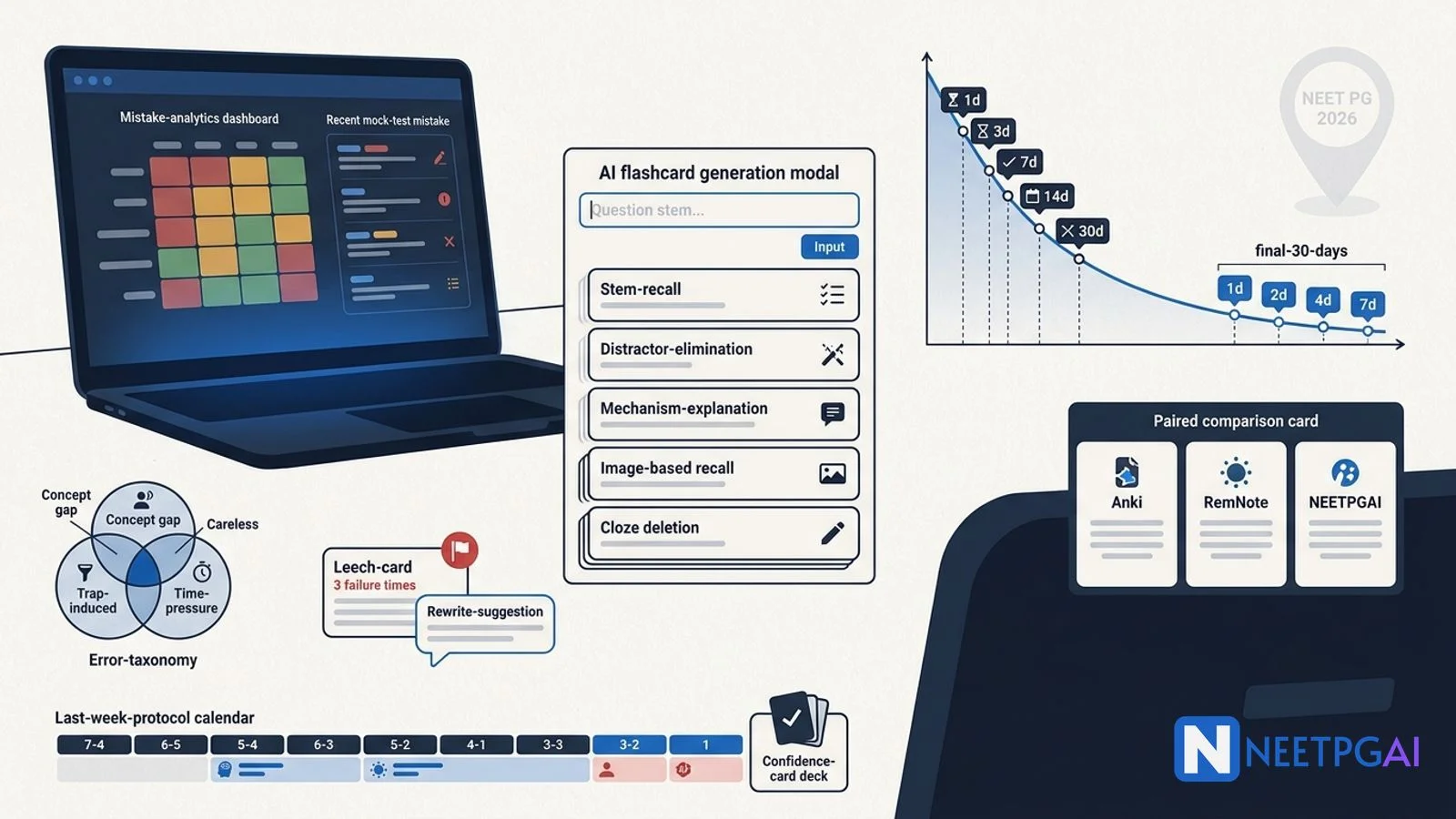
- Tag every mistake by error taxonomy — concept gap, careless, trap-induced, time-pressure
- Extract mistakes from mock tests and practice — auto-export from NEETPGAI analytics; manual journaling for non-digital sources
- Choose your flashcard tool — Anki, RemNote, or NEETPGAI AI flashcards (or a hybrid)
- Follow the SR cadence — 1d / 3d / 7d / 14d / 30d with active recall
- Use AI to generate 3-5 card variants per mistake — stem-recall, distractor elimination, mechanism, image
- Daily review protocol — 15 minutes new cards + 45 minutes reviews; cap total at 60-90 minutes
- Identify and rewrite leech cards — cards that fail 3 or more times need rewriting or deletion
- Measure progress — retention rate, weak-topic surfacing rate, mock-score trend
- Last-week protocol — review only, no new content; consolidate with confidence cards
NEETPGAI's AI flashcard generator automates card creation, embeds spaced repetition, and tags by subject/topic so this protocol can be run with minimal manual overhead.
Why mistake-based revision beats topic-based revision in the final stretch
The average NEET PG aspirant who has completed one full coaching cycle scores 60-70 percent on a mock test. The remaining 30-40 percent — the questions you got wrong — is where all your remaining marks live. Reviewing topics you already know yields tiny marginal gains; reviewing your wrong answers yields large marginal gains. The math is unforgiving:
- Topic-based revision in months 10-12: each hour adds 0.3-0.5 marks (mostly through reinforcement of strong areas)
- Mistake-based revision in months 10-12: each hour adds 1.5-2.5 marks (direct fix of weak areas)
Multiply across 200-300 study hours in the last 3 months and the gap is 200-500 marks of potential improvement — easily a 5,000-15,000 rank difference. NEETPGAI cohort data consistently shows that students who switch to mistake-based revision in the last 90 days move from the 60th percentile to the 80th percentile of their study group.
The shift is psychological as well as mathematical. Mistake-based revision feels productive (every card you master is a real exam-day gain). Topic-based revision in the final stretch often feels comforting but unproductive (you re-read material that gives no new yield).
Step 1: Build your error taxonomy
Not all mistakes are equal. Tag each error you make into one of four buckets — the remediation strategy is different for each.
| Type | Description | Frequency in NEET PG cohorts | Remediation |
|---|
| Concept gap | You did not know the underlying fact, framework, or mechanism | 40-50 percent | Revise the concept; build a flashcard; 30-60 min per concept |
| Careless | You knew the answer but misread NOT/EXCEPT, swapped options, miscalculated | 20-30 percent | Build a meta-card noting the trap pattern; 2-5 min |
| Trap-induced | Examiner used a partial-truth distractor, obsolete framework, or look-alike option | 15-20 percent | Build a flashcard with the trap explicitly listed; 5-10 min |
| Time-pressure | You guessed because you ran out of time | 10-15 percent | Improve time management, not the concept |
Why this matters: A careless error and a concept gap need different fixes. Careless errors do not need flashcards — they need a meta-strategy (e.g., "underline NOT in every question stem"). Concept gaps need flashcards. Time-pressure errors need pacing practice, not flashcards. Tagging mistakes correctly stops you wasting flashcard slots on the wrong type of error.
NEETPGAI's analytics auto-tag each mistake with an AI-suggested error category based on the question pattern, your previous accuracy on similar questions, and the time you spent on the question. You can override the tag manually.
Step 2: Extract mistakes from every practice source
A complete mistake-bank pulls from multiple sources.
- Mock tests — the single richest source. Every NEETPGAI grand-test, Marrow GT, PrepLadder GT, DAMS test should be analysed within 24 hours; capture every wrong answer plus every right-answer-with-doubt
- Daily MCQs — NEETPGAI's daily challenges (10 questions per day) and the topic practice mode; tag mistakes by topic for end-of-week consolidation
- PYQs — previous-year NEET PG, INI-CET, AIIMS, JIPMER questions; especially the last 5 years (high recurrence)
- Coaching test series — local coaching mocks, often subject-wise; mistake patterns from these calibrate your weak subjects
- Textbook practice questions — questions at end-of-chapter from Marrow notes, PrepLadder rapid revision, standard textbooks (Harrison, Bailey & Love)
- Spontaneous gaps — moments when you couldn't recall a fact during clinical work or rounds; jot these in a "live capture" notebook and convert to flashcards weekly
Workflow:
- Auto-export from NEETPGAI — go to /analytics → Mistakes → Export to CSV/Anki/PDF
- Manual capture from non-digital sources — keep a small notebook (paper or Notion) for live captures; convert weekly
- Cap the bank size — typical 3-month bank stabilises at 600-1000 unique cards. If you have over 1500, you're not consolidating correctly; review the leech cards and prune duplicates
Step 3: Choose your flashcard tool
| Tool | Strengths | Weaknesses | Best for |
|---|
| Anki (free desktop, paid iOS) | Mature SM-2/FSRS algorithm, massive shared decks (Zanki, AnKing, Pepper), works offline, cross-platform | Manual card building, cluttered UI without addons, no AI generation | Students wanting community decks and proven SRS for high-volume drilling |
| RemNote (freemium) | Note-taking + SRS integration; build cards while taking notes | Smaller medical community; less mature SRS than Anki | Note-takers who want all-in-one revision |
| NEETPGAI AI flashcards (Pro) | Auto-generate 3-5 card variants from each mistake (stem-recall, distractor elimination, mechanism, image), tagged by subject/topic/Bloom, integrated with mock analytics | Pro feature; works best inside NEETPGAI ecosystem | Students wanting maximum automation and NEET PG-specific context |
| Quizlet | Easy UI, good for shared sets | SRS is weaker than Anki/SM-2; less customisable | Quick group revision in coaching batches |
| Brainscape | Cognitive science backing, confidence-based repetition | Smaller medical content library | Confidence-based learners |
Practical recommendation: Use NEETPGAI AI flashcards for card generation (saves 80 percent of the manual build time), then export to Anki via the NEETPGAI → Anki bridge for the proven long-term SM-2 cycle. Cost-conscious students using only free tools pair Anki with manual card creation. Avoid building everything from scratch in Anki for NEET PG — it consumes too much time you could spend doing actual MCQs.
Step 4: Apply the spaced repetition cadence
The canonical Ebbinghaus-derived schedule for NEET PG is 1d, 3d, 7d, 14d, 30d, then 60d intervals once mastered. Modern SRS algorithms (SM-2 in Anki, FSRS) automate this:
- Cards you mark "Again" (failed) — interval drops back to 1 day
- Cards you mark "Hard" — interval shortens, ease factor decreases
- Cards you mark "Good" — interval advances per the schedule
- Cards you mark "Easy" — interval skips ahead, ease factor increases
Non-negotiable principles:
- Active recall — answer the card before flipping; do not passively read. Active recall produces 2-3x more retention per hour than passive re-reading
- Honest grading — mark "Again" if you needed prompts; do not pad your streak with optimistic grading
- Daily consistency — 6 days a week minimum; missing 3 days creates a review backlog that demotivates
Final-30-days adjustment: Many candidates tighten intervals to 1d/2d/4d/7d in the last month for accelerated retention. This adds 30-45 minutes per day but lifts exam-day recall by 5-10 percent.
Step 5: Use AI to generate multiple card variants per mistake
For each mistake, manual flashcard creation typically produces one card. AI generation produces 3-5 variants from the same mistake, each testing the same concept in a different format. This is far more efficient.
The 5 AI-generated card variants:
- Stem-recall card — front shows the question stem with the answer hidden; back shows the answer and brief explanation
- Distractor-elimination card — front shows the question with one wrong option highlighted; back explains why the distractor is wrong
- Mechanism-explanation card — front asks "why does X happen?"; back gives the mechanism (useful for pharmacology, pathology, biochemistry)
- Image-based recall card — front shows the relevant image with the answer hidden; back shows the labelled image (useful for radiology, anatomy, dermatology, pathology)
- Cloze deletion card — front shows a paragraph with key facts hidden as blanks; back fills them in (useful for staging, classifications, drug doses)
NEETPGAI's AI flashcard generator (Pro tier) creates these 5 variants in 30-60 seconds per mistake. Pipeline:
- Paste the question stem or mistake description
- The Claude Haiku 4.5 model reads the question, identifies the underlying concept, and generates the 5 card variants
- Cards are tagged by subject, topic (mapped to NEETPGAI taxonomy), Bloom level (recall / application / analysis), and difficulty
- You review the cards, edit if needed, and add to your deck
- Cards sync with the NEETPGAI analytics so you can see retention rates per topic
Manual card building takes 5-10 minutes per mistake; AI generation takes 30-60 seconds per mistake. Across an 800-card bank that's 50-100 hours saved.
Step 6: Daily review protocol
Target: 15 minutes new cards + 45 minutes reviews + 0-15 minutes mistake capture from the day's practice = 60-75 minutes total daily.
Schedule template (timestamps are suggestions; adapt to your routine):
| Time | Activity | Duration |
|---|
| Morning (7-8 AM) | 45-min flashcard review (cards due today) | 45 min |
| Mid-day | Practice / mocks (separate from flashcards) | 2-4 hr |
| Afternoon | Topic study / notes / video lectures | 2-3 hr |
| Evening (8-9 PM) | 15-min new flashcards from the day's mistakes; 15-min mistake-bank consolidation | 30 min |
| Before sleep | 10-min light review of "confidence cards" (cards you know cold) | 10 min |
Cap daily reviews at 90 minutes. If your daily review queue exceeds 90 minutes, you have too many cards. Prune duplicates and low-yield cards.
Weekly consolidation (typically Sunday): Review the previous week's mistake bank; tag patterns (e.g., "I keep missing pharmacology side-effects"); plan the next week's topic focus.
Step 7: Manage leech cards
A leech card is one that you have failed 3 or more times. Anki flags leeches automatically. These cards consume disproportionate time and demoralise the reviewer.
Three options for each leech card:
- Rewrite — if the card is poorly worded, ambiguous, or testing too much at once, rewrite it. A bad card is a bad card forever; rewriting often fixes the failure pattern
- Decompose — split a complex card into 2-3 simpler cards (e.g., a card listing all 6 TG18 severity criteria becomes 6 separate cards)
- Delete — if the concept is genuinely too obscure or low-yield for NEET PG, delete the card. Not every fact deserves a flashcard
Decision rule: If a card has failed 3 times and rewriting/decomposing has not helped, delete it. The opportunity cost of repeatedly failing the same card is higher than the value of the underlying fact.
NEETPGAI's AI flashcard system automatically flags leech cards and suggests rewrites or decompositions based on the underlying NEET PG taxonomy.
Step 8: Measure progress
Three metrics to track weekly:
- Retention rate — percentage of cards you mark "Good" or "Easy" on first review (target 85-90 percent; under 80 percent means cards are too hard or reviews are too far apart)
- Weak-topic surfacing rate — how many new mistakes per subject per week (declining trend = good; flat or rising = the underlying topic needs more focused study, not just more flashcards)
- Mock-score trend — biweekly mock-test percentile (target +2-3 percentile per fortnight in the final 3 months)
NEETPGAI's /analytics dashboard surfaces all three in a single view. The retention rate is calculated per card; the weak-topic surfacing rate aggregates mistakes by NEETPGAI taxonomy topic; the mock-score trend plots your last 10 grand-tests with subject-wise breakdowns.
Common failure mode: focusing on the card-count instead of the retention rate. A 2000-card bank with 60 percent retention is worse than a 600-card bank with 90 percent retention. Quality over quantity.
Step 9: Avoid common pitfalls
Pitfall 1: Card hoarding. Building hundreds of cards from every question without reviewing them. Solution: cap new cards at 15-25 per day; if you cannot keep up with reviews, stop adding.
Pitfall 2: Optimistic grading. Marking cards "Good" when you actually struggled. Solution: if you needed any prompt, mark "Again" honestly. The SRS algorithm depends on honest input.
Pitfall 3: Passive re-reading. Treating flashcards like notes. Solution: always attempt the answer before flipping. Active recall is the entire point.
Pitfall 4: Skipping difficult cards. Avoiding cards that consistently fail. Solution: leeches need rewriting or decomposition, not avoidance.
Pitfall 5: Last-minute deck import. Importing a 5000-card shared deck (e.g., Zanki) in the last month. Solution: shared decks are useful at 9-12 months out; in the final 3 months, only your personal mistake-bank gives high-yield gains.
Pitfall 6: Neglecting non-flashcard study. Flashcards reinforce; they do not build new conceptual understanding. Solution: pair flashcards with actual MCQ practice (60-90 questions per day) and topic study (notes, video lectures) for concept gaps.
Pitfall 7: Confidence-card neglect. Spending all your time on hard cards and never reinforcing the 30-50 cards you know cold. Solution: build a "confidence card" deck (top 50 facts you are 100 percent on) and review for 10 minutes before mocks and on the day before the exam — primes neural retrieval and reduces exam-day anxiety.
Step 10: Last-week protocol
The last 7 days before NEET PG are for retrieval consolidation, not new learning. Neurocognitive evidence is clear — new memories require 24-72 hours of sleep-mediated consolidation before they are reliably retrievable under exam stress. Cards added in the last week are in an unstable consolidation phase and unreliable on exam day.
Days 7-4 (4 days) — Review the existing mistake-bank twice through. Force all cards to maximum-recall intervals (1d). Expect 80-90 percent first-pass accuracy. Reset failures to 1d. Cap reviews at 90 minutes per day. No new cards.
Days 3-2 (2 days) — Review only the leech cards (failed 3 or more times) and the top 100 highest-yield trap cards. 60 minutes per day. Use this time also to revisit the NEET PG exam pattern, time-per-question math, and exam-day logistics.
Day 1 (day before exam) — Light review of the confidence card deck (the 30-50 cards you know cold) for 20-30 minutes. This primes neural retrieval and builds confidence. No new flashcards. No new content. Light walk, normal meals, 7-8 hours sleep. Pack admit card, ID, water, snacks. Plan transport.
Exam day — Wake up normal time, light breakfast, no caffeine binge. Arrive 60-90 minutes early. Do NOT review flashcards 30 minutes before the exam (creates anxiety, no marginal benefit). Trust the work you have done.
A worked example — Riya's 3-month mistake-bank trajectory
Riya is an MBBS final-year student preparing for NEET PG 2027. Her diagnostic mock 12 weeks before the exam scored 58 percentile. She built a mistake-bank using the protocol above.
Week 1-2 — Set up NEETPGAI AI flashcards. Generated 240 cards from 60 mock-test mistakes (4 variants per mistake). Tagged by error type — 100 concept gaps, 60 careless, 50 trap-induced, 30 time-pressure (which she did not turn into flashcards). Daily review 45 min; new cards 15-20 per day.
Week 3-6 — Bank grew to 580 cards. Daily review 60-75 min. Retention rate stabilised at 82 percent. Identified 18 leech cards; rewrote 12, decomposed 4, deleted 2. Weekly mock-test percentile moved from 58 to 67.
Week 7-10 — Bank stabilised at 720 cards as new mistakes balanced with mastered cards moving to 30d intervals. Daily review 75 min. Retention rate 88 percent. Weekly mock percentile 72-76.
Week 11 — Tightened intervals to 1d/2d/4d/7d. Daily review 90 min. New mistakes from grand-tests added (about 30 cards). Weekly mock percentile 78-81.
Week 12 (last 7 days) — No new cards. Last-week protocol applied. Built a 45-card confidence deck of the highest-yield "won't ever forget" facts.
Exam day — Scored 86 percentile. Improvement of 28 percentile in 12 weeks via mistake-based revision with AI flashcards.
Total time spent on flashcard system across 12 weeks — approximately 130 hours (1.5 hours/day average) vs an estimated 80 hours of equivalent topic-based revision that would have produced 8-12 percentile improvement instead of 28.
How NEETPGAI's AI flashcard system fits in
NEETPGAI is built around the mistake-based revision philosophy. The relevant features:
- Auto-export of mistakes from /analytics into the flashcard generator
- 5-variant AI generation per mistake via Claude Haiku 4.5 (stem, distractor elimination, mechanism, image-based, cloze)
- NEET PG taxonomy tagging so cards are linked to subject/topic/Bloom level
- Built-in spaced repetition with the SM-2/FSRS algorithm
- Anki export bridge so cards can sync to your existing Anki workflow
- Leech-card flagging with rewrite suggestions
- Mock-test analytics that surface weak topics and feed back into flashcard generation
- Confidence-card deck builder for the last-week protocol
The AI MCQ generator and AI flashcard generator are Pro features (the question bank, mock tests, revision, analytics, and PYQs are all free). Free-tier users can manually build cards in Anki using exports from NEETPGAI's analytics — the workflow takes longer but the underlying philosophy works just as well.
Key takeaways
- Mistake-based revision in the final 3 months yields 3-5x more marks per hour than topic-based revision
- Tag every mistake by error taxonomy — concept, careless, trap, time-pressure — for the right remediation
- Cap your mistake-bank at 600-1000 cards; quality over quantity
- Choose your tool — Anki for veteran community-deck users, NEETPGAI AI flashcards for automation, hybrid for both worlds
- SR cadence — 1d/3d/7d/14d/30d with active recall and honest grading
- Use AI to generate 5 card variants per mistake (stem, distractor, mechanism, image, cloze)
- 60-75 min daily review, capped at 90; weekly consolidation on Sundays
- Manage leech cards by rewriting, decomposing, or deleting
- Track 3 metrics — retention rate (target 85-90 percent), weak-topic surfacing trend, mock percentile trend
- Last-week protocol — review only, no new content; consolidate with confidence cards
Frequently Asked Questions
Why is mistake-based revision better than topic-based revision in the last 3 months of NEET PG preparation?
Mistake-based revision focuses your limited final-stretch time on the questions you got wrong, which is exactly where marks are still recoverable. Topic-based revision in the final 3 months mostly re-covers material you already know, wasting hours. Cohort analysis from NEETPGAI mock tests shows the average student gets 60-70 percent of questions right on the first attempt; the remaining 30-40 percent contains both careless errors (recoverable in minutes) and concept gaps (recoverable in hours). Spending 80 percent of your time on this 30-40 percent — drilled via flashcards in a spaced-repetition cycle — yields 15-25 marks of improvement vs 5-10 marks for the same time spent on topic-based revision. The principle is the Pareto law applied to exam prep: 20 percent of the syllabus (your weak spots) accounts for 80 percent of your remaining gains. Once the mistake-bank shrinks (typical 3-month trajectory: 800 cards → 400 cards → 150 cards), you can confidently shift back to topic-based revision for marginal gains.
What is the error taxonomy for NEET PG mistakes and why does it matter?
Errors split into four functional categories with different remediation strategies. (1) Concept gap — you do not know the underlying fact or framework. Example: missed the TG18 grading of cholecystitis. Remediation: revise the concept from notes or a video, then build a flashcard. Takes 30-60 minutes per concept gap. (2) Careless error — you knew the answer but misread the question, missed a NOT/EXCEPT keyword, or chose the wrong option after eliminating others. Remediation: build a meta-card reminding you of the trap pattern; takes 2-5 minutes. (3) Trap-induced — examiner used a tempting distractor (e.g., a partial truth, an obsolete framework like DSM-IV substance abuse). Remediation: build a flashcard explicitly listing the trap and the correct answer. Takes 5-10 minutes. (4) Time-pressure error — you guessed because you were running short. Remediation: improve time management, not the concept. Don't waste flashcard slots on these. NEET PG cohort data shows the split is approximately 40-50 percent concept gaps, 20-30 percent careless, 15-20 percent trap-induced, 10-15 percent time-pressure. Tagging each mistake by category in your bank makes the 3-month review pattern much more efficient.
How do you compare Anki, RemNote, and NEETPGAI AI flashcards for NEET PG revision?
Anki — open-source, mature spaced-repetition algorithm (SM-2 / FSRS), massive shared decks (Zanki, AnKing, Pepper), works offline, cross-platform, free on desktop and Android, paid on iOS. Best for high-volume drilling with shared community decks. Weakness: cards must be hand-built or imported; no AI generation; cluttered for medical use without addons. RemNote — note-taking app with built-in spaced repetition. Best for students who want to integrate revision with their main notes. Weakness: smaller medical community, less mature SRS algorithm than Anki. NEETPGAI AI flashcards — auto-generate flashcards from your mistakes (paste the question stem, get 3-5 card variations including stem-recall, distractor-elimination, mechanism-explanation, image-based recall), tagged by subject/topic/Bloom level, integrated with the NEETPGAI question bank and analytics. Best for students who want to skip the manual card-building step and want NEET PG-specific context. Weakness: only useful within the NEETPGAI ecosystem; Pro feature (free tier limited). Practical recommendation: use NEETPGAI AI flashcards for fresh mistake-bank cards (saves 80 percent of the build time), then export to Anki via NEETPGAI's Anki export for long-term retention with the proven SM-2 cycle. Cost-conscious students using only free tools can pair Anki with manual card creation.
What is the optimal spaced repetition cadence for NEET PG flashcards?
The canonical Ebbinghaus-derived schedule for NEET PG is review at 1 day, 3 days, 7 days, 14 days, and 30 days after first learning the card, then 60-day intervals once mastered. Cards you get wrong drop back to the start of the cycle (back to 1 day). Cards you get right at each interval advance to the next. Modern SRS algorithms (SM-2 in Anki, FSRS) automate this — they shorten intervals for hard cards (ease factor decreases) and lengthen for easy cards (ease factor increases). For a typical NEET PG aspirant with a 800-card mistake-bank, daily review takes 30-45 minutes once the bank stabilises (around week 2). In the final 30 days, intervals tighten — many candidates switch to 1d/2d/4d/7d for accelerated retention, accepting more daily review time (60-90 minutes) for higher exam-day recall. The two non-negotiable principles are active recall (answer before flipping the card; do not passively read) and honest grading (mark a card 'again' if you needed prompts; do not pad your review streak with optimistic grading). The forgetting curve is your friend if you respect it and your enemy if you cheat it.
What is the last-week protocol for NEET PG revision and why no new cards?
The last 7 days before NEET PG are for retrieval consolidation, not new learning. The neurocognitive rationale is that new memories require sleep-mediated consolidation (typically 24-72 hours for declarative memories) to be reliably retrievable under exam stress; cards added in the last 7 days are still in the unstable consolidation phase and unreliable on exam day. The last-week protocol is (1) Days 7-4: review the existing mistake-bank twice through, with all cards forced to maximum-recall intervals (1d). Expect 80-90 percent first-pass accuracy; reset failures to 1d. Limit reviews to 90 minutes per day. (2) Days 3-2: review only the leech cards (cards you've failed 3 or more times) and the top 100 highest-yield trap cards. 60 minutes per day. (3) Day 1 (day before exam): no new flashcards; only a 20-30 minute warm-up of pre-selected 'confidence cards' (the 30-50 cards you know cold) to build neural priming and confidence. Light review of the NEET PG exam-day logistics (admit card, ID, timing, food, transport). Sleep 7-8 hours. The temptation to cram new content in the last week is statistically counterproductive — multiple studies of medical board candidates show last-week cramming reduces overall recall by 5-10 percent through interference with consolidation.
This content is for educational purposes for NEET PG exam preparation. It is not a substitute for professional medical advice, diagnosis, or treatment. Clinical information has been reviewed by qualified medical professionals.
Written by: NEETPGAI Editorial Team
Reviewed by: Pending SME Review
Last reviewed: May 2026