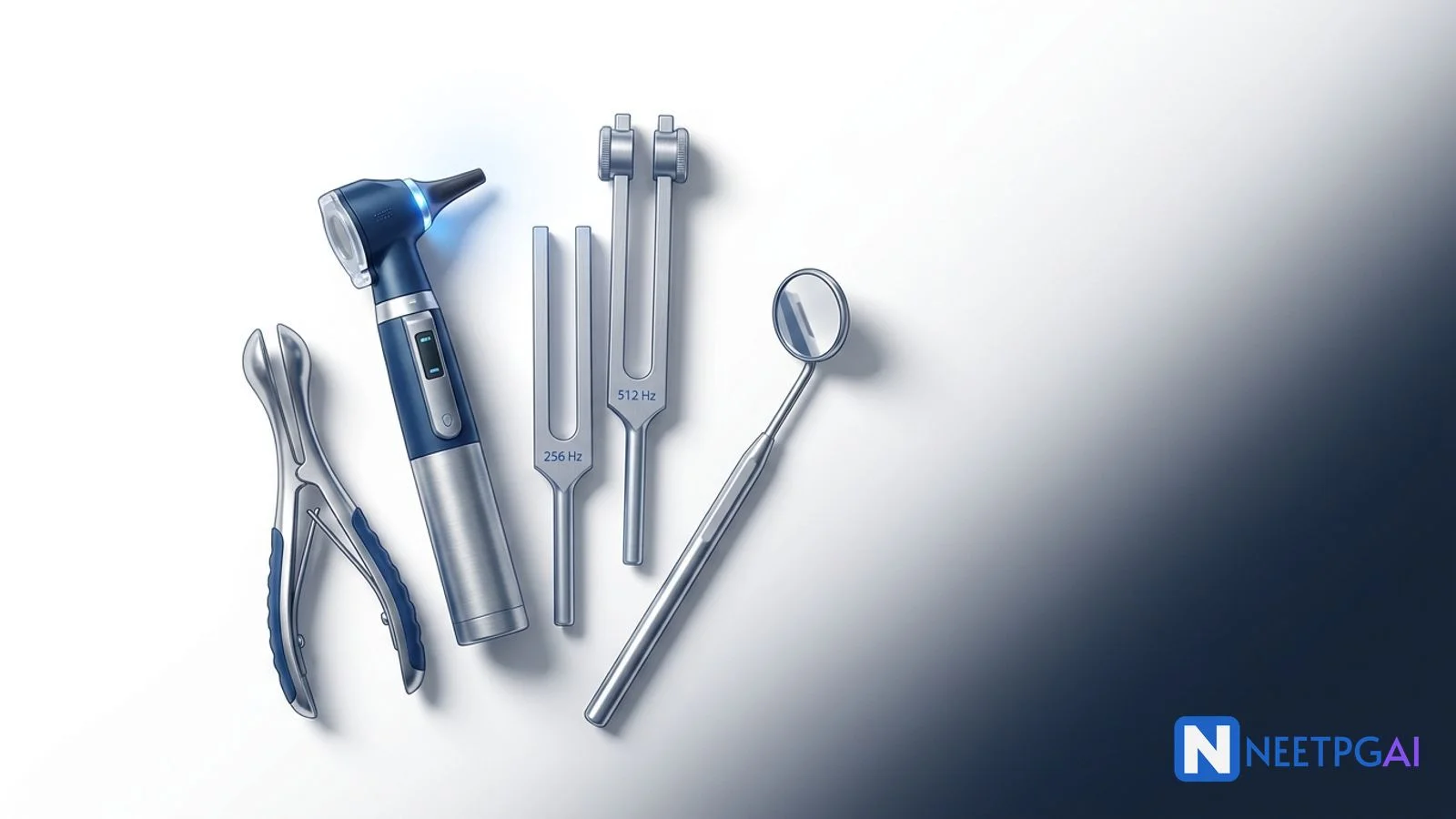
Complete Guide to NEET PG ENT High-Yield Topics | NEETPGAI
entneet pg 2027high yield
Complete Guide to NEET PG ENT High-Yield Topics
Master every high-yield ENT topic for NEET PG 2027: otology (CSOM, cholesteatoma, otosclerosis, BPPV), rhinology, laryngology, pharyngology, audiometry, foreign bodies, head and neck tumors, and tracheostomy with exam-focused facts.
NEETPGAI EditorialPublished 18 Dec 2025Updated 29 Sept 202617 min read
Share this article
This content is for educational purposes for NEET PG exam preparation. It is not a substitute for professional medical advice, diagnosis, or treatment. Clinical information has been reviewed by qualified medical professionals.
Ready to put this into practice?
Start practicing NEET PG MCQs with AI-powered explanations.
Comparison of the authorities that shape NEET PG, INI-CET, FMGE, and Indian medical education: NMC (regulator), NBEMS (exam conductor), MCC (AIQ counseling), DGHS (health services), AIIMS (INI-CET), plus state councils and FMG pathway — clarifies who does what.
ENT contributes 8-12 questions to NEET PG and rewards candidates who master a focused set of clinical associations rather than attempting encyclopedic coverage. The eight high-yield areas are:
Otology — CSOM types (tubotympanic vs atticoantral), cholesteatoma (keratinized squamous epithelium in middle ear), otosclerosis (Schwartze sign, Carhart notch at 2 kHz, stapedectomy), BPPV (Dix-Hallpike test, Epley maneuver)
Rhinology — DNS (septal spur causing unilateral obstruction), sinusitis (maxillary most common, ethmoidal in children), epistaxis (Little area anteriorly, Woodruff plexus posteriorly), nasal polyps (ethmoidal polyps bilateral, antrochoanal unilateral)
Laryngology — vocal cord paralysis (RLN injury patterns), laryngeal cancer (glottic vs supraglottic), stridor (inspiratory = supraglottic, biphasic = glottic/subglottic)
ENT is the subject where a single clinical sign often points to the diagnosis. A foul-smelling ear discharge means atticoantral CSOM until proven otherwise. A Schwartze sign on otoscopy means otosclerosis. A unilateral nasal polyp in an adolescent male means angiofibroma. NBE recycles these associations year after year.
This guide covers the eight high-yield areas with the clinical facts NBE tests. Pair it with the ENT subject hub and daily MCQ practice to lock in 6-10 marks from ENT alone.
Otology: CSOM, cholesteatoma, otosclerosis, and BPPV
Otology is the highest-yield subdivision of ENT, contributing 3-4 questions per paper. CSOM differentiation and cholesteatoma are perennial favorites.
Chronic suppurative otitis media (CSOM)
CSOM is chronic inflammation of the middle ear cleft (middle ear + mastoid + Eustachian tube) with a persistent tympanic membrane perforation and recurrent ear discharge for more than 6 weeks.
Medical (aural toilet + topical antibiotics); surgery if failed (tympanoplasty)
Surgical — mastoidectomy (mandatory, medical management insufficient)
Cholesteatoma
Cholesteatoma is a sac of keratinized stratified squamous epithelium in the middle ear or mastoid. It is locally destructive — erodes bone through pressure necrosis and enzymatic (collagenase) action.
Types:
Congenital — epithelial rest behind an intact tympanic membrane, no history of infection
Acquired primary — retraction pocket in pars flaccida (invagination theory) without prior perforation
Acquired secondary — squamous epithelium migrates through a marginal perforation
Complications of cholesteatoma: Erosion of ossicles (incus most commonly affected), labyrinthine fistula (lateral semicircular canal), facial nerve palsy, meningitis, brain abscess (temporal lobe or cerebellar), lateral sinus thrombosis, extradural abscess.
Treatment: Canal wall down mastoidectomy (modified radical mastoidectomy) is the standard for extensive cholesteatoma. Canal wall up mastoidectomy preserves the posterior canal wall but has a higher recurrence rate and requires planned second-look surgery.
Otosclerosis
Otosclerosis is abnormal bone remodeling of the otic capsule, most commonly affecting the stapes footplate at the fissula ante fenestram, causing progressive conductive hearing loss.
Clinical features: Bilateral progressive conductive hearing loss in a young adult (20-40 years), often female. Family history positive in 50% (autosomal dominant with incomplete penetrance). Paracusis of Willis — hearing better in noisy environments (raised voice level of others overcomes the conductive barrier).
Otoscopy findings:
Schwartze sign — reddish/pink tinge on promontory seen through intact tympanic membrane, due to increased vascularity of active otosclerotic focus. This is pathognomonic.
Tympanic membrane is otherwise normal.
Audiometry: Conductive hearing loss with air-bone gap. Carhart notch — apparent dip in bone conduction at 2000 Hz (an artifact, not true SNHL). This disappears after successful stapedectomy.
Treatment: Stapedectomy (replacement of stapes with a prosthesis) or stapedotomy (small fenestra technique). Alternatively, hearing aids for those declining surgery. Sodium fluoride may slow active otosclerosis (controversial).
BPPV (Benign Paroxysmal Positional Vertigo)
BPPV is the most common cause of peripheral vertigo. Caused by displaced otoconia (calcium carbonate crystals) from the utricle entering the semicircular canals (most commonly the posterior semicircular canal).
Clinical features: Brief episodes (under 60 seconds) of intense rotatory vertigo triggered by head position changes (rolling over in bed, looking up, bending down). No hearing loss, no tinnitus (distinguishes from Meniere disease).
Diagnosis:Dix-Hallpike test — patient is rapidly moved from sitting to supine with head turned 45 degrees and extended 30 degrees over the edge of the bed. Positive test: torsional nystagmus with latency (2-5 seconds), fatiguable (decreases on repetition), duration under 60 seconds.
Treatment:Epley maneuver (canalith repositioning procedure) — sequential head positions to guide otoconia out of the posterior SCC back into the utricle. Success rate above 80% in a single session.
Rhinology: DNS, sinusitis, epistaxis, and nasal polyps
Rhinology contributes 1-2 questions per paper. The focus is on sinusitis, epistaxis management, and the critical differentiation between ethmoidal and antrochoanal polyps.
Deviated nasal septum (DNS)
DNS is deviation of the nasal septum from the midline, causing unilateral nasal obstruction. The deviated side shows a septal spur or deflection; the opposite side often shows compensatory inferior turbinate hypertrophy.
Surgical correction: Septoplasty (submucous resection of deviated cartilage/bone, preserving the mucoperichondrium). Indicated for symptomatic obstruction, recurrent sinusitis, or as an access procedure for endoscopic sinus surgery.
Sinusitis
The maxillary sinus is the most commonly affected sinus in adults (dependent drainage position — the ostium is located high on the medial wall, near the roof, making gravity-dependent drainage difficult). The ethmoidal sinuses are most commonly affected in children (ethmoids are the first sinuses to develop and are the only sinuses present at birth).
Complications of sinusitis (rhinogenic):
Orbital — preseptal cellulitis, orbital cellulitis, subperiosteal abscess, orbital abscess, cavernous sinus thrombosis. The lamina papyracea (paper-thin medial wall of orbit) is the barrier; ethmoidal sinusitis spreads to the orbit through this bone.
Anterior epistaxis (90% of cases) — originates from Little area (Kiesselbach plexus) on the anterior nasal septum. Blood supply from branches of both internal and external carotid arteries (anterior ethmoidal artery + sphenopalatine artery + superior labial artery + greater palatine artery). Most common in children and young adults.
Posterior epistaxis (10%) — originates from Woodruff plexus (sphenopalatine artery area) on the posterior lateral nasal wall. More common in elderly, hypertensives. Heavier bleeding, harder to control.
Management stepwise: Anterior nasal packing (Merocel or ribbon gauze with bismuth iodoform paraffin paste/BIPP), posterior nasal packing (Foley catheter or posterior pack), endoscopic sphenopalatine artery ligation, external carotid artery ligation, or embolization for refractory cases.
Nasal polyps
Feature
Ethmoidal polyps
Antrochoanal polyp
Origin
Ethmoidal labyrinth mucosa
Maxillary sinus (antrum)
Side
Bilateral (typically)
Unilateral
Number
Multiple
Single, pedunculated
Extension
Nasal cavity
Nasal cavity → choana → nasopharynx
Age
Adults (40+); associated with asthma and aspirin sensitivity (Samter triad)
Adolescents/young adults
Treatment
Endoscopic polypectomy + steroids; high recurrence
Endoscopic removal with clearance of maxillary sinus origin
Samter triad (aspirin-exacerbated respiratory disease): Nasal polyps + asthma + aspirin sensitivity. These patients are at risk of severe bronchospasm with NSAIDs.
Laryngology: vocal cord paralysis, cancers, and stridor
Laryngology contributes 1-2 questions per NEET PG paper, focused on recurrent laryngeal nerve (RLN) injury patterns and laryngeal carcinoma staging.
Vocal cord paralysis
Unilateral RLN palsy: Vocal cord in paramedian (cadaveric) position on the affected side. Presents with hoarseness, breathy voice, and aspiration. Most common cause: thyroid surgery (iatrogenic). Other causes: lung carcinoma (left RLN, longer course around aortic arch), aortic aneurysm, neck surgery.
Bilateral RLN palsy:
Bilateral abductor palsy — both cords in midline/paramedian position. Presents with stridor and airway obstruction (good voice but cannot breathe). Requires emergency tracheostomy.
Bilateral adductor palsy — both cords in cadaveric/intermediate position. Presents with aphonia and aspiration (cannot speak or protect airway, but airway is open). Uncommon.
Semon law: In progressive RLN lesions, abductors (posterior cricoarytenoid — the only abductor of vocal cords) are affected before adductors. Therefore, early RLN palsy presents with the cord in the midline (abductor paralysis), while complete RLN palsy moves the cord to the paramedian/cadaveric position.
Laryngeal carcinoma
Glottic carcinoma (60-65% of laryngeal cancers) — arises from the true vocal cords. Presents early with hoarseness (even a small lesion affects voice). Lymphatic drainage is poor from the glottis (vocal cords have sparse lymphatics), so nodal metastasis is late. Best prognosis of all laryngeal cancers.
Supraglottic carcinoma (30-35%) — arises from epiglottis, aryepiglottic folds, false cords. Presents late (no early voice change). Rich lymphatic drainage — nodal metastasis is early and often bilateral. Worse prognosis.
Subglottic carcinoma (rare, <5%) — presents with stridor. Often advanced at diagnosis.
Stridor
Stridor is a high-pitched sound produced by turbulent airflow through a narrowed airway. Its timing indicates the level of obstruction:
Expiratory stridor — tracheobronchial obstruction (foreign body in bronchus, tracheomalacia)
Pharyngology: tonsillitis and peritonsillar abscess
Acute tonsillitis
Most common in children aged 5-15 years. Causes: Group A beta-hemolytic Streptococcus (GAS) is the most important bacterial cause due to complications (rheumatic fever, post-streptococcal glomerulonephritis). Viruses account for the majority of episodes.
Indications for tonsillectomy (Paradise criteria): 7 or more episodes in 1 year, or 5 or more episodes per year for 2 years, or 3 or more episodes per year for 3 years. Each episode must have documented sore throat with at least one of: fever above 38.3 C, cervical lymphadenopathy, tonsillar exudate, or positive GAS culture.
Peritonsillar abscess (quinsy)
Collection of pus between the tonsillar capsule and the superior constrictor muscle. Most common deep neck space infection.
Clinical features: Severe unilateral sore throat, trismus (difficulty opening mouth — spasm of medial pterygoid), uvula deviated to the opposite side, "hot potato" voice (muffled), drooling, and unilateral tonsillar swelling with displacement medially and inferiorly.
Treatment: Aspiration or incision and drainage (at the point of maximum bulging, typically the superior pole). IV antibiotics (amoxicillin-clavulanate or clindamycin). Interval tonsillectomy may be considered after resolution (especially in recurrent quinsy).
Hearing assessment: audiometry and tuning fork tests
Audiometry interpretation is a standalone question topic in NEET PG, separate from the disease-specific questions.
Tuning fork tests
Test
Technique
Conductive hearing loss
SNHL
Rinne
Compare AC (fork near ear) vs BC (fork on mastoid)
Negative (BC > AC)
Positive (AC > BC, but both reduced)
Weber
Fork on vertex of skull
Lateralizes to affected ear
Lateralizes to better ear
ABC (Absolute Bone Conduction)
Compare patient BC with examiner BC
Normal (cochlea is normal)
Reduced
Rinne false negative: In severe unilateral SNHL, the patient may hear the fork placed on the affected mastoid via transcranial transmission to the opposite ear, giving a false Rinne positive. The masking (Barany noise box) eliminates this.
Pure tone audiometry patterns
Condition
Air conduction
Bone conduction
Air-bone gap
Normal
0-25 dB
0-25 dB
Absent
Conductive loss
Elevated
Normal
Present (characteristic)
Sensorineural loss
Elevated
Elevated (equal to AC)
Absent
Mixed loss
Elevated
Elevated (but less than AC)
Present
Tympanometry (impedance audiometry)
Type
Curve
Interpretation
Type A
Normal peak at 0 daPa
Normal middle ear function
Type As
Low amplitude, normal peak position
Otosclerosis (stiff ossicular chain)
Type Ad
Very high amplitude
Ossicular discontinuity
Type B
Flat, no peak
Middle ear effusion (secretory otitis media) or tympanic membrane perforation
Type C
Peak shifted to negative pressure
Eustachian tube dysfunction
Foreign bodies: ear, nose, and airway
Ear foreign bodies
Common in children (beads, stones, insects). For live insects: instill mineral oil or 4% lidocaine to kill the insect first, then remove. Never attempt syringing for vegetable matter (swells with water).
Nasal foreign bodies
Classic presentation: Unilateral foul-smelling nasal discharge in a child. The discharge is purulent and bloodstained. A rhinolith (calcified foreign body) may form if the object is retained for a long period.
Button battery — a nasal emergency. Causes liquefactive necrosis of septal cartilage within 4 hours due to alkali leakage. Immediate removal required. Septal perforation is a common complication.
Airway foreign bodies
Inhaled foreign bodies lodge preferentially in the right main bronchus (wider, shorter, more vertical than the left). Most common in children aged 1-3 years.
Clinical features: Sudden onset coughing, choking, wheezing. If a check-valve mechanism develops: hyperinflation of the affected lung (obstructive emphysema on CXR — affected side hyperinflated, mediastinal shift to opposite side on expiration).
Management: Rigid bronchoscopy for removal in children. Heimlich maneuver for acute complete obstruction in conscious patients. Back blows and chest thrusts for infants under 1 year.
Head and neck tumors: nasopharyngeal carcinoma and JNA
Nasopharyngeal carcinoma (NPC)
Strong association with Epstein-Barr virus (EBV) — the most important etiological factor. Endemic in Southern China, Southeast Asia. WHO classification: Type I (keratinizing SCC), Type II (non-keratinizing), Type III (undifferentiated — most common type, strongest EBV association).
Trotter triad: Conductive hearing loss (Eustachian tube obstruction), ipsilateral palatal paralysis, and trigeminal neuralgia — indicates lateral pharyngeal space invasion. This is a classic NEET PG association.
Treatment: Primary radiotherapy (NPC is radiosensitive). Concurrent chemoradiotherapy for advanced stages. Surgery has a limited role due to anatomical inaccessibility of the nasopharynx.
Juvenile nasopharyngeal angiofibroma (JNA)
Benign vascular tumor arising from the sphenopalatine foramen region. Occurs exclusively in adolescent males (10-25 years). Hormonally responsive (androgen receptors present).
Clinical features: Unilateral nasal obstruction + recurrent severe epistaxis in a teenage male. Smooth, lobulated, reddish mass in the nasopharynx.
Investigation: CT/MRI shows a vascular mass with Holman-Miller sign (anterior bowing of the posterior maxillary wall on lateral X-ray). Biopsy is absolutely contraindicated — the tumor is highly vascular and biopsy risks life-threatening hemorrhage.
Treatment: Pre-operative embolization (internal maxillary artery) followed by surgical excision. Radiotherapy reserved for inoperable or recurrent cases.
Tracheostomy: indications, anatomy, and complications
Elective: Prolonged intubation (>7-10 days), major head and neck surgery, neurological conditions (poor cough reflex), selected obstructive sleep apnea cases
Surgical anatomy
The incision is made between the 2nd and 4th tracheal rings. The thyroid isthmus lies over the 2nd-3rd rings and may need to be divided or retracted. The key relations:
Tube change should NOT be done in first 72 hours (tract not formed)
Late
Tracheal stenosis (most common late complication), tracheo-esophageal fistula, tracheo-innominate artery fistula (catastrophic hemorrhage)
High-pressure cuffs cause ischemic necrosis of tracheal wall
Study strategy: converting ENT knowledge into exam marks
Phase 1: Foundation (1 week)
Cover the eight areas using Dhingra's Diseases of Ear, Nose and Throat. Spend one day on otology (the highest-yield section), one day on rhinology + laryngology, and one day on audiometry + miscellaneous. Build one-page summaries for: CSOM comparison table, tuning fork test grid, and laryngeal cancer types.
Phase 2: MCQ drilling (1 week)
Solve 25-30 mixed ENT MCQs daily. Focus on audiogram interpretation and clinical vignettes. Build a spaced repetition deck of named signs (Schwartze, Carhart notch, Trotter triad, Holman-Miller).
P.L. Dhingra, Diseases of Ear, Nose and Throat, 7th Edition, 2018 — standard Indian ENT reference for NEET PG.
Logan Turner, Diseases of the Nose, Throat and Ear, 11th Edition, 2016 — comprehensive otology and rhinology reference.
K.J. Lee, Essential Otolaryngology: Head and Neck Surgery, 12th Edition, 2019 — clinical reference for head and neck surgery.
American Academy of Otolaryngology-Head and Neck Surgery (AAO-HNS), Clinical Practice Guidelines, 2024 — evidence-based ENT management guidelines.
WHO Report on Hearing, 2021 — global epidemiological data on hearing loss.
Frequently asked questions
How many ENT questions appear in NEET PG?
ENT contributes 8-12 questions in NEET PG (2021-2024 analysis). Otology (CSOM, cholesteatoma, hearing loss types) accounts for 3-4 questions most years, followed by laryngology (1-2), rhinology (1-2), and head and neck tumors (1-2). Audiometry interpretation and tuning fork tests appear as standalone questions almost every year.
Which ENT topics are tested most frequently in NEET PG?
CSOM types (tubotympanic vs atticoantral) with cholesteatoma is the single highest-yield ENT topic. Otosclerosis (Schwartze sign, Carhart notch), BPPV (Dix-Hallpike, Epley maneuver), tuning fork tests, vocal cord paralysis, and laryngeal cancer staging are consistent contributors.
What is the best textbook for ENT NEET PG preparation?
Dhingra's Diseases of Ear, Nose and Throat is the standard for Indian PG entrance exams. Supplement with Logan Turner for otology depth. Focus 60% of study time on otology — it carries the highest question density.
How do I differentiate tubotympanic from atticoantral CSOM?
Tubotympanic (safe) has central perforation, non-foul mucoid discharge, and no cholesteatoma. Atticoantral (unsafe) has marginal/attic perforation, foul-smelling discharge, and cholesteatoma. Atticoantral CSOM requires surgical management (mastoidectomy).
What is the Carhart notch and why is it important?
The Carhart notch is an apparent bone conduction dip at 2000 Hz, characteristic of otosclerosis. It is an artifact that disappears after successful stapedectomy. NEET PG tests this as an audiogram pattern recognition question.
How should I interpret tuning fork tests for NEET PG?
Rinne negative (BC > AC) = conductive loss. Weber lateralizes to affected ear in conductive loss, to better ear in SNHL. These combinations appear as clinical scenarios testing your ability to localize the type and side of hearing loss.
What are the indications for tracheostomy in NEET PG?
Emergency: complete upper airway obstruction, failed intubation, bilateral vocal cord paralysis. Elective: prolonged intubation over 7-10 days, major head/neck surgery, neurological conditions with poor cough reflex. Know the anatomy (2nd-4th tracheal rings) and complications.
What is the best strategy for last-minute ENT revision?
Focus on tables: CSOM types, tuning fork test interpretation, laryngeal cancer staging, and audiometry patterns. Solve 20 ENT MCQs daily. On exam day, review only the tuning fork grid and CSOM comparison — these cover 3-4 questions.
Start your ENT prep today. Open the ENT subject page and solve your first 15 MCQs — the clinical associations you drill now are the answers you will retrieve on exam day. Want unlimited AI-powered ENT MCQs with detailed explanations? Explore NEETPGAI Pro.
Written by: NEETPGAI Editorial Team
Reviewed by: NEETPGAI Medical Advisory Board
Last reviewed: April 2026
This article is reviewed by qualified medical professionals for clinical accuracy and exam relevance. For corrections or updates, contact the editorial team.