Complete Guide to NEET PG Community Medicine (PSM) High-Yield Topics | NEETPGAI
community medicineneet pg 2027high yield
Complete Guide to NEET PG Community Medicine (PSM) High-Yield Topics
Master every high-yield community medicine topic for NEET PG 2027: epidemiology, biostatistics, national health programs, nutrition, demography, environmental health, occupational health, and health management with real exam facts and study strategies.
NEETPGAI EditorialPublished 7 Dec 2025Updated 29 Sept 202626 min read
Share this article
This content is for educational purposes for NEET PG exam preparation. It is not a substitute for professional medical advice, diagnosis, or treatment. Clinical information has been reviewed by qualified medical professionals.
Ready to put this into practice?
Start practicing NEET PG MCQs with AI-powered explanations.
Comparison of the authorities that shape NEET PG, INI-CET, FMGE, and Indian medical education: NMC (regulator), NBEMS (exam conductor), MCC (AIQ counseling), DGHS (health services), AIIMS (INI-CET), plus state councils and FMG pathway — clarifies who does what.
Community Medicine (PSM) contributes 15-20 questions to NEET PG and is one of the most scoring subjects because it heavily tests factual recall over conceptual reasoning. The eight high-yield areas that return with the highest frequency are:
Epidemiology — study designs (case-control vs cohort vs RCT), measures of disease frequency (incidence, prevalence), screening test evaluation (sensitivity, specificity, PPV, NPV)
Biostatistics — mean/median/mode, standard deviation, chi-square test, p-value interpretation, confidence intervals, Type I and Type II errors
National health programs — RNTCP/NTEP (DOTS), NVBDCP (malaria, dengue), NPCB (blindness), RMNCH+A (maternal-child health)
Health management — PHC/CHC/district hospital staffing norms, IPHS standards, healthcare delivery structure in India
This guide covers each area with the factual details that NBE tests, the calculations you must be able to perform, and a study strategy to secure 12+ marks from PSM alone.
Community Medicine (Preventive and Social Medicine) is the subject where public health principles meet exam strategy. Unlike clinical subjects where you need to reason through a vignette, PSM rewards direct factual recall — you either know the DOTS regimen or you do not, you either remember the NFHS-5 TFR or you do not. This makes PSM one of the most efficient subjects to prepare: the effort-to-marks ratio is among the highest in NEET PG.
The catch is volume. Park's Textbook covers epidemiology, biostatistics, nutrition, demography, environmental science, occupational health, national programs, sociology, health planning, and international health. A scattered approach across all these domains leads to superficial knowledge and missed marks. The solution is targeted preparation of the eight high-yield areas that generate 80% of the questions.
This guide covers those eight areas with the specific facts, formulas, and program details that NBE tests. Pair it with the full Community Medicine subject hub and daily MCQ practice to build retrievable knowledge.
Epidemiology: study designs, disease measures, and screening tests
Epidemiology is the study of the distribution and determinants of disease in populations — and it is the single largest question source within PSM, generating 5-7 questions per NEET PG paper. NBE tests three areas: study designs, measures of disease frequency, and screening test evaluation.
Study designs
Study Design
Direction
Starting Point
Measure of Association
Key Feature
Case-control
Retrospective
Disease (cases vs controls)
Odds ratio (OR)
Best for rare diseases; quick, cheap; subject to recall bias
Cohort
Prospective (or retrospective)
Exposure (exposed vs unexposed)
Relative risk (RR)
Establishes temporal sequence; expensive, long follow-up
Cross-sectional
Snapshot
Neither
Prevalence, prevalence odds ratio
Measures prevalence, not incidence; cannot establish causation
RCT
Prospective
Intervention (randomized)
Relative risk, NNT
Gold standard for causation; double-blinding reduces bias
Case-control studies are the most frequently tested design. The key facts: they are retrospective (look backward from disease to exposure), they measure odds ratio (not relative risk — a classic trap), and they are ideal for rare diseases because you start by selecting cases. They are subject to recall bias (cases may remember exposures differently from controls) and cannot establish incidence.
Cohort studies measure relative risk and can establish temporal sequence (exposure precedes disease). The Framingham Heart Study is the classic example — a prospective cohort that identified cardiovascular risk factors. NBE tests the Framingham study by name.
Randomized controlled trials (RCTs) are the gold standard for establishing causation. Key concepts: randomization (eliminates confounding), blinding (single, double, triple), intention-to-treat analysis (analyzes subjects in their assigned groups regardless of compliance), and number needed to treat (NNT = 1/ARR).
Measures of disease frequency
Incidence measures new cases arising in a defined population over a specified time:
Incidence rate (person-time) = New cases / Person-time at risk
Attack rate = New cases / Population at risk during an epidemic (used for outbreaks)
Prevalence measures all existing cases (new + old) at a point or period:
Point prevalence = All cases at a specific time / Total population
Period prevalence = All cases during a period / Total population at midpoint
Relationship: Prevalence = Incidence x Duration. This is tested directly — for chronic diseases with long duration (diabetes), prevalence is much higher than incidence. For acute diseases with short duration (cholera), prevalence approximates incidence.
The 2x2 table is the most important calculation framework in PSM:
Disease Present
Disease Absent
Test Positive
True Positive (TP)
False Positive (FP)
Test Negative
False Negative (FN)
True Negative (TN)
Sensitivity = TP / (TP + FN) — proportion of diseased correctly identified as positive. High sensitivity means few false negatives. Use for screening (rule OUT: SnNout).
Specificity = TN / (TN + FP) — proportion of non-diseased correctly identified as negative. High specificity means few false positives. Use for confirmation (rule IN: SpPin).
PPV = TP / (TP + FP) — probability that a positive test truly has disease. Depends on prevalence — as prevalence decreases, PPV decreases even with the same sensitivity and specificity.
NPV = TN / (TN + FN) — probability that a negative test truly does not have disease.
NBE trap on PPV and prevalence: Students often calculate PPV correctly from a 2x2 table but do not realize that PPV changes with prevalence. A screening test with 99% sensitivity and 99% specificity will have a PPV of only 50% if the disease prevalence is 1%. This is tested as a conceptual question.
Likelihood ratios:
Positive LR = Sensitivity / (1 - Specificity). LR+ >10 is strong evidence for disease.
Negative LR = (1 - Sensitivity) / Specificity. LR- <0.1 is strong evidence against disease.
Biostatistics: measures, tests, and interpretation
Biostatistics is the application of statistical methods to biological and medical data — and it generates 3-5 questions per NEET PG paper. The questions are increasingly application-based: you are given data and asked to select the appropriate test or interpret a result.
Measures of central tendency and dispersion
Mean — arithmetic average. Affected by outliers. Best for normally distributed data.
Median — middle value when data is arranged in order. Not affected by outliers. Best for skewed distributions. If mean > median, the distribution is positively (right) skewed. If mean < median, it is negatively (left) skewed.
Mode — most frequently occurring value. A distribution can be bimodal or multimodal.
Standard deviation (SD) — measures dispersion around the mean.
Normal (Gaussian) distribution properties:
Mean = Median = Mode (symmetrical)
Mean +/- 1 SD includes 68.27% of observations
Mean +/- 2 SD includes 95.45% of observations
Mean +/- 3 SD includes 99.73% of observations
These percentages are tested directly. The 95% figure (roughly 2 SD) is the basis for the 95% confidence interval.
Statistical tests: choosing the right one
Data Type
Groups
Parametric Test
Non-parametric Alternative
Quantitative, 2 groups
Independent
Unpaired t-test
Mann-Whitney U test
Quantitative, 2 groups
Paired (before/after)
Paired t-test
Wilcoxon signed-rank test
Quantitative, 3+ groups
Independent
ANOVA
Kruskal-Wallis test
Qualitative (categorical)
2+ groups
Chi-square test
Fisher exact test (small samples)
Correlation
2 quantitative variables
Pearson r
Spearman rho
Chi-square test is the most frequently tested statistical test. It compares observed frequencies with expected frequencies in categorical data. Conditions: expected frequency in each cell should be >5 (use Fisher exact test if <5). Degrees of freedom = (rows - 1) x (columns - 1).
p-value and confidence intervals
p-value <0.05 means the result is statistically significant at the 5% level — there is less than a 5% probability that the observed result occurred by chance alone. A p-value does NOT indicate the magnitude of the effect or clinical significance.
95% confidence interval — the range within which the true population parameter lies with 95% confidence. If the CI for a relative risk includes 1.0, the result is not statistically significant. If the CI for a mean difference includes 0, the result is not statistically significant.
Types of error
Error
Also Called
Meaning
Controlled By
Type I (alpha)
False positive
Rejecting a true null hypothesis
Significance level (alpha, usually 0.05)
Type II (beta)
False negative
Failing to reject a false null hypothesis
Power of the study (1 - beta)
Power = 1 - beta = probability of correctly rejecting a false null hypothesis (detecting a true difference). Power is increased by increasing sample size, increasing effect size, or increasing alpha. A study should have at least 80% power (beta <0.2).
National health programs: RNTCP, NVBDCP, NPCB, and RMNCH+A
National health programs generate 3-5 questions per NEET PG paper. NBE tests program names, years of launch, key strategies, treatment protocols, and current targets. This is pure recall territory — make a master table and revise it weekly.
NTEP (formerly RNTCP) — National Tuberculosis Elimination Programme
The Revised National Tuberculosis Control Programme (RNTCP) was launched in 1997, based on the WHO-recommended DOTS (Directly Observed Treatment, Short-course) strategy. It was renamed NTEP in 2020 with the goal of TB elimination by 2025 (aligned with WHO End TB Strategy target of 2030, but India set a more ambitious national target).
DOTS strategy components:
Political commitment with increased and sustained financing
Case detection through quality-assured bacteriology (sputum microscopy for AFB)
Standardized treatment with supervision and patient support
Effective drug supply and management system
Monitoring and evaluation with impact measurement
Current treatment regimen (based on WHO 2022 guidelines):
MDR-TB (multidrug-resistant): Resistance to at least isoniazid AND rifampicin. Treated with second-line drugs (bedaquiline-based shorter regimen, 9-11 months)
Nikshay is the web-based surveillance system for TB case notification in India. DBT (Direct Benefit Transfer) of Rs 500/month is provided to TB patients for nutritional support (Nikshay Poshan Yojana).
NVBDCP — National Vector Borne Disease Control Programme
NVBDCP covers six vector-borne diseases: malaria, dengue, chikungunya, Japanese encephalitis, kala-azar, and lymphatic filariasis.
Malaria key facts for NEET PG:
Plasmodium vivax — most common species in India (responsible for ~50% of cases). Causes benign tertian malaria (48-hour cycle). Dormant liver stage (hypnozoite) requires primaquine for radical cure.
Plasmodium falciparum — most dangerous species. Causes malignant tertian malaria. Cerebral malaria, severe anemia, renal failure. No hypnozoite stage. First-line treatment: ACT (artemisinin-based combination therapy).
Dengue: Transmitted by Aedes aegypti. Serotypes 1-4. Dengue hemorrhagic fever (DHF) occurs typically on second infection with a different serotype (antibody-dependent enhancement). Tourniquet test positive. NS1 antigen for early diagnosis (day 1-5), IgM antibody after day 5.
Kala-azar (visceral leishmaniasis): Transmitted by sandfly (Phlebotomus). Caused by Leishmania donovani. Endemic in Bihar, Jharkhand, West Bengal, UP. Treatment: liposomal amphotericin B (single dose) is first-line in India. Elimination target: <1 case per 10,000 population at block level by 2023 (extended).
NPCB — National Programme for Control of Blindness and Visual Impairment
Launched in 1976. Goal: reduce prevalence of blindness from 1.4% to 0.3%.
Leading causes of blindness in India (Park's Textbook, 25th Edition):
Cataract (62.6%) — most common cause, treatable
Refractive errors (19.7%)
Glaucoma (5.8%)
Corneal blindness (0.9%)
NPCB key activities: free cataract surgery camps, school eye screening, strengthening of district hospitals for eye care, training of ophthalmic assistants. Target: 66 lakh cataract surgeries annually.
RMNCH+A — Reproductive, Maternal, Newborn, Child, and Adolescent Health
RMNCH+A is not a single program but a strategic approach integrating multiple maternal-child health initiatives under one framework (launched 2013).
Key components:
Janani Suraksha Yojana (JSY) — conditional cash transfer for institutional delivery. BPL women receive Rs 1,400 (rural) or Rs 1,000 (urban) for delivering in a health facility.
Janani Shishu Suraksha Karyakram (JSSK) — free and cashless delivery, C-section, drugs, diagnostics, diet, blood, and transport for pregnant women and sick neonates.
RBSK (Rashtriya Bal Swasthya Karyakram) — child health screening at birth, 6 weeks, 6 months, 9 months, and then annually for 4Ds (defects, diseases, deficiencies, developmental delays).
NFHS-5 (2019-2021) key indicators:
TFR: 2.0 (below replacement level of 2.1 for the first time nationally)
IMR: 35.2 per 1,000 live births
Under-5 mortality rate: 41.9 per 1,000 live births
Institutional delivery: 88.6%
Full immunization (12-23 months): 76.4%
Master community-medicine with AI-powered practice — adaptive MCQs with instant explanations.
Nutrition: PEM classification, vitamin deficiencies, and ICDS
Nutrition generates 2-3 questions per NEET PG paper. The questions test protein-energy malnutrition classification systems, vitamin deficiency recognition, and national nutrition programs. This is a high-yield section because the classifications and programs are tested with near-annual regularity.
Weight for height (wasting) + Height for age (stunting)
Wasted: low weight for height; Stunted: low height for age
Distinguishes acute malnutrition (wasting) from chronic malnutrition (stunting)
WHO classification
Z-scores (SD from median)
Moderate: -2 to -3 SD; Severe: <-3 SD
Standard for research and NFHS surveys
Kwashiorkor vs Marasmus:
Kwashiorkor — protein deficiency with adequate calories. Edema (hallmark), moon face, flag sign (depigmented hair), dermatosis (flaky paint), fatty liver, reduced albumin. Typically age 1-3 years.
Marasmus — total calorie deficiency (protein + energy). Severe wasting, "old man face," no edema, ravenous appetite, skin and bones appearance. Typically <1 year.
Marasmic-kwashiorkor — features of both. Worst prognosis.
MUAC (Mid-Upper Arm Circumference): Used for rapid community-based screening of malnutrition in children 6 months to 5 years.
Green: >13.5 cm (normal)
Yellow: 12.5-13.5 cm (moderate malnutrition)
Red: <12.5 cm (severe acute malnutrition)
ICDS (Integrated Child Development Services)
ICDS was launched on October 2, 1975, and is the world's largest community-based program for child development. It targets children <6 years, pregnant and lactating mothers, and adolescent girls (11-18 years).
Six services of ICDS:
Supplementary nutrition
Immunization
Health check-ups
Referral services
Nutrition and health education
Pre-school (non-formal) education
Service delivery: Through Anganwadi centers. Each Anganwadi worker (AWW) covers a population of 1,000 (800 in tribal areas). The Anganwadi helper assists the AWW.
Mid-Day Meal Scheme (PM POSHAN): Launched in 1995 nationally. Provides cooked meals to children in government and government-aided schools (classes 1-8). Calorie norms: 450 kcal + 12 g protein for primary, 700 kcal + 20 g protein for upper primary.
Vitamin deficiency diseases relevant to PSM
Deficiency
Disease
Public Health Significance
Program/Intervention
Vitamin A
Night blindness, Bitot spots, xerophthalmia
Leading cause of preventable blindness in children
VADS (Vitamin A prophylaxis): 1 lakh IU at 9 months, 2 lakh IU every 6 months till 5 years
Iodine
Goitre, cretinism, IDD
Endemic in sub-Himalayan belt
Universal salt iodization (USI); NIDDCP (National Iodine Deficiency Disorders Control Programme)
Iron
IDA (iron deficiency anemia)
Most common nutritional deficiency in India
WIFS (Weekly Iron Folic Acid Supplementation) for adolescents
Demography: CBR, CDR, NRR, and the demographic transition
Demography is the study of population dynamics — and it generates 1-3 questions per paper. NBE tests rate definitions, the demographic transition model, and India's current demographic indicators from census and NFHS data.
Vital statistics and demographic indicators
Indicator
Formula
India (recent)
Key Fact
CBR (Crude Birth Rate)
Live births / Mid-year population x 1,000
20.0 (SRS 2020)
Does not account for age/sex composition
CDR (Crude Death Rate)
Deaths / Mid-year population x 1,000
6.0 (SRS 2020)
Crude — not adjusted for age structure
IMR (Infant Mortality Rate)
Infant deaths (<1 yr) / Live births x 1,000
28 (SRS 2020)
Most sensitive indicator of health status of a community (Park's Textbook)
NMR (Neonatal Mortality Rate)
Deaths <28 days / Live births x 1,000
20 (SRS 2020)
Reflects quality of obstetric and neonatal care
MMR (Maternal Mortality Ratio)
Maternal deaths / Live births x 100,000
97 (SRS 2018-2020)
India target: <70 by 2030 (SDG)
TFR (Total Fertility Rate)
Sum of age-specific fertility rates
2.0 (NFHS-5)
Replacement level is 2.1
NRR (Net Reproduction Rate)
Daughters who survive to reproductive age per woman
~0.9
NRR = 1 means population replacement; <1 means declining
GRR (Gross Reproduction Rate)
Daughters born per woman (ignoring mortality)
—
GRR > NRR always (GRR does not account for female mortality)
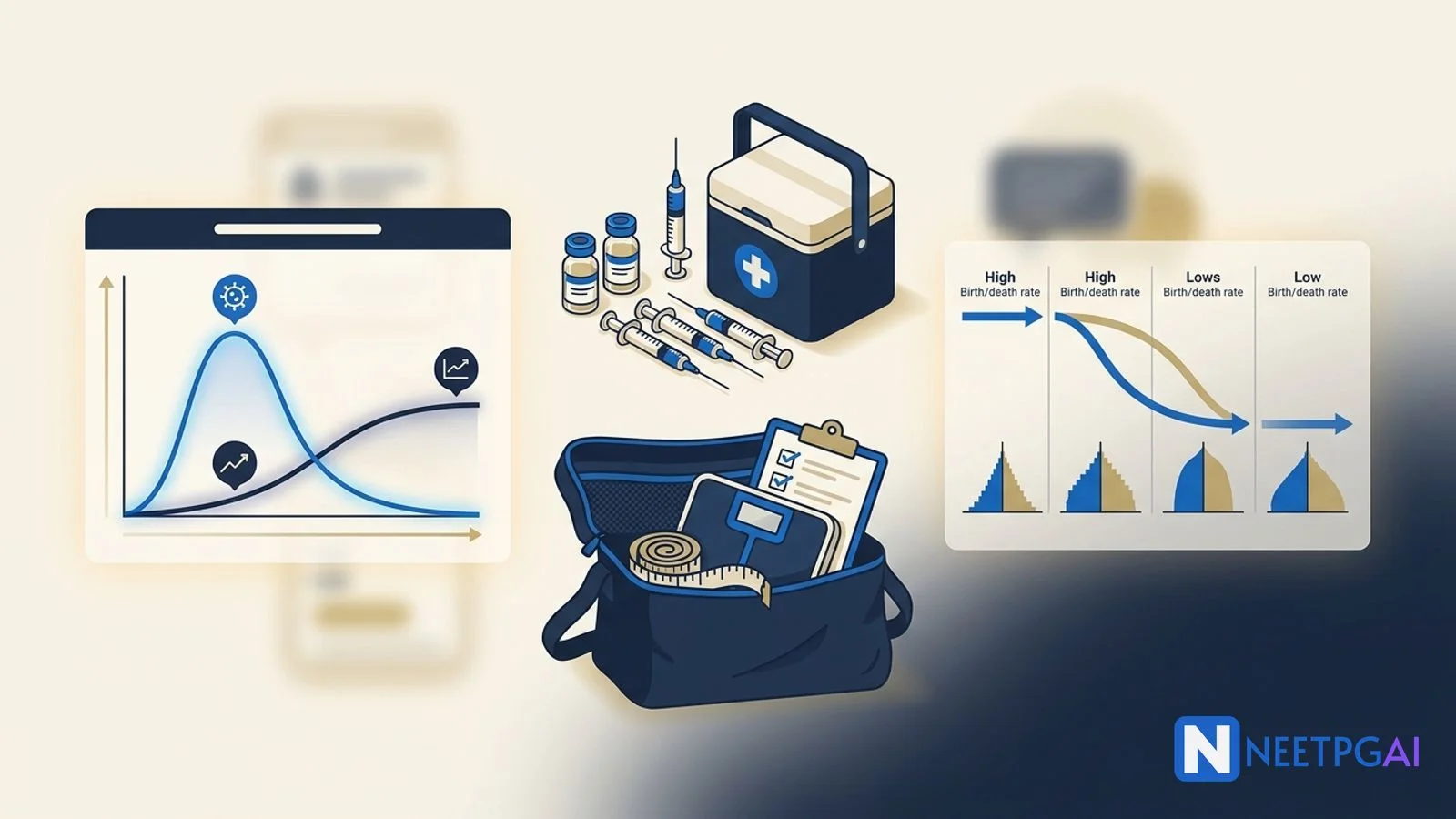
Demographic transition model (4 stages):
Stage I (High stationary): High birth rate, high death rate. Population stable. Pre-industrial societies.
Stage II (Early expanding): High birth rate, declining death rate. Rapid population growth. Improved sanitation, nutrition.
Stage III (Late expanding): Declining birth rate, low death rate. Population growth slows. Urbanization, education, contraception.
Stage IV (Low stationary): Low birth rate, low death rate. Population stable or declining. Developed countries.
India is currently in late Stage III — birth rate declining, death rate already low, population growth decelerating. This is a frequently tested classification.
Environmental health: water purification, Horrock's apparatus, and air pollution
Environmental health generates 1-2 questions per paper, focused on water purification methods, chlorination standards, and waste disposal. These are direct factual questions — know the standards and you score.
Water purification
Purification of water on a large scale (municipal level):
Storage (plain sedimentation) — 24-48 hours reduces bacteria by 90%
Coagulation and flocculation — alum (potash alum) is the most common coagulant
Rapid sand filtration — filters at 5-15 m/hr (compared to slow sand filter at 0.1-0.4 m/hr)
Disinfection (chlorination) — the most important step for making water bacteriologically safe
Chlorination:
Breakpoint chlorination — adding enough chlorine to satisfy the chlorine demand (organic matter, ammonia) and then provide a free residual chlorine of 0.5 mg/L after 1 hour of contact. This is the WHO-recommended standard for safe water.
Horrock's apparatus — used to determine the dose of bleaching powder needed for chlorination of well water. It consists of 6 cups, each with a different concentration of bleaching powder. After 30 minutes, the cup showing a distinct blue color with the ortho-tolidine test (indicating free residual chlorine of 0.2 mg/L) indicates the correct dose.
Superchlorination — adding excess chlorine (2-5 mg/L) followed by dechlorination. Used for emergency disinfection.
Most Probable Number (MPN): The bacteriological standard for safe drinking water. WHO standard: 0 coliform organisms per 100 mL for treated piped water. E. coli is the indicator organism for fecal contamination.
Air pollution
National Ambient Air Quality Standards (NAAQS) — set by CPCB (Central Pollution Control Board) for PM2.5, PM10, SO2, NO2, CO, O3, lead, and ammonia.
Yellow category — human anatomical waste, animal waste, soiled waste → incineration or deep burial
Red category — contaminated recyclable waste (tubing, bottles) → autoclaving then recycling
White (translucent) — waste sharps (needles, blades) → autoclaving, shredding, then disposal in sharp pits
Blue category — glassware waste → autoclaving then recycling
Occupational health: pneumoconioses and occupational cancers
Occupational health generates 1-2 questions per paper. The questions cluster around pneumoconioses (dust diseases of the lung) and occupational carcinogen associations.
Pneumoconioses
Disease
Dust Exposure
Key Feature
Complication
Silicosis
Free silite (SiO2) — mining, stone cutting, sandblasting
Most common pneumoconiosis worldwide. "Eggshell calcification" of hilar lymph nodes on CXR. Progressive massive fibrosis.
Increased risk of TB (silicotuberculosis) — silica impairs macrophage function
Asbestosis
Asbestos — mining, insulation, shipbuilding
Pleural plaques (most common manifestation), pleural effusion, interstitial fibrosis
Mesothelioma (most specific association), bronchogenic carcinoma (most common malignancy)
Byssinosis
Cotton dust — textile mills
"Monday morning fever" — symptoms worst at start of work week
Chronic bronchitis-like syndrome
Bagassosis
Sugarcane dust (bagasse)
Type III hypersensitivity pneumonitis
—
Coal worker's pneumoconiosis
Coal dust — coal mining
Caplan syndrome (CWP + rheumatoid arthritis = large nodules)
Progressive massive fibrosis
NBE trap on asbestos: The most common malignancy associated with asbestos is bronchogenic carcinoma, NOT mesothelioma. However, mesothelioma is the most specific (pathognomonic) — it almost exclusively occurs with asbestos exposure. Students confuse "most common" with "most specific."
Occupational cancers
Carcinogen
Occupation
Cancer
Asbestos
Insulation, shipbuilding
Mesothelioma, bronchogenic carcinoma
Benzene
Rubber, petroleum industry
Acute myeloid leukemia
Vinyl chloride
PVC manufacturing
Hepatic angiosarcoma
Aniline dyes (beta-naphthylamine)
Dye industry
Urinary bladder carcinoma
Arsenic
Mining, pesticide manufacturing
Skin cancer, lung cancer
Chromium
Chrome plating, pigment manufacturing
Lung cancer
Nickel
Nickel refining
Lung cancer, nasal sinus cancer
Health management: PHC, CHC, and IPHS standards
Health management questions test the structure of India's healthcare delivery system, staffing norms, and IPHS (Indian Public Health Standards). These are direct recall questions — know the numbers and you score.
Healthcare delivery structure in India
Level
Population Covered
Key Features
Sub-centre
5,000 (3,000 in hilly/tribal)
Most peripheral contact point. Staff: 1 ANM + 1 male health worker. Does NOT have a medical officer.
PHC (Primary Health Centre)
30,000 (20,000 in hilly/tribal)
First referral point with a medical officer. Staff: 1 medical officer + 14 paramedical staff. 6 beds.
CHC (Community Health Centre)
120,000 (80,000 in hilly/tribal)
First referral unit (FRU) for obstetric emergencies. 30 beds. 4 specialist doctors (surgeon, physician, OBG, pediatrician).
Sub-district hospital
500,000-1,000,000
31-100 beds. Specialist services.
District hospital
1,000,000-2,500,000
100-500 beds. Apex of the district healthcare system.
IPHS (Indian Public Health Standards): Set by the Directorate General of Health Services for each facility level. Key IPHS norms:
PHC: should function 24x7, provide BEmONC (Basic Emergency Obstetric and Newborn Care)
CHC: should provide CEmONC (Comprehensive Emergency Obstetric and Newborn Care), blood storage, surgical services
Sub-centre: should have separate rooms for clinical examination and procedures
ASHA (Accredited Social Health Activist)
ASHA is a community health volunteer under the National Health Mission (NHM), one per 1,000 population (one per habitation in tribal areas). Key roles:
First contact point at the community level
Facilitates institutional delivery (accompanies pregnant women to health facility)
DOTS provider for TB treatment
Distributes ORS, IFA tablets, chloroquine
Performance-based compensation (not a salaried employee)
Anganwadi Worker vs ASHA: The AWW is under ICDS (Ministry of Women and Child Development) and focuses on child nutrition and pre-school education. ASHA is under NHM (Ministry of Health) and focuses on health service facilitation. NBE tests this distinction.
Study strategy: converting PSM knowledge into exam marks
PSM is among the most scoring subjects in NEET PG because it is heavily factual. The strategy is simple: build comprehensive tables, revise them with high frequency, and solve MCQs under timed conditions.
Phase 1: Foundation reading (2 weeks)
Read the eight sections in this guide alongside the corresponding chapters in Park's Textbook of Preventive and Social Medicine (25th Edition). Park's is concise enough to read cover-to-cover in two weeks at 40-50 pages per day. Build a master table for each section: study designs, screening test formulas, national health programs (name, year, strategy, target), PEM classifications, demographic indicators, water purification methods, pneumoconioses, and PHC/CHC staffing norms.
Solve 15 PSM MCQs daily on the topic you read that day.
Phase 2: MCQ drilling (2 weeks)
Increase to 25-30 PSM MCQs daily. Mix topics. For each wrong answer, trace the error:
Program confusion — you mixed up two programs or their years
Calculation error — you set up the 2x2 table incorrectly or applied the wrong formula
Classification gap — you confused two classification systems (IAP vs Gomez vs Waterlow)
For a comprehensive preparation strategy that integrates PSM with clinical subjects, read Medicine high-yield topics — Medicine and PSM share significant overlap in infectious diseases, nutritional deficiencies, and national program targets.
Phase 3: Revision and mocks (1 week)
In the final week, revise your master tables daily. PSM decays faster than clinical subjects because it is pure recall. Solve one full-length PSM mock under timed conditions. On the day before the exam, review only three things: the national health programs master table, the 2x2 table formulas, and the demographic indicators with their current values.
Park's Textbook of Preventive and Social Medicine, 25th Edition (K. Park, 2019) — the definitive reference for NEET PG community medicine.
World Health Organization, Global Tuberculosis Report 2023 — current TB epidemiology, treatment, and elimination targets.
National Family Health Survey-5 (NFHS-5), 2019-2021, Ministry of Health and Family Welfare — current Indian demographic and health indicators.
National Health Mission (NHM), Guidelines for Sub-centres, PHCs, and CHCs, 2022 — IPHS standards and staffing norms.
Frequently asked questions
How many community medicine questions appear in NEET PG?
Community Medicine (PSM) contributes 15-20 questions in NEET PG, making it one of the highest-weighted subjects. Epidemiology and biostatistics account for 5-7 questions, national health programs for 3-5, nutrition for 2-3, and demography, environmental health, and occupational health for the remainder. Many questions are direct factual recall, making this a high-scoring subject with focused preparation.
Which community medicine topics are most frequently tested in NEET PG?
Epidemiological study designs (case-control vs cohort vs RCT), sensitivity-specificity-PPV calculations, national health programs (RNTCP, NVBDCP), nutritional assessment (PEM classification, vitamin deficiencies), and demographic indicators (CBR, CDR, NRR) are the most frequently tested areas. Biostatistics questions on p-value interpretation and confidence intervals have increased since 2023.
Is Park's Textbook enough for NEET PG community medicine?
Park's Textbook of Preventive and Social Medicine is the gold standard for NEET PG PSM. Unlike other subjects where concise guides suffice, Park's is concise enough to read cover-to-cover and comprehensive enough to cover 95% of NEET PG questions. Supplement with WHO and NHM guideline updates for the most recent program modifications.
How do I differentiate case-control from cohort studies in NEET PG?
The key discriminator is the starting point: case-control studies start with disease status (cases vs controls) and look backward at exposure (retrospective), measuring odds ratio. Cohort studies start with exposure status (exposed vs unexposed) and look forward at disease development (prospective), measuring relative risk. If the stem says "patients with lung cancer were compared to healthy controls," it is case-control.
How do I calculate sensitivity and specificity for NEET PG?
Sensitivity = TP/(TP+FN) — the ability to detect disease (true positive rate). Specificity = TN/(TN+FP) — the ability to exclude disease (true negative rate). Remember: SeNsitivity rules OUT disease when Negative (SnNout), and SPecificity rules IN disease when Positive (SpPin). Construct a 2x2 table from the stem and calculate directly.
Which national health programs are most tested in NEET PG?
RNTCP/NTEP (tuberculosis — DOTS strategy, diagnostic criteria, treatment categories), NVBDCP (malaria, dengue, kala-azar), NPCB/NPHCE (blindness prevention), and RMNCH+A (maternal and child health indicators) are the most frequently tested. Know the year of launch, key strategies, and current targets for each program.
How important is biostatistics for NEET PG?
Biostatistics contributes 3-5 questions per paper and is increasing in weight. Focus on measures of central tendency and dispersion, the normal distribution curve properties, chi-square test applications, p-value interpretation (p <0.05 means statistically significant), confidence intervals, and types of error (Type I alpha vs Type II beta). These are tested as applied problems, not theoretical definitions.
What is the best strategy for last-minute PSM revision before NEET PG?
In the final two weeks, revise three things: the national health programs table (program name, year, strategy, target), the epidemiological study design comparison table, and the 2x2 table calculations for sensitivity/specificity/PPV/NPV. Solve 20-30 PSM MCQs daily. PSM is a high-scoring subject with last-minute revision because much of it is factual recall rather than conceptual reasoning.
How are NFHS-5 data points tested in NEET PG?
NFHS-5 (2019-2021) data points are tested as factual recall: Total Fertility Rate (TFR 2.0 nationally, below replacement for the first time), infant mortality rate, under-5 mortality rate, institutional delivery percentage (88.6%), and full immunization coverage. Know the national averages and the general state-level trends (Kerala vs Bihar extremes).
What is the difference between incidence and prevalence in NEET PG?
Incidence measures NEW cases arising in a defined population over a specified time period (measures risk). Prevalence measures ALL existing cases (new + old) at a point or period in time (measures burden). Prevalence = Incidence x Duration. For chronic diseases (diabetes, hypertension), prevalence is much higher than incidence because duration is long.
Start your PSM prep today. Open the Community Medicine subject page and solve your first 15 MCQs — the program facts and formulas you drill now are the ones you will retrieve on exam day. Want unlimited AI-powered PSM MCQs with detailed explanations? Explore NEETPGAI Pro.
Written by: NEETPGAI Editorial Team
Reviewed by: Pending SME Review
Last reviewed: April 2026
This article is reviewed by qualified medical professionals for clinical accuracy and exam relevance. For corrections or updates, contact the editorial team.