Version 1.0 — Published May 2026
Quick Answer
In 2026, Indian postgraduate medical entrance is dominated by two exams: NEET PG (conducted by NBEMS for most government, private, and DNB seats nationwide) and INI-CET (conducted by AIIMS New Delhi for the 8 elite Institutes of National Importance). The standalone AIIMS-PG exam was subsumed under INI-CET in 2019 and no longer exists as a separate entity. JIPMER-PG and PGI-PGEE as standalone exams have also been absorbed.
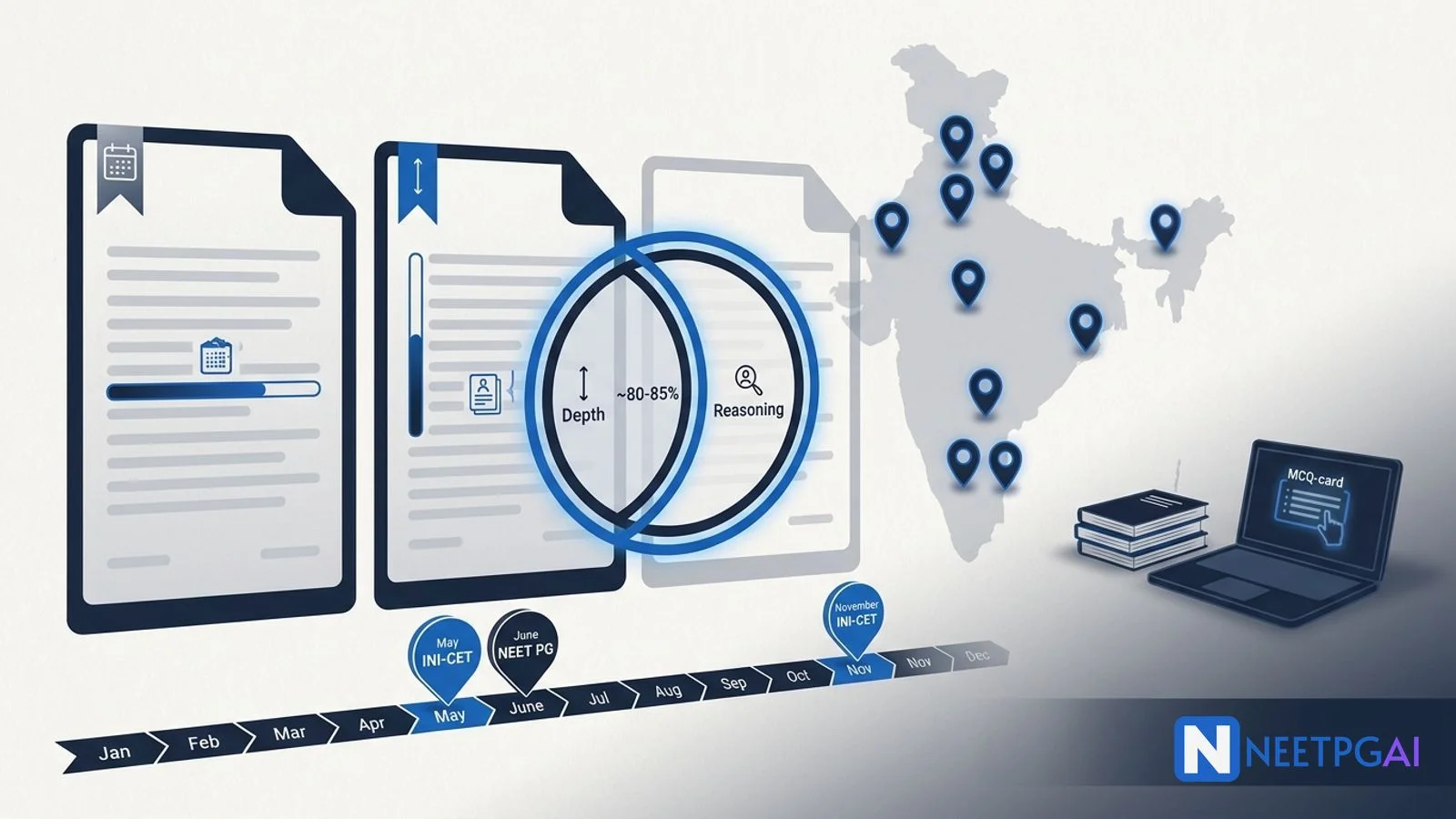
Honest single-line recommendation: prepare for both NEET PG and INI-CET in parallel using a single core curriculum (80-85 percent syllabus overlap) and sharpen to INI-CET depth and reasoning in the final 2-3 months. Most serious aspirants attempt INI-CET (May), NEET PG (June-August window), and INI-CET (November) within the same cycle — three high-stakes attempts off one preparation base.
This comparison maps each exam's pattern, syllabus, counselling, and recommended preparation strategy so you can build a stack that maximises your chances across all available seats.
The Indian postgraduate medical-entrance landscape in 2026 is structurally different from 5 years ago. Multiple separate entrance exams (AIIMS-PG, JIPMER-PG, PGI-PGEE, NIMHANS-PG, DM/MCh entrance exams) have been consolidated into INI-CET. NEET PG continues to dominate by volume and seat count. The serious aspirant prepares for both — but the depth, reasoning, and rank-cutoffs differ markedly.
This article compares the two exams in detail, explains why AIIMS-PG no longer exists as a standalone exam, and lays out a combined preparation strategy for 2026 aspirants.
Full disclosure: this article is published on the NEETPGAI blog. We have an interest in promoting NEETPGAI's adaptive MCQ engine. To keep the comparison honest, we treat NEET PG and INI-CET on their merits, acknowledge where competitors (PrepLadder, Marrow, DAMS) genuinely outperform NEETPGAI, and recommend combined approaches where that is the most evidence-based path.
NEET PG — the volume exam
Conducting body, pattern, and seats
Conducted by: National Board of Examinations in Medical Sciences (NBEMS), under the Ministry of Health and Family Welfare, Government of India.
Exam pattern (2026):
| Feature | NEET PG |
|---|
| Mode | Computer-based test (CBT), single shift |
| Duration | 3 hours 30 minutes (210 minutes) |
| Questions | 180 MCQs |
| Marks | 4 marks correct, −1 wrong (negative marking) |
| Maximum marks | 720 |
| Sections | 5 timed sections (Groups A–E), 36 questions each × 42 minutes; each section locks when its timer expires (no back-navigation between sections) |
| Question types | Single-best-answer MCQ; clinical vignettes; image-based questions (around 15-20 percent) |
| Difficulty | NEET PG standard — predominantly application + recall; clinical vignette-heavy in recent papers |
| Language | English only |
Eligibility: Indian MBBS degree (or qualified foreign medical graduate with FMGE pass), with internship completed by the prescribed date.
Frequency: Annual (typically May-June; date varies year to year). Often a single attempt per year.
Seats available: Approximately 70,000+ PG seats across India through NEET PG counselling. Includes:
- All India Quota (AIQ, 50 percent) — central counselling by MCC for all government medical colleges
- State Quota (50 percent) — state counselling for state government colleges + private colleges in each state
- DNB seats — across DNB-recognised institutions
- Central institutes — AFMC, BHU, Aligarh, etc. (100 percent under AIQ for these)
- Newer AIIMS — Patna, Raipur, Nagpur, Mangalagiri, Bibinagar, Kalyani, Gorakhpur, etc. (these are NOT in INI-CET — they use NEET PG)
- Private colleges — both management quota and merit seats under state counselling
Counselling and quotas
NEET PG counselling occurs in two streams:
| Stream | Authority | Seats covered |
|---|
| All India Quota (AIQ) | Medical Counselling Committee (MCC), DGHS | 50 percent of government college seats nationwide + central institutes |
| State Quota | Each state's authority (e.g., HMS Maharashtra, Anna University Tamil Nadu, MP DME) | Remaining 50 percent of government seats + private college seats in that state |
Multiple rounds occur — Round 1, Round 2, mop-up, and stray vacancy round. Reservations apply throughout: SC (15 percent), ST (7.5 percent), OBC-NCL (27 percent), EWS (10 percent), PWBD (5 percent horizontal).
Strengths and limits of NEET PG
Strengths:
- Largest pool of seats — by far the volume route into PG
- Single attempt covers most institutions — efficient
- Wide question pool drawn from 19 subjects with predictable high-yield clusters
- Negative marking is moderate (−1 per wrong) — risk-managed guessing is viable
Limits:
- Single shift / single attempt per cycle — bad day = bad year
- No state-specific or institute-specific weighting — same paper for everyone
- Counselling is fragmented between AIQ and state — needs vigilance to track multiple registrations and choice-filling rounds
- Cutoffs for top branches at top colleges are extremely competitive — Radiology / Dermatology / General Medicine at top-ranked colleges typically need ranks under 1,000-3,000
INI-CET — the elite institute exam
Conducting body, pattern, and seats
Conducted by: AIIMS New Delhi, on behalf of all 8 Institutes of National Importance (INIs).
Exam pattern (2026):
| Feature | INI-CET |
|---|
| Mode | Computer-based test (CBT), single shift |
| Duration | 3 hours (180 minutes) |
| Questions | 200 MCQs |
| Marks | 1 mark correct, −1/3 wrong (negative marking) |
| Maximum marks | 200 |
| Sections | Single combined paper across all subjects |
| Question types | Single-best-answer MCQ + image-based (around 25-30 percent — significantly higher than NEET PG); heavy clinical vignettes; multi-step reasoning; some "extended matching" or "assertion-reason" style |
| Difficulty | Significantly higher than NEET PG; deeper concept testing; recent paper trends include physiology/biochemistry-heavy reasoning questions |
| Language | English only |
Eligibility: Indian MBBS degree (with internship completed by the prescribed date) plus the institute-specific eligibility (most INIs require Indian MBBS; some accept FMGs with FMGE pass).
Frequency: Twice a year — May session and November session (separate notifications, separate counselling).
Seats available: Approximately 1,200-1,400 PG seats across the 8 INIs:
| Institute | Location | Approximate PG seats per cycle |
|---|
| AIIMS New Delhi | Delhi | ~250 |
| PGIMER | Chandigarh | ~300 |
| JIPMER | Puducherry | ~250 |
| NIMHANS | Bengaluru | ~50-70 (mental health and neurosciences only) |
| AIIMS Bhopal | Madhya Pradesh | ~125 |
| AIIMS Bhubaneswar | Odisha | ~100 |
| AIIMS Jodhpur | Rajasthan | ~125 |
| AIIMS Rishikesh | Uttarakhand | ~125 |
The actual seat matrix varies each cycle and includes branch-wise distribution announced before counselling. INI-CET also covers MDS, MCh, and DM specialty seats at these institutes.
Counselling
INI-CET counselling is conducted centrally by AIIMS New Delhi in a unified process for all 8 INIs. There is no state quota — all seats are filled through a single national merit list. Reservations apply (SC/ST/OBC/EWS/PWBD). Counselling typically takes 2-3 rounds over 6-8 weeks and is faster than NEET PG counselling.
The top 100 ranks in INI-CET typically secure the most competitive branches (Radiology, Dermatology, General Medicine, Anaesthesia, Ophthalmology) at AIIMS New Delhi or PGIMER. Below rank 300-500, most seats at the newer AIIMS in less competitive branches are available.
Strengths and limits of INI-CET
Strengths:
- Elite institutions — outstanding faculty, research culture, PG stipends, fellowship trajectories
- Two attempts per year (May and November) — error-correction possible
- Smaller, focused syllabus testing — depth rewarded
- Centralised counselling — efficient seat allocation
- Career multiplier — INI alumni status accelerates fellowships, faculty positions, and international research roles
Limits:
- Very limited seats — approximately 1,200-1,400 vs 70,000+ in NEET PG (less than 2 percent of total PG capacity)
- Markedly higher difficulty — even strong NEET PG performers can struggle on INI-CET
- No state-quota safety net — purely national merit
- Image-heavy and reasoning-heavy — needs targeted practice beyond standard NEET PG question banks
AIIMS-PG — what happened to the legacy exam
The standalone AIIMS-PG entrance was conducted by AIIMS New Delhi until 2019 as a separate exam for AIIMS PG admissions. In 2019, the central government and AIIMS New Delhi consolidated multiple INI entrance exams (AIIMS-PG, JIPMER-PG, PGI-PGEE for PGIMER Chandigarh) into a single INI-CET to:
- Reduce the burden on candidates of multiple separate applications and exams
- Standardise the question quality and difficulty across INIs
- Enable centralised counselling and seat allocation
Operationally for 2026 aspirants:
- There is no separate AIIMS-PG exam to prepare for
- AIIMS New Delhi PG seats are accessed through INI-CET
- The newer AIIMS (Patna, Raipur, Nagpur, Mangalagiri, Bibinagar, Kalyani, Gorakhpur, etc.) are NOT under INI-CET — they fill PG seats through NEET PG counselling (AIQ)
- Some readers still see legacy YouTube content or older books labelled "AIIMS PG" — treat these as INI-CET-equivalent
Side-by-side feature comparison
| Feature | NEET PG | INI-CET | Legacy AIIMS-PG |
|---|
| Conducting body | NBEMS | AIIMS New Delhi | (Subsumed under INI-CET since 2019) |
| Frequency | Annual (May-June typical) | Twice a year (May + November) | Discontinued |
| Duration | 3 h 30 min | 3 h | — |
| Questions | 180 MCQs (5 sections of 36) | 200 MCQs | — |
| Marking | +4 / −1 | +1 / −1/3 | — |
| Max marks | 720 | 200 | — |
| Image-based questions | ~15-20 percent | ~25-30 percent | — |
| Difficulty | Standard MCQ; clinical vignette-heavy | Markedly higher; depth + reasoning | — |
| Seats | ~70,000+ across India | ~1,200-1,400 at 8 INIs | — |
| Counselling | AIQ (50 percent) + State Quota (50 percent) | Centralised by AIIMS New Delhi | — |
| Institutions covered | All government, private, DNB, newer AIIMS, central institutes | 8 INIs (AIIMS New Delhi/Bhopal/Bhubaneswar/Jodhpur/Rishikesh, PGIMER, JIPMER, NIMHANS) | — |
| Negative marking risk | Moderate (1 mark loss per wrong vs 4 mark gain per right) | Higher (1/3 mark loss per wrong vs 1 mark gain) — be conservative on guessing | — |
Syllabus overlap — what differs and what does not
The syllabus is substantially identical between NEET PG and INI-CET. Both test the 19 subjects of the MBBS curriculum at the postgraduate-entrance level:
Tier-1 (high-yield, large question share): Medicine, Surgery, OBG, Pediatrics, Pharmacology, Pathology, Microbiology, PSM (Community Medicine).
Tier-2 (moderate): Anatomy, Physiology, Biochemistry, Forensic Medicine, Ophthalmology, ENT, Orthopedics, Anesthesia, Radiology.
Tier-3 (lower volume): Dermatology, Psychiatry.
Where INI-CET goes deeper
INI-CET differs from NEET PG in depth and reasoning style:
| Aspect | NEET PG | INI-CET |
|---|
| Bloom's level | Predominantly Recall + Application | Application + Analysis (more reasoning) |
| Clinical vignette length | Moderate (3-5 lines typical) | Often longer (5-10 lines) with multiple findings to integrate |
| Image-based weight | ~15-20 percent | ~25-30 percent |
| Basic science integration | Less prominent | More prominent (anatomy/physiology/biochemistry reasoning questions) |
| Branched / multi-step questions | Rare | More common |
| Assertion-reason / Both-true-Both-false patterns | Rare | Occasional |
| Recent paper / research-trend questions | Standard | Higher proportion of new-trend questions; recent landmark trials and guidelines often featured |
| Pharmacology depth | Standard drug-doses-and-mechanisms | More detail on receptor subtypes, kinetics, novel agents |
| Pathology depth | Standard | More molecular pathology, biomarkers, IHC patterns |
What stays the same
- Subjects and topics — identical at the curriculum level
- High-yield areas — the same topics are over-represented in both exams (e.g., diabetes, hypertension, IHD, sepsis, ARDS, neonatal resuscitation, antenatal care, common cancers, infectious diseases, key pharmacology classes, immunology basics, public health programs like NHM/RNTCP/IMNCI)
- India-specific content — both exams test Indian NHM programs, IAP guidelines, FOGSI protocols, Indian legal frameworks (forensic medicine), NPCB, etc.
The implication is critical: 80-85 percent of preparation transfers directly between the two exams. Aspirants who treat them as separate syllabi waste time.
Scoring and rank cutoffs (2024-2025 reference)
Cutoffs vary every cycle but recent patterns:
NEET PG (representative)
| Branch + College tier | Approximate AIQ rank cutoff |
|---|
| Radiology at top central institutes (AIIMS Newer, Maulana Azad, VMMC) | ~1-1,500 |
| Dermatology at top central institutes | ~500-2,500 |
| General Medicine at top state government colleges | ~5,000-15,000 |
| General Surgery at top state colleges | ~10,000-25,000 |
| OBG at top state colleges | ~10,000-25,000 |
| Pediatrics at top state colleges | ~15,000-30,000 |
| PSM / Anatomy / Biochemistry (lower-demand) | ~50,000-100,000+ |
| Private college MD/MS general branches | Up to 200,000+ depending on college |
INI-CET (representative)
| Branch + Institute | Approximate INI-CET rank cutoff |
|---|
| Radiology at AIIMS New Delhi | ~1-30 |
| Dermatology at AIIMS New Delhi | ~5-50 |
| General Medicine at AIIMS New Delhi or PGIMER | ~30-150 |
| General Surgery at AIIMS New Delhi | ~50-200 |
| Anaesthesia at AIIMS New Delhi | ~100-300 |
| Most branches at AIIMS Bhopal / Bhubaneswar / Jodhpur / Rishikesh | ~200-800 |
| Lower-demand branches at newer AIIMS | ~500-1,200 |
The contrast is stark: INI-CET's top 50-100 ranks unlock branches and institutions that would require top 1,000-3,000 in NEET PG. But INI-CET has approximately 60-100x fewer seats overall.
Preparation strategy — combined and stage-wise
Months 1-3 (Foundation phase, typically Sep-Nov of MBBS final year or first 3 months of dedicated prep)
Goal: complete a video curriculum for major subjects, build foundational notes, start MCQ practice.
- Video curriculum: complete 1 high-yield video lecture series for Pathology, Pharmacology, Medicine, Surgery, OBG, Pediatrics — pick PrepLadder or Marrow based on teaching style preference
- Notes: maintain compact one-page-per-topic notes; never re-create textbooks
- MCQ drilling: NEETPGAI Pro for daily 50-80 MCQ practice with AI explanations; spaced repetition activated
- Avoid: trying to study from textbooks (Harrison, Bailey & Love) — for entrance exams, video lectures + notes are sufficient
- Mock tests: none yet — building the base
Months 4-6 (Building phase)
Goal: complete remaining subjects, deepen MCQ practice, start subject-wise mocks.
- Video curriculum: complete remaining 13 subjects (Anatomy, Physiology, Biochemistry, Microbiology, PSM, Forensic, Ophthal, ENT, Orthopedics, Anesthesia, Radiology, Dermatology, Psychiatry)
- MCQ practice: 100-150 MCQs/day via NEETPGAI Pro
- Subject-wise mock tests: 1 per week — 50 questions, single subject, timed
- Revision: weekly review of incorrect MCQs from spaced repetition
- First INI-CET-pattern questions: start exposing yourself to longer clinical vignettes and reasoning-heavy MCQs
Months 7-9 (Integration phase)
Goal: full-length mock tests, identify weak topics, intensive revision.
- Full-length mock tests (NEET PG pattern): 1 per week; 180 questions (5 sections of 36) in 3 h 30 min
- Full-length mock tests (INI-CET pattern): 1 per 2 weeks; 200 questions in 3 h with heavier image and reasoning
- Topic-wise revision: identify weak subjects from mock-test analysis and dedicate days to weak-topic concept revision
- Image atlas: spend dedicated time on radiology, pathology, dermatology, ENT, ophthalmology image atlases — both exams are increasingly image-heavy
- Avoid: switching video platforms or starting new curricula
Months 10-11 (Sharpening phase)
Goal: INI-CET-specific reasoning, peak-form mock tests.
- Mock tests: 2 NEET PG-pattern + 1 INI-CET-pattern per week
- Concept revision: rapid revision modules (DAMS Rapid Revision, Marrow Pearls, or NEETPGAI's spaced repetition queue)
- Drugs and biostats: dedicated revision rounds — these are high-yield in both exams and forgetting-prone
- Recent trials and guidelines: read top 10-15 recent landmark trials in Medicine, OBG, Pediatrics (relevant to INI-CET)
- PYQ practice: previous year question banks of both exams; pattern recognition improves marks more than fresh learning at this stage
Final 30 days (Peak phase)
Goal: consolidation, conservative practice, mental and physical readiness.
- Mock tests: every 2 days alternating between NEET PG and INI-CET pattern
- Compact revision notes only — no new topics introduced
- Health: 7-8 hours sleep, regular exercise, avoid burnout
- Mock test analysis: every wrong answer reviewed via AI tutor for concept clarity
- Day before exam: light revision of compact notes, no new practice, full night sleep
- Day of exam: standard exam-day routine; one practice MCQ to warm up; nothing more
Recommended resources by exam
For NEET PG breadth
| Resource | Use |
|---|
| PrepLadder or Marrow video curriculum | Foundation video lectures |
| NEETPGAI Pro (MCQ + AI tutor) | Daily adaptive MCQ practice + doubt-solving |
| DAMS All-India Test Series | National percentile benchmark mock tests |
| High-yield image atlases | Radiology, pathology, dermatology |
| PSM by Vivek Jain (compact) | India-specific NHM programs and biostatistics |
For INI-CET depth
| Resource | Use |
|---|
| All above | Same foundation |
| PrepLadder INI-CET targeted module or Marrow INI-CET prep | INI-specific depth |
| Recent landmark trials / guidelines | Up-to-date reasoning questions |
| Cross-subject reasoning practice | Multi-step clinical vignettes |
| Image-heavy practice question banks | Higher image weight in INI-CET |
Common mistakes in combined preparation
Mistake 1: Treating INI-CET as a separate syllabus. It is not. 80-85 percent of NEET PG preparation transfers to INI-CET. The remaining 15-20 percent is depth and reasoning sharpening.
Mistake 2: Skipping NEET PG to focus only on INI-CET. Even strong students should attempt both. INI-CET has only 1,200-1,400 seats; you need NEET PG as a backup.
Mistake 3: Skipping INI-CET because it "looks too hard." INI-CET attempts cost almost nothing extra in preparation time and give two additional shots at elite institutions. The opportunity cost of not attempting is high.
Mistake 4: Over-investing in video lectures in the final 3 months. At month 10+, additional video lectures rarely move the needle. MCQ practice + concept revision + mock tests are higher leverage.
Mistake 5: Ignoring the negative marking difference. NEET PG (−1) is more forgiving of guessing than INI-CET (−1/3 relative to +1). Calibrate your guessing strategy per exam — INI-CET rewards conservative answering more.
Mistake 6: Underestimating image-based questions. Both exams are increasingly image-heavy; INI-CET more so. Maintain dedicated image practice (radiology, pathology, dermatology, ophthalmology, ENT).
Mistake 7: Treating both exams as the same. They share syllabus but differ in marking, depth, and question style. Practise both patterns separately in the final 2 months.
Mistake 8: Not registering for state-quota counselling. Many NEET PG aspirants miss state-quota deadlines; state-quota seats can be more competitive in some states. Track multiple counselling registrations carefully.
Mistake 9: Burning out before the exam. A consistent 8-10 hour preparation day for 9-11 months outperforms a chaotic 14-hour day for 4 months. Sleep, exercise, and breaks matter.
Mistake 10: Not using post-mock analysis. Every wrong answer in a mock test is a free improvement opportunity. Spend 1-2 hours after each mock reviewing every wrong answer with the AI tutor or your concept notes — this is the highest-leverage time in the entire preparation.
How NEETPGAI helps with combined preparation
NEETPGAI is built specifically for the combined NEET PG and INI-CET preparation pattern. Five features matter most:
- Adaptive MCQ engine — identifies your weak subjects, weak Bloom levels (recall vs application vs analysis), and weak question types (text vs image), and routes practice there. Especially valuable for the INI-CET reasoning sharpening phase.
- 24/7 AI tutor — instant doubt-solving with concept depth. Replaces the asynchronous faculty doubt-solving of legacy coaching platforms.
- Pattern-aware practice modes — separate practice modes for NEET PG (standard MCQ + moderate vignettes) and INI-CET (longer vignettes + reasoning questions + heavier image practice).
- Spaced repetition — forgetting-curve-based review of every wrong MCQ. Especially valuable for high-volume subjects like Pharmacology, Microbiology, and PSM.
- Mock test analytics — subject-wise, topic-wise, Bloom-level performance with predicted score trajectories.
Combined with a video curriculum (PrepLadder or Marrow) and the DAMS All-India Test Series for national-percentile benchmarking, NEETPGAI fills the daily MCQ practice and adaptive analytics layer that legacy platforms struggle to deliver at scale.
Conclusion — the 2026 aspirant's decision framework
If you are a 2026 NEET PG / INI-CET aspirant:
- Prepare for both exams in parallel — 80-85 percent overlap, low marginal cost
- NEET PG is the volume route — 70,000+ seats, AIQ + state quota, single annual attempt
- INI-CET is the elite route — 1,200-1,400 seats at 8 INIs, twice-yearly attempts, deeper and harder
- AIIMS-PG no longer exists as a standalone exam — AIIMS PG admissions are through INI-CET since 2019
- Build NEET PG breadth in months 1-9, sharpen to INI-CET depth in months 10-11
- Use a single core curriculum (1 video platform + NEETPGAI Pro + DAMS test series) — do not switch platforms mid-preparation
- Attempt both INI-CET sessions (May and November) if eligible — three high-stakes attempts off one preparation base
- Track counselling deadlines carefully across AIQ, state, and INI-CET — many aspirants lose seats to administrative errors
- Manage your mental health through 9-11 months — preparation is a marathon, not a sprint
There is no single "best" exam. Prepare for both, attempt both, and pick the seat that matches your career goals — clinical specialisation, research, faculty trajectory, or community service.
Frequently Asked Questions
What are the key differences between NEET PG and INI-CET in 2026?
NEET PG is conducted by the National Board of Examinations in Medical Sciences (NBEMS) as a single-shift MCQ-only exam (180 questions delivered in 5 timed sections, 3 hours 30 minutes, +4 / −1 marking) for admission to MD/MS/DNB seats across most government and private medical colleges in India via the All India Quota (50 percent) and State Quota counselling. INI-CET (Institute of National Importance Combined Entrance Test) is conducted by AIIMS New Delhi twice a year (May and November) for admission to MD/MS/MDS/MCh courses at the 8 INIs — AIIMS New Delhi, JIPMER Puducherry, PGIMER Chandigarh, NIMHANS Bengaluru, and the newer AIIMS at Bhopal, Bhubaneswar, Jodhpur, and Rishikesh. INI-CET is 200 MCQs in 3 hours (or 1 hour for INI-SS), markedly more difficult and reasoning-heavy than NEET PG, with higher proportion of image-based questions, clinical vignettes, and multi-step problem-solving. NEET PG tests breadth; INI-CET tests depth and clinical reasoning. The AIIMS-PG exam as a standalone entity has been subsumed under INI-CET since 2019.
Which exam should an MBBS final-year student prepare for in 2026?
Most serious MBBS final-year students should prepare for both NEET PG (for the seat-rich main counselling) and INI-CET (for the 8 INIs which have outstanding faculty, research, and stipends). Preparation overlap is approximately 80-85 percent at the topic level — the same subjects, same syllabus, same high-yield topics. The key differences are depth (INI-CET goes deeper) and reasoning (INI-CET prefers application over recall). The most efficient strategy is to build NEET PG-level breadth across all 19 subjects in months 1-9, then sharpen to INI-CET depth and reasoning in the final 2-3 months before each cycle. INI-CET May cycle runs in parallel with NEET PG May/June; INI-CET November cycle gives a separate attempt. A well-prepared aspirant typically attempts INI-CET first (May cycle) to test their level, then NEET PG (June-August window), then INI-CET November if needed.
How is counselling different for NEET PG vs INI-CET?
NEET PG counselling is conducted in two streams. The All India Quota (AIQ) counselling for 50 percent of government college seats nationwide and 100 percent of central institute seats (e.g., AFMC, BHU, Aligarh) is conducted by the Medical Counselling Committee (MCC) of the Directorate General of Health Services. The State Quota counselling for the remaining 50 percent of government seats and the private college seats in each state is conducted by individual state authorities (e.g., HMS Maharashtra, Anna University Tamil Nadu). Multiple rounds occur — Round 1, Round 2, mop-up, and stray vacancy round. INI-CET counselling is conducted centrally by AIIMS New Delhi for all 8 INIs in a single unified process — there is no state quota. INI-CET counselling is much faster than NEET PG (typically 2-3 rounds in 6-8 weeks). Domicile, reservation (SC/ST/OBC/EWS), and PWBD categories apply to both. INI-CET seats are highly competitive — the top 100 ranks in INI-CET typically secure top branches (Radiology, Dermatology, General Medicine) at AIIMS New Delhi.
Is the AIIMS-PG exam still conducted in 2026?
The standalone AIIMS-PG exam (separate entrance for AIIMS New Delhi and the newer AIIMS) has been subsumed under INI-CET since 2019. AIIMS New Delhi, AIIMS Bhopal, AIIMS Bhubaneswar, AIIMS Jodhpur, AIIMS Rishikesh — along with JIPMER, PGIMER, and NIMHANS — are all 8 Institutes of National Importance whose PG admissions are now consolidated under INI-CET conducted by AIIMS New Delhi. The newer AIIMS (Patna, Raipur, Nagpur, Mangalagiri, Bibinagar, Kalyani, Gorakhpur, etc.) are NOT yet covered under INI-CET as of 2026 — their PG admissions continue to use NEET PG. JIPMER-PG and PGI-PGEE as separate entities also stopped functioning as standalone exams once INI-CET took over (since 2019). For aspirants in 2026, the operational mental model is: NEET PG for most colleges including the newer AIIMS; INI-CET for the 8 elite INIs.
What is the most efficient combined preparation strategy for NEET PG and INI-CET?
The most efficient combined strategy uses a single core curriculum (NEET PG-aligned coverage of all 19 subjects) with INI-CET-specific reasoning sharpening in the final 2-3 months. Months 1-9: complete a video curriculum (PrepLadder or Marrow) PLUS daily MCQ drilling (NEETPGAI Pro for adaptive practice + concept revision via spaced repetition) PLUS subject-wise revision rounds. Months 10-11: shift to clinical-vignette-heavy practice, attempt 2-3 INI-CET-pattern full-length mock tests per week, and review every mistake in the AI tutor for concept clarification. Final month: high-yield rapid revision modules, 3-5 NEET PG-pattern full-length mocks, and one or two INI-CET-pattern mocks per week. The biggest mistake is treating INI-CET as a separate syllabus — it is not; it is the same syllabus tested at higher depth. The biggest opportunity is recognising that INI-CET preparation makes NEET PG feel easier, so aspirants who prepare for INI-CET often outperform on NEET PG too.
This content is for educational purposes for NEET PG exam preparation. It is not a substitute for professional medical advice, diagnosis, or treatment. Clinical information has been reviewed by qualified medical professionals.
Written by: NEETPGAI Editorial Team
Reviewed by: Pending SME Review
Last reviewed: May 2026