Quick Answer
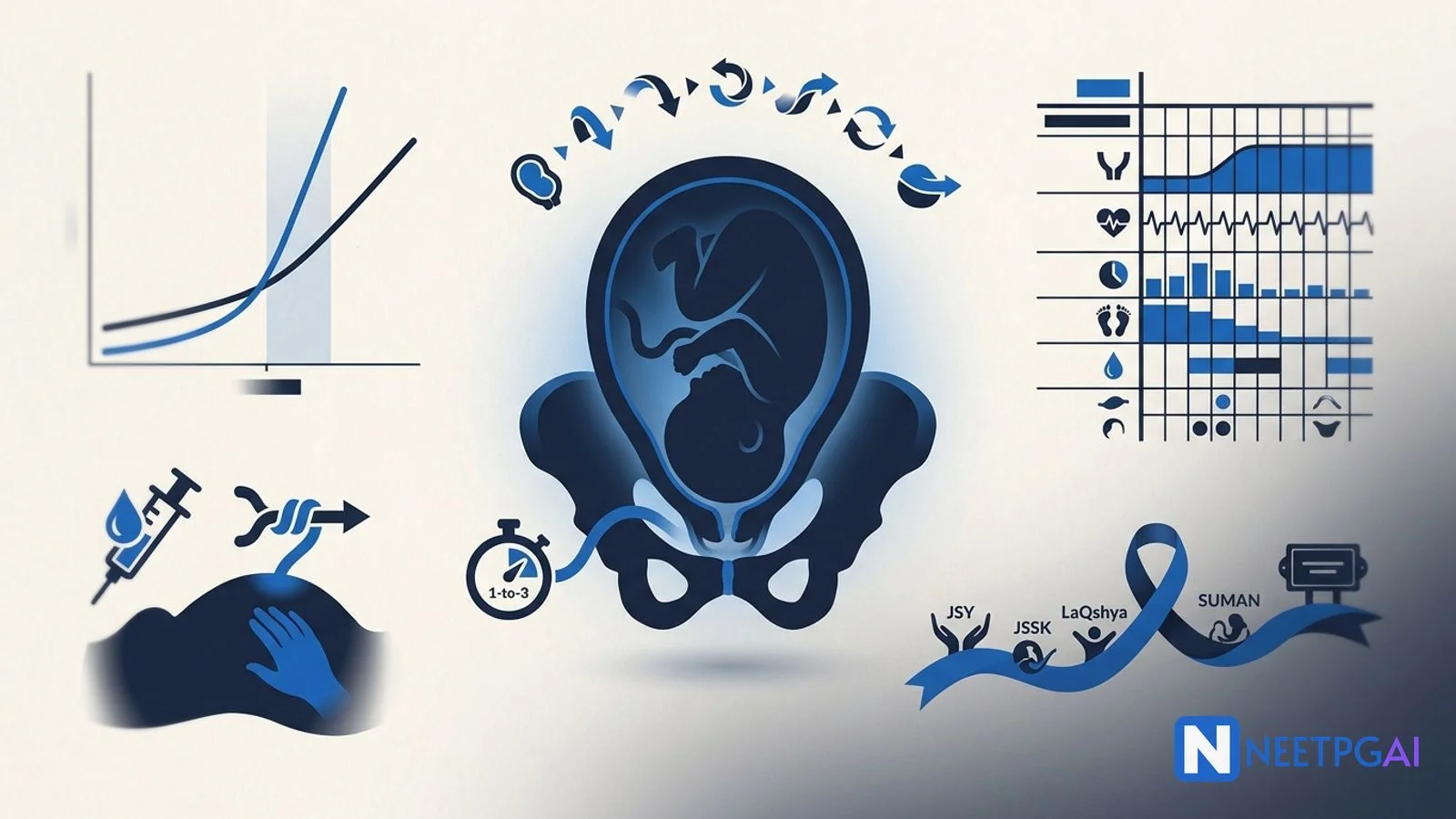
Labor and partograph are reliably tested OBG topics for NEET PG. Lock these:
- 3 stages — Stage 1 onset → 10 cm, Stage 2 → delivery, Stage 3 → placenta.
- Active phase — now defined from 6 cm (Zhang), not 4 cm (Friedman).
- WHO 2018 Labour Care Guide replaces alert/action partograph for global use.
- AMTSL — oxytocin 10 IU IM within 1 min, controlled cord traction, uterine massage.
- Delayed cord clamping — 1 to 3 minutes; improves neonatal iron.
- Restrictive episiotomy — no routine; only for shoulder dystocia, instrumental, or imminent perineal tear.
- JSY + JSSK + LaQshya — institutional delivery rate up to 89 percent (NFHS-5).
Labor is a core NEET PG OBG topic that overlaps with PSM (JSY/JSSK/LaQshya/MMR) and Paediatrics (delayed cord clamping, neonatal resuscitation). The biggest examiner-favoured shift in the last decade is away from Friedman and toward the Zhang/WHO active-phase-at-6 cm model — this single change reduces the diagnosis of "failure to progress" and unnecessary primary caesareans.
This NEETPGAI deep dive covers true labor definition, the three (or four) stages, Friedman vs Zhang curves, the WHO 2018 partograph (Labour Care Guide), management of the second and third stages including AMTSL, the restrictive episiotomy policy, and the Indian programmatic context (JSY, JSSK, LaQshya, MMR). Pair this with the contraception methods and counselling guide for the full OBG examiner stack.
Defining labor
True labor is regular, painful, progressively stronger uterine contractions producing cervical effacement and dilation with descent of the presenting part. Distinguish from false labor (Braxton-Hicks) — irregular contractions, no cervical change.
Onset of labor: contractions every 5 to 10 minutes lasting 30 to 45 seconds with cervical change (effacement and ≥ 1 cm dilation).
The three (or four) stages
| Stage | From | To | Nullipara duration | Multipara duration |
|---|
| 1 (latent) | Labor onset | 5 to 6 cm | Up to 20 h | Up to 14 h |
| 1 (active) | 5 to 6 cm | 10 cm | 4 to 6 h | 2 to 4 h |
| 2 | Full dilation | Delivery of baby | Up to 3 h (with epidural; up to 4 h) | Up to 2 h (with epidural; up to 3 h) |
| 3 | Delivery of baby | Delivery of placenta | 5 to 30 min | 5 to 30 min |
| 4 (some references) | Placental delivery | 1 h postpartum | 1 h close monitoring | 1 h close monitoring |
Friedman vs Zhang labor curves
- Friedman (1954) — active phase begins at 4 cm with minimum dilation rate 1.2 cm/h (nullipara) or 1.5 cm/h (multipara). Any slower = "active phase arrest" → operative intervention.
- Zhang (2010, modern population, Consortium on Safe Labor data) — active phase begins at 6 cm, and dilation from 4 to 6 cm can take 6 hours without being abnormal. Contemporary women labor more slowly (older average age, higher BMI, more epidurals).
Clinical implication — ACOG/SMFM (2014) and WHO recommend that active-phase labor arrest should NOT be diagnosed before 6 cm dilation. This has reduced unnecessary primary caesareans.
WHO 2018 Labour Care Guide (modern "partograph")
The WHO 2018 Labour Care Guide replaces the classical partograph for global use.
Variables tracked
| Variable | Frequency |
|---|
| Fetal heart rate | Every 15-30 min in first stage; every 5 min in second stage |
| Liquor (colour, blood, meconium) | Each examination |
| Caput and moulding | Each PV examination |
| Cervical dilation | Every 4 h (Stage 1) |
| Descent of head (fifths palpable abdominally) | Every 4 h |
| Contractions per 10 min and duration | Every 30 min |
| Oxytocin / medications | Each administration |
| Maternal pulse, BP, temperature, urine | Per protocol |
Removed from WHO 2018 LCG
- Alert line (1 cm/h fixed slope) — replaced by individualised dilation reference.
- Action line (4 h to the right of alert) — replaced by individualised assessment.
This realigns the document with the Zhang curve and reduces unnecessary augmentation.
Management of the first stage
- Latent phase — observation, support, nutrition; do NOT augment if maternal/fetal status reassuring.
- Active phase — repeat PV exam every 4 h; rupture membranes if no spontaneous rupture by 5 to 6 cm AND if augmentation needed; oxytocin augmentation for arrest (no progress for 4+ h with adequate contractions OR 6+ h with inadequate contractions).
- Continuous EFM indicated for high-risk pregnancies; intermittent auscultation (Pinard, Doppler) for low-risk.
Failure to progress
- CPD (cephalopelvic disproportion) — large head, small pelvis; deflexed/asynclitic head.
- Malposition — occiput posterior, occiput transverse arrest at mid-pelvis.
- Hypotonic uterine activity — fewer than 3 contractions per 10 min, < 200 Montevideo units; treat with oxytocin.
Management of the second stage
- Maternal positioning — upright, lateral, or semi-recumbent (no evidence for routine lithotomy).
- Delayed pushing — wait 1 to 2 h after full dilation in nullipara with epidural before active pushing (reduces operative delivery rate).
- Episiotomy — restrictive policy (do NOT do routinely). Indications — shoulder dystocia, instrumental delivery (forceps/vacuum), imminent third-degree tear, fetal distress requiring expedited delivery, breech delivery. Mediolateral preferred over midline in India (less third/fourth-degree extension).
Second-stage duration limits (ACOG 2014)
| Parity | Without epidural | With epidural |
|---|
| Nullipara | 3 h | 4 h |
| Multipara | 2 h | 3 h |
Beyond these — consider instrumental or caesarean delivery.
Management of the third stage — AMTSL
Active management of the third stage of labor is the WHO-recommended evidence-based approach for ALL deliveries. It reduces postpartum haemorrhage (PPH) risk by 60 to 70 percent.
Three components
- Uterotonic within 1 minute of delivery — oxytocin 10 IU IM is first-line. Alternatives — carbetocin 100 micrograms IM (heat-stable, increasingly used in India), misoprostol 600 micrograms sublingual (where injectables unavailable), ergometrine (avoid in hypertension/pre-eclampsia).
- Controlled cord traction with counter-traction on the uterus (Brandt-Andrews manoeuvre).
- Uterine massage after placental delivery, then 15-min checks for 2 hours.
Delayed cord clamping
1 to 3 minutes post-delivery (or until pulsation ceases). Improves neonatal iron stores, reduces anaemia in infancy, reduces need for blood transfusion in preterms. Universal recommendation now.
Postpartum monitoring
- Vital signs and uterine tone every 15 min for 2 h, then hourly.
- Active bleeding — first response is bimanual uterine compression + uterotonics + IV fluids + blood; consider B-Lynch suture, uterine artery ligation, intrauterine balloon (Bakri), hysterectomy.
- Breastfeeding initiation — within first hour (skin-to-skin); accelerates uterine involution via endogenous oxytocin.
NEET PG MCQ traps
- Active phase onset — modern definition is 6 cm, not 4 cm.
- Friedman vs Zhang — Zhang allows slower normal labor and has reduced primary caesareans.
- WHO 2018 Labour Care Guide — no alert or action line; individualised dilation reference.
- AMTSL — oxytocin 10 IU IM within 1 minute of delivery.
- Delayed cord clamping — 1 to 3 minutes; improves neonatal iron.
- Episiotomy — restrictive policy; mediolateral preferred in India.
- Second-stage duration limit — nullipara 3 h (without epidural), 4 h (with epidural).
- Active-phase labor arrest — do NOT diagnose before 6 cm.
- Carbetocin — heat-stable uterotonic; CHAMPION trial supports use in low-resource settings.
- Misoprostol — sublingual 600 micrograms PPH prophylaxis where injectables unavailable.
- Ergometrine — avoid in HTN, pre-eclampsia, cardiac disease.
- Bandl's ring — pathological retraction ring → obstructed labor → impending uterine rupture.
- Cardinal movements of labor — engagement, descent, flexion, internal rotation, extension, external rotation, expulsion.
- Descent of head in fifths — > 4/5 palpable = unengaged; 0/5 = full engagement.
- Effacement before dilation — primigravida; simultaneous in multipara.
- Vital signs in labor — pulse hourly, BP every 4 h, temp every 4 h.
- Fetal heart rate — listen every 15 to 30 min in Stage 1, every 5 min in Stage 2 (or continuous EFM if high-risk).
- JSY incentive — Rs 1,400 (rural) / Rs 1,000 (urban) for institutional delivery.
Recent updates and Indian context
- WHO 2018 Labour Care Guide — adopted by Government of India for public health system rollout; training underway via state SIHFW.
- LaQshya certification — over 600 facilities certified across India; aims at every delivery point achieving NQAS standards.
- JSY / JSSK — flagship cash-transfer + free-care schemes; institutional delivery rate now 89 percent (NFHS-5, 2019-21).
- Carbetocin (heat-stable) — included in National List of Essential Medicines 2022; replacing oxytocin in cold-chain-challenged areas.
- Maternal mortality ratio (MMR) — 97 per 100,000 live births (SRS 2018-20), down from 130 in 2014-16; states like Kerala (19) and Tamil Nadu (54) have achieved SDG target; UP (167) and Assam (195) lag.
- Mission "Surakshit Matritva Aashwasan" (SUMAN, 2019) — guarantees free, dignified, quality maternal care to every woman.
- Caesarean rates — 21 percent nationally (NFHS-5); private sector 47 percent vs public 14 percent — reduced via Zhang-based active-phase definition and respectful intrapartum care.
Frequently asked questions
What defines true labor and the three stages?
True labor is defined by regular, painful, progressively stronger uterine contractions accompanied by cervical effacement and dilation, with descent of the presenting part. The three stages are — Stage 1 (onset of labor to full dilation 10 cm), subdivided into a latent phase (cervix < 6 cm) and active phase (6 to 10 cm). Stage 2 (full dilation to delivery of the baby). Stage 3 (delivery of the baby to delivery of the placenta and membranes). Some references include Stage 4 (1 hour post-placental delivery, focused on monitoring for haemorrhage).
What is the WHO 2018 partograph and how does it differ from older versions?
The WHO 2018 partograph (Labour Care Guide) is the updated graphical tool for tracking labor progress, fetal wellbeing, and maternal status. Key changes from earlier versions — the alert and action lines have been removed in favour of an individualised cervical dilation reference; active phase is now defined from 5 to 6 cm (not 4 cm); friendly-format documentation of contractions, fetal heart rate, descent of head in fifths palpable abdominally, liquor colour, caput/moulding, maternal vital signs, and oxytocin/medications. The aim is to reduce unnecessary intervention and improve respectful care.
What is active management of the third stage of labor (AMTSL)?
Active management of the third stage of labor reduces postpartum haemorrhage risk by 60 to 70 percent. The three components per WHO are — (1) administration of a prophylactic uterotonic within 1 minute of delivery (oxytocin 10 IU IM is first-line; carbetocin 100 micrograms in heat-stable formulation increasingly used in India); (2) controlled cord traction with counter-traction on the uterus (Brandt-Andrews); (3) uterine massage after placental delivery. Routine cord clamping is now delayed by 1 to 3 minutes to improve neonatal iron stores.
What is the difference between Friedman and Zhang labor curves?
Friedman (1954) defined the classic labor curve with active phase starting at 4 cm and a minimum dilation rate of 1.2 cm/hour in nulliparas (1.5 cm/hour in multiparas). Zhang (2010, modern population) showed that contemporary labor is slower — active phase begins at 6 cm, and dilation from 4 to 6 cm can take 6+ hours without being abnormal. Zhang's curve underpins the ACOG/WHO recommendation that active-phase labor arrest should not be diagnosed before 6 cm dilation. This has reduced unnecessary primary caesarean rates.
What are LaQshya and JSY under the Indian maternal health programme?
JSY (Janani Suraksha Yojana, 2005) is a conditional cash-transfer scheme incentivising institutional delivery — pregnant women receive Rs 1,400 (rural) or Rs 1,000 (urban) on delivering at a public facility. JSSK (Janani Shishu Suraksha Karyakram, 2011) provides free delivery, drugs, diet, transport, and referral. LaQshya (Labour Room Quality Improvement Initiative, 2017) certifies labour rooms and obstetric OTs to deliver respectful, evidence-based intrapartum care — 'labour room ki guarantee'. Together they have driven India's institutional delivery rate from 39 percent (NFHS-3, 2005-6) to 89 percent (NFHS-5, 2019-21).
This content is for educational purposes for NEET PG exam preparation. It is not a substitute for professional medical advice, diagnosis, or treatment. Clinical information has been reviewed by qualified medical professionals.
Written by: NEETPGAI Editorial Team
Reviewed by: Pending SME Review
Last reviewed: May 2026