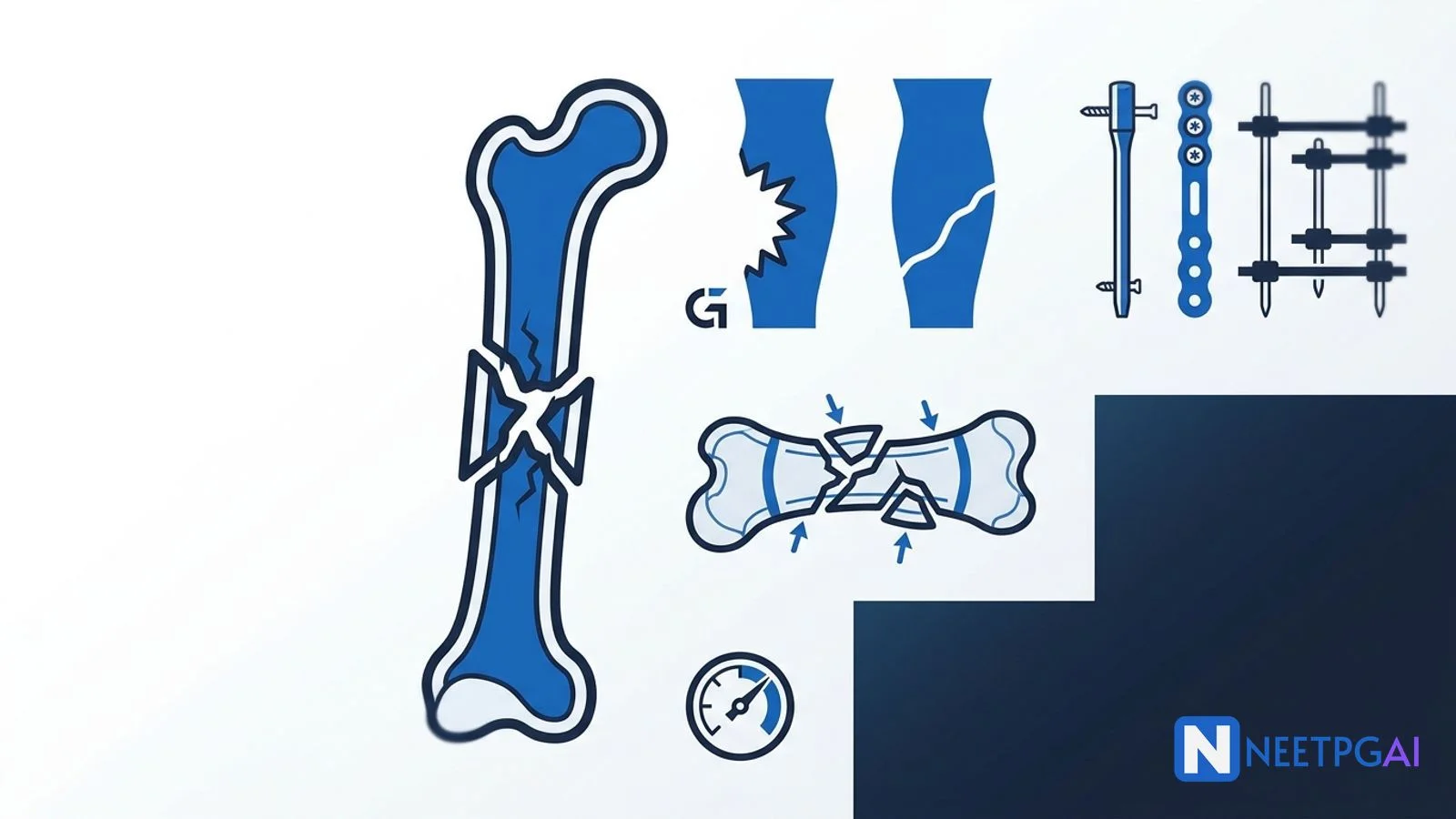
Fractures & Trauma Management for NEET PG 2027 Guide
Master fracture types, Gustilo classification, Salter-Harris, common adult/pediatric fractures, AO principles, and compartment syndrome for NEET PG 2027.
Dr. NEETPGAI Editorial TeamPublished 12 Mar 2026Updated 29 Sept 202611 min read
Share this article
Ready to put this into practice?
Start practicing NEET PG MCQs with AI-powered explanations.
DVT prophylaxis — LMWH within 24 hr of major orthopedic surgery.
AO principles — anatomic reduction, stable fixation, preserve blood supply, early mobilisation.
Fractures and trauma are the bread-and-butter of orthopedic NEET PG questions. Examiners love the eponymous fracture trivia (Galeazzi, Monteggia, Bennett, Rolando), the classification systems that map directly to management decisions (Gustilo, Salter-Harris, Garden, Weber), and the time-critical complications — compartment syndrome, fat embolism, vascular injury — that decide who gets to theatre next.
This NEETPGAI deep dive covers fracture biology and classification, the most testable adult and pediatric fractures, AO/ASIF principles of fixation, the trauma-induced systemic complications you cannot miss, and the Indian-specific MCQ traps. Pair this with the Orthopedics hub and the trauma management ATLS protocols guide.
Displacement: apposition (% bone contact), angulation, rotation, translation, shortening.
Skin envelope:closed vs open (compound).
Gustilo-Anderson classification of open fractures
Type
Wound
Soft-tissue damage
Infection rate
I
<1 cm, clean
Minimal
0-2%
II
1-10 cm
Moderate
2-5%
IIIA
>10 cm or grossly contaminated
Adequate periosteal coverage
5-10%
IIIB
Extensive
Periosteal stripping, requires flap
10-50%
IIIC
Any size
Vascular injury requiring repair
25-50%
Antibiotic prophylaxis within 1 hour is now the benchmark. Type I-II receive cefazolin alone. Type III adds gentamicin. Farm injuries or sewage contamination add penicillin or metronidazole. Tetanus prophylaxis is mandatory.
Pediatric fractures — Salter-Harris
The growth plate (physis) is the weakest part of the developing skeleton. The SALTR mnemonic captures the five Salter-Harris types:
S — Slipped (Type I): through the physis only. Common in infants and birth injuries. Good prognosis.
A — Above (Type II): through the physis plus a triangular metaphyseal fragment (Thurston-Holland). Most common type (~75%). Good prognosis.
L — Lower (Type III): through the epiphysis into the joint. Intra-articular. Anatomic reduction required.
T — Through (Type IV): through epiphysis, physis, and metaphysis. Highest displacement risk; intra-articular.
R — Rammed/cRush (Type V): crush injury to the physis. Worst prognosis; growth arrest is common. Often diagnosed retrospectively.
Higher-grade injuries have higher rates of premature physeal closure, limb-length discrepancy, and angular deformity.
Other pediatric-specific fracture patterns
Greenstick — incomplete fracture; one cortex broken, the other bowed.
Torus / buckle — compression of metaphyseal bone, common in distal radius.
Plastic deformation — bone bends without fracture; commonly seen in radius/ulna.
Toddler fracture — non-displaced spiral fracture of distal tibia in 1-3 year olds learning to walk.
Supracondylar humerus fracture — most common pediatric elbow fracture; Gartland I-III. Risk of brachial artery injury and Volkmann ischemic contracture if missed.
Garden classification of femoral neck fractures (intracapsular):
I — incomplete, valgus impacted
II — complete, undisplaced
III — complete, partially displaced
IV — complete, fully displaced
Garden I-II are usually fixed (cancellous screws). Garden III-IV in elderly are usually replaced (hemiarthroplasty or total hip replacement) due to high avascular necrosis risk.
Supracondylar fracture of humerus — Gartland I (undisplaced), II (displaced posteriorly with intact posterior cortex), III (completely displaced). Watch anterior interosseous nerve, brachial artery.
Pulled elbow (nursemaid's elbow) — radial head subluxation, age 1-4, sudden axial pull on extended forearm. Reduce by supination + flexion.
Cozen fracture — proximal tibial metaphyseal fracture in toddlers; valgus deformity may develop.
AO/ASIF principles of fracture management
The four AO principles (Müller 1958, still the conceptual spine of fracture surgery):
Anatomic reduction of articular fragments.
Stable fixation appropriate to the fracture personality (absolute stability for articular, relative for diaphyseal).
Compartment syndrome — the time-critical emergency
Acute compartment syndrome occurs when interstitial pressure within an osteofascial compartment exceeds capillary perfusion pressure, producing ischemia within 4-6 hours.
Scaphoid fracture — initial X-ray normal in 30%. Treat clinically suspicious cases (snuffbox tenderness, axial loading pain) with thumb spica and repeat imaging at 10-14 days.
Galeazzi fracture-dislocation — distal radius shaft fracture with DRUJ disruption; always check the wrist.
Monteggia fracture-dislocation — proximal ulna fracture with radial head dislocation; always check the elbow.
Volkmann ischemic contracture — late sequela of missed compartment syndrome; flexion deformity of fingers.
Compartment syndrome — pulses can be present; do not wait for pulselessness.
Bohler angle < 20° on calcaneal X-ray indicates calcaneal fracture (lover's fracture from fall from height).
Pelvic ring fractures — anterior + posterior ring breaks; massive haemorrhage; pelvic binder is life-saving in unstable rings.
Fat embolism vs PE — fat embolism has petechial rash and cerebral signs; PE has hypoxia, tachycardia, pleuritic chest pain.
Stress fractures — femoral neck (high-risk, can complete and displace), tibial shaft (low-risk), 2nd metatarsal (march fracture).
Recent updates and Indian context
Damage control orthopedics (DCO) — externally fix fractures in polytrauma, defer definitive fixation until physiology stabilises (lactate, pH, temperature).
Tranexamic acid (TXA) — 1 g IV at induction reduces blood loss and transfusion need in hip and knee replacement surgery and major fractures (CRASH-2 / WOMAN trial extension).
Locking plate technology — superior in osteoporotic and metaphyseal fractures.
Suprapatellar tibial nailing — improved alignment for proximal-third tibia fractures.
Indian context: road traffic accidents account for the majority of long-bone trauma in NEET PG vignettes. The Pradhan Mantri Jan Arogya Yojana (PM-JAY) covers selected fracture surgeries. Open fractures from agricultural injuries are common and should always trigger Clostridium coverage.
Frequently asked questions
What is the Gustilo-Anderson classification of open fractures?
Type I — clean wound less than 1 cm. Type II — wound 1-10 cm without extensive soft-tissue damage. Type IIIA — wound greater than 10 cm or contamination, periosteum intact. Type IIIB — periosteal stripping requiring soft-tissue coverage. Type IIIC — vascular injury requiring repair. Higher type means worse prognosis and higher infection rate.
What is the Salter-Harris classification of pediatric physeal injuries?
SH I — Slipped (through physis only). SH II — Above (metaphysis fragment, most common). SH III — Lower (epiphysis only, intra-articular). SH IV — Through (epiphysis + physis + metaphysis). SH V — Rammed (crush injury, worst prognosis). Mnemonic: SALTR. Higher types have higher growth-arrest risk.
How do you diagnose acute compartment syndrome?
Compartment syndrome is a clinical diagnosis — pain out of proportion, pain on passive stretch, paraesthesia, pallor, paralysis, pulselessness (late). Compartment pressure greater than 30 mmHg or delta-pressure (DBP minus compartment pressure) less than 30 mmHg confirms diagnosis. Treatment is emergency 4-compartment fasciotomy within 6 hours.
When should an open fracture receive antibiotics?
Within 1 hour of presentation per modern guidelines (formerly 6 hours). Type I-II open fractures get a first-generation cephalosporin (cefazolin). Type III adds an aminoglycoside (gentamicin). Farm injuries or soil contamination add penicillin or metronidazole for clostridial coverage. Tetanus prophylaxis based on immunisation history.
What is fat embolism syndrome and when does it occur?
Fat embolism syndrome occurs 24-72 hours after long-bone or pelvic fracture — classic triad of respiratory distress, neurological dysfunction, and petechial rash on chest/axilla/conjunctiva. Hypoxia is most consistent feature. Diagnosis is clinical (Gurd criteria); management is supportive with oxygen and ventilation. Early fracture fixation reduces incidence.
This content is for educational purposes for NEET PG exam preparation. It is not a substitute for professional medical advice, diagnosis, or treatment. Clinical information has been reviewed by qualified medical professionals.
Written by: NEETPGAI Editorial Team
Reviewed by: Pending SME Review
Last reviewed: April 2026